
WINDHAM – The recent inclusion of Windham in a quarantined area designed to contain the spread of the hemlock woolly adelgid has forced the Roosevelt Trail Nursery and Garden Center to adapt.
This season, the nursery, located on Route 302 in Windham, will maintain a hemlock holding area in Casco, which is outside the quarantine, in order to distribute hemlocks to Mainers who live in non-quarantined areas.
The inconvenience does not bother Joe Gagne, the owner of the nursery, in the slightest.
“I support it 100 percent,” Gagne said. “We’ve got a responsibility to our ecosystem out here. That’s what we’re all about. We’re not out there to try and just sell a tree for the sake of selling a tree.”
In September of 2013, the Department of Agriculture, Conservation and Forestry substantially expanded the woolly adelgid quarantine area, which was instituted in Maine in 1988.
Before the expansion, the quarantine only included six towns in York County – Eliot, Kittery, Ogunquit, South Berwick, Wells and York. The expanded quarantine includes all of York, Lincoln and Sagadahoc counties, five towns in Androscoggin County, two towns in Kennebec County, and 22 towns in Cumberland County, including Frye Island, Gray, New Gloucester, Raymond, Standish and Windham.
According to Ann Gibbs, Maine State horticulturalist, the quarantine was expanded in response to the woolly adelgid’s continuing northward march, which she attributes to the wind, birds and global warming.
“We’ve had a huge increase in the spread of the pest,” Gibbs said. “In particular there was sort of a spike in 2010 where there was a great increase in infestations, and it was really spreading up the coast and inland a little bit.”
The state has not detected the woolly adelgid in all the quarantined towns. Rather, it has used towns on the outer edges of the quarantine as a buffer. According to Gibbs, the hemlock woolly adelgid has been found “severely stressing and killing hemlock trees” in York, Harpswell, Freeport, Kittery and Great Diamond Island off Portland.
According to Gibbs, 5 percent of the state’s trees are hemlocks.
That’s one of the reasons why Gagne said he favors the expansion of the quarantine area.
“It will devastate our natural forest if that gets in there, and it doesn’t get controlled,” he said.
The quarantine regulates the movement of hemlock plants and plant products in several ways. Any hemlock plants that originate in quarantined areas are not allowed into non-quarantined areas, with a few exceptions, including hemlock chips and uncomposted bark. A violation of the quarantine is considered a Class-E crime, which can be punishable by up to six months incarceration and a $1,000 fine.
This year, Gagne said, nursery employees will ask customers where they live when they purchase a hemlock.
“Anybody who buys hemlocks, we have to know where they live,” he said.
According to Gen Coombs, the nursery’s manager and horticulturalist, the quarantine does not require such a procedure.
“We believe it’s in our best interest to keep them as informed as possible, because if the customers bring a hemlock purchased here to a non-quarantined area, the customer is responsible for this and (is) in violation of the quarantine,” Coombs said.
Coombs said that she was not aware of any hemlock woolly adelgid sightings in Windham.
“Windham is really more of a buffer town,” she said. “I don’t believe at this point there have been any confirmed sightings of adelgid in Windham, but there’s a national forest two towns over, so we’re in a buffer zone.”
Since the wooly adelgid was introduced from Japan into Virginia in the 1950s, it has spread up and down the East Coast.
“It uses piercing, sucking mouth parts and sucks the juices out of a tree, and it will kill the tree over a period of time,” Gibbs said. “It’s very hard to see until the population has increased.”
Coombs said that this year’s cold winter may have temporary diminished the adelgid population, which has trouble surviving minus-17 degree temperatures, in the region.
“The good thing is with the super cold temperatures we had this year, the 20 below, they can’t survive that,” she said. “So large numbers of them hopefully were killed off due to the extreme cold temperatures this winter.”
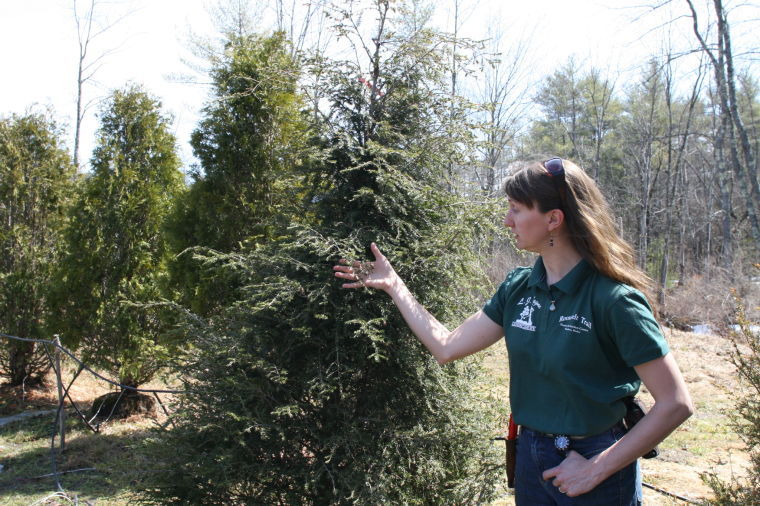 Gen Coombs, the Roosevelt Trail Nursery and Garden Center’s manager and horticulturalist, said that this year’s cold winter may have temporarily diminished the hemlock wooly adelgid population, which has trouble surviving in temperatures below minus-17 degrees.
Comments are no longer available on this story