
SCARBOROUGH – The Scarborough Town Council voted 5-1 on Feb. 12 to expand the “traditional neighborhood” zoning in the 154-lot Eastern Village subdivision to an adjacent 2.39-acre lot purchased last year by developer Kerry Anderson, but neighbors who objected to the change are likely to continue their appeals to the Planning Board.
Anderson purchased the lot at the end of Westwood Avenue in May 2013 from the estate of Christina Conley for $165,000 through his company, Ballantyne Development, which began work on Eastern Village in 2005. Anderson is in “Phase II” of the development, building homes on Inspiration Drive. In a Jan. 4 letter to the Town Council, Anderson said he hopes to develop this new parcel as well.
The purpose of rezoning the new lot – taking it out of the R-4 Residential District and reclassifying it as a “Traditional Neighborhood Development Option Overlay District” – he said, would allow him a measure of “creativity and flexibility” in development. It also would allow him to build 11 housing units on the property, provided that one-third meet the specifications of Scarborough’s Affordable Housing Program. Only nine lots would be allowed under residential zoning rules.
Anderson said repeatedly during the Feb. 12 council meeting that he had no intention of using Westwood Avenue to access these new homes. He’ll route traffic in from Ward Street, which connects to Route 1 across from town hall, he said. An extension of Ward Street into Eastern Village is already under construction. Additionally, Anderson said he has a traffic permit from the Maine Department of Transportation for Eastern Village access off Commerce Drive for more lots than he intends to build. Still, several neighbors openly doubted Anderson’s promise.
“I do not think that our close-knit neighborhood should be asked to bear the burden of any additional traffic,” said Fairfield Drive resident Stephanie Ruel. “Already cars cut through during peak commuting hours. Cars treat this neighborhood as a race track, trying to shortcut the failing intersection at Route 1.”
Many commuters avoid the Oak Hill intersection, getting from Route 1 to Black Point Road, by using Westwood Avenue or the parallel streets of Fairfield Road and Libby Street, then the cross streets of Seaview Avenue and Thornton Road.
“There is already too much traffic in a small area,” said Ruel. “The bad planning needs to stop. It’s already near impossible to take a left from any of our streets onto Route 1 now. If this receives approval, a disaster is bound to happen.”
“If that is a right of way to Route 1, it will pretty much destroy that neighborhood,” agreed Jon Cahill of Westwood Avenue.
Cahill echoed his Westwood neighbor, Lorraine Libby, saying that while they appreciated Anderson’s “intent” to avoid connecting his new neighborhood to theirs, “the possibility once that is developed is for that to change.”
Ruel also called on Council Chairman Richard Sullivan to recuse himself from the vote, because property owned by Sullivan’s brother, Daniel Sullivan, uses a right of way across Anderson’s new lot to access Westwood Avenue.
However, the council voted 0-4 on forcing Sullivan to refrain from debate and voting after he said his own home is “pretty close to a mile away, as the crow flies,” from the development site.
“I have noting to do with that piece of property,” said Sullivan. “If anything, I’m probably protecting Westwood Avenue for the neighbors I grew up with and my brother.”
Sullivan also rebutted a neighborhood concern that he might somehow be in cahoots with Anderson by saying that, prior to last week’s council meeting, they had not spoken directly in “four or five years.”
Anderson said he favored the zoning change because the rules for a “traditional neighborhood” allow for narrower streets and other design options, while requiring landscaping and 5-foot-wide sidewalks with granite curbing. While he could just plan no-frills house lots under the minimum residential zone rules, and be done with it, the added measures match what he is trying to accomplish in Eastern Village, he said.
“What we’re trying to do is build a neighborhood you would have seen 100 years ago, in terms of architecture and scale and even building materials,” Anderson told the council, advising them, “You’re not voting against the tariff, you’re voting for what you think the development should look like.”
Town Planner Dan Bacon added that whatever Anderson designs, whether under rules for a residential district of the “traditional neighborhood” overlay, Planning Board approval would still be required.
“Basically this [zone change] decision is dictating the style of development more than the process,” he said.
Bacon said that as long as the road into the new development site is no longer than 2,000 feet from its connection to Ward Street, it could be a dead-end. However, the question remains how to prevent people from accessing Westwood Avenue, which transverses the Anderson lot on a right of way to the Daniel Sullivan property?
“If all of the people down there realize there is a little bit of a shortcut, bingo, they’re going to use it,” said Councilor Ed Blaise.
Some discussion was given to installing a fire gate that would leave room for bicycles and pedestrians while allowing vehicle access only to the Sullivan family and emergency vehicles. However, it was decided that decision fell outside council purview.
“I think the Planning Board would have to weigh on what they ultimately would like to see there,” said Anderson.
Only Councilor James Benedict voted against the zoning change. He did not speak during debate and gave no indication why he voted against Anderson’s request.
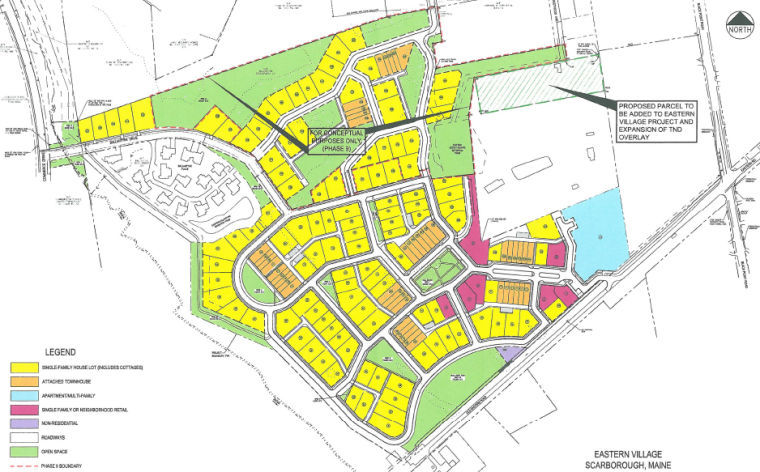 Above is a map of the Eastern Village subdivision in Scarborough, showing an adjacent 2.39-acre lot recently purchased by site developer Kerry Anderson.
Comments are no longer available on this story