
FREEPORT – Brian Beal, the University of Maine marine ecology professor who managed last year’s town-commissioned green crabs study, will return to the shores of the Harraseeket River in late April – this time armed with a $200,000 University of Maine grant.
The grant will allow Beal and volunteers to follow up and expand on the study, for which he made a preliminary report to the Freeport Town Council on Jan. 14. What it won’t do, Beal cautions, is remove the menace from feeding on soft-shelled clams. The invasive green crabs are thought to be responsible for depleting the shellfish stock.
Last year, workers brought in six metric tons of green crabs from various spots around the river, and 11,715 crabs were measured and sexed. There was no indication that the haul made any dent in the crab population.
Beal agrees with clammers that a much wider effort will be necessary to make a dent in the green crab population.
“In order to have any sort of green crab control,” he said, “that’s going to take an army of traps. It’s going to be a huge undertaking – much more than we can do with one study. One year’s worth of information is what it is.”
Members of the Maine Clammers Association have said that area fishing towns and the lobster industry must be involved.
“They’re absolutely right,” Beal said.
Beal said that the new grant will allow him and volunteers to resume trapping and fencing, as they did last year, and more. The grant will pay for work to be done into November, and to resume for a short time in 2015, he said.
Beal said there was a big difference in crabs caught per trap below Western Point, which includes Collins Cove through the channel, and above Western Point, which includes the intertidal areas of Porter Landing, Pettingill Flat and Sandy Beach.
“The catch per trap didn’t change through time at around 10 pounds, below Western Point,” he said.
The problem with that, from the clammer’s point of view, is they are concentrating their clamming in the intertidal zone, because the lower tidal zones have fewer clams. It would figure, then, that the crabs are where the clams are.
Workers used traps and set up fencing to capture the crabs. Fencing was problematic last year, Beal said, because the fences set up at Recompence Cove were too long, and sustained wind and tidal damage.
Beal said that this year, instead of blocking off the cove with a fence 2,100 feet long, workers will install fences in plots 30 feet by 30 feet. Moreover, the grant will pay someone to oversee the fencing operation.
“There was a lot of ambiguity as to who was getting paid to do what in 2013,” he said.
Nora Healy, acting chairwoman of the Freeport Shellfish Conservation Commission, said she will reserve comment on the town-commissioned study until Beal delivers his final report to the Town Council. Healy said she expects to have that report in hand when the commission conducts a workshop with the council on Feb. 11. The commission will meet two days later, at 6:30 p.m. at the Freeport Community Center.
“We certainly support Dr. Beal’s efforts in this area and we’re looking forward to the final results,” Healy said.
Healy added that, from her own perspective, the danger that green crabs pose to the local clamming industry is not isolated to Freeport.
“This is a problem up and down the coast,” she said. “It’s urgent. We’re waking up and realizing that. It’s a full-time livelihood for a lot of families. It would be horrible to see that industry collapse.”
Healy pointed out that green crabs also threaten the oyster and mussel populations, and perhaps even lobsters.
“I’ve seen a videotape of a green crab eating a lobster,” she said.
In addition to trapping and netting this year, Beal and his crew will work to enhance the clam population. Last year, they placed clams in protected pots, and came back later to find they had thrived.
Beal said plans call for planting hatchery seed under netting in April, and “following their fate” to November.
In addition, volunteers will work with clammers to place a floating platform at the marina in South Freeport. The platform will be designed to grow a million soft-shell clams in the spring, “hopefully to a plantable size of about three-quarters of an inch,” he said.
The clams will rest on screens, and water pumped up through the river will provide feed, he said. Someone will clean and tend to the screens twice weekly, he said.
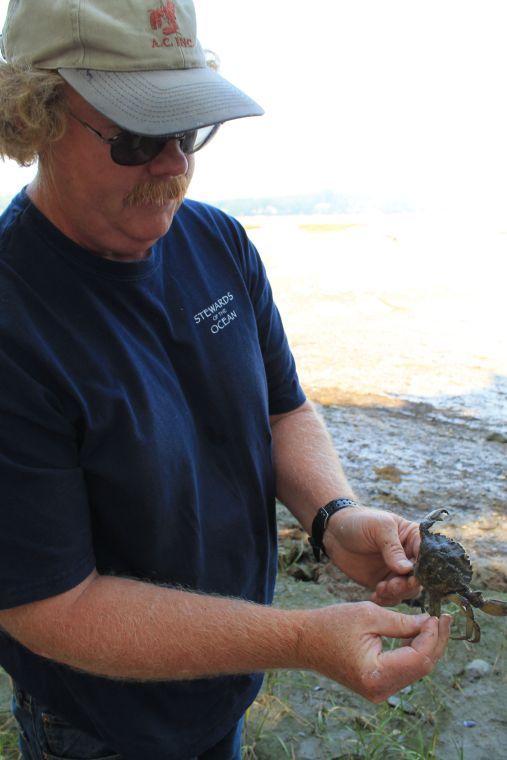 Brian Beal, University of Maine professor of marine ecology, holds a green crab on the clam flats of Winslow Park in South Freeport last year.
Comments are no longer available on this story