
WINDHAM – The search for Appalachian Trail hiker Geraldine Largay sounds easy from one’s armchair, but for Windham’s Larry DeHof, who was one of several hundred volunteers involved with the painstaking and frustrating effort, tromping through Maine’s woods over steep and rocky terrain was anything but easy.
DeHof, 63, and a resident of Basin Road, is a retired police detective for Prince George’s County in Maryland. He said he’s seen it all when it comes to gruesome discoveries, but as a member of the Largay search team he’s baffled that the experienced hiker has gone undiscovered despite the efforts of searchers.
DeHof is a founding member and secretary for Pine Tree Search & Rescue, a southern Maine-based group affiliated with and licensed by the Maine Association of Search and Rescue, also known by the acronym MASAR, which was founded in 1990. DeHof and his friend, Brian Courtois of Portland, started the nonprofit Pine Tree group last year and already have 18 members. Six members have achieved their search license, which allows them to take part in teams overseen by the warden’s service. The other 12 members are in the process of meeting their license qualifications, which involves passing various tests of search and rescue knowledge and physical fitness tests.
The Largay search was Pine Tree’s fourth, and by far the most extensive and exhausting. DeHof and four other licensed searchers spent the last two weekends taking part in search crews in areas where authorities thought Largay could be, mostly in the Carrabassett River Valley near Sugarloaf Mountain.
DeHof said his crew did all they could to help locate the 66-year-old Tennessee woman, who was known as a competent hiker. Largay was in the process of hiking the Appalachian Trail from West Virgina to Maine when she went missing July 24 after failing to meet her husband at an agreed-upon trail crossing in Wyman Township north of Sugarloaf.
DeHof said he has much concern for Largay’s family.
“You’re thinking more about the family. Because when anyone goes out and hikes, that has a certain amount of danger in it, they’re taking a risk. Hiking the Appalachian Trail by yourself is a risk. You could fall and hurt yourself, in a situation similar to this, and nobody could find you. Most of the time, they do. Most of the time, they fall close to the trail and can be found easily,” DeHof said. “But I’m more concerned about the family. My compassion has been more for the husband. He is up here in a strange environment, doesn’t know people. His wife is missing. Every day goes by, you don’t hear anything. When do you give up? When do you go home?”
DeHof said search on Sunday, Aug. 3, brought the Pine Tree team to the town of Stratton at the base of Sugarloaf Mountain. After arriving at 7 a.m., the team was told to drive 40 miles to the backside of Sugarloaf Mountain. Wardens then drove them on ATVs two miles to a 1-square-mile area they were to search.
The search process was slow and steady, DeHof said. Searchers form lines and canvass an area, known as the search grid, in a back-and-forth action so all areas are surveyed. If the area is dense with undergrowth, searchers will criss-cross the area. They are issued a GPS device by the wardens and told to stay within the prescribed search area. When their grid is searched, the volunteer searchers bring their GPS unit back to the warden’s station at Sugarloaf and the data is downloaded onto a larger map.
DeHof said the three other searches he’s been on in the past year were in rural residential areas, but that the remote terrain near the top of Sugarloaf was fraught with downed trees, moss-covered rocks, thick undergrowth and uneven footing. He fell several times and ripped his clothing and gear.
“The problem with this search is this stretch of the A.T. near Sugarloaf is one of the toughest sections there is. And since you can’t see your feet, you don’t know what you’re stepping on, and because it’s so thick, we pretty much had to stay within arm’s reach of each other because if she was 20 feet off to your right or left you wouldn’t see her. It was that thick,” DeHof said.
Dehof loves the adventure and purpose of the mission. The former police detective says he has a desire to “fix things” and that volunteers play a vital role in search and rescue.
“People don’t realize it’s all volunteer. The 300 to 400 people who have gone out on this at various stages, they are all volunteer. It’s tough, tough work. That’s why they restricted this search to people who were members of trained search and rescue groups. Nobody else was allowed to go out on this,” DeHof said.
Lt. Kevin Adam, of the Maine Warden Service, is overseeing the Largay search, which was reduced after Sunday’s search proved fruitless. The volunteers won’t be called again unless a new lead presents itself, he said. He said volunteers such as DeHof and others were key in the two-week drama.
“Average citizens, if they’re part of MASAR (Maine Association of Search and Rescue), help out quite a bit,” Adam said. “That’s why we use MASAR because I know they meet certain certification standards and we know we can give them GPS coordinates and certain types of search tactics and they know what that means. With untrained people, we don’t know what we’re getting. They might not have compass skills, they might not have GPS skills, plus the other things we teach them about first aid, or crime scene skills, if it becomes that.”
The Maine Warden Service oversees most search and rescue operations in the state, except for water rescues. Volunteers have been a part of Maine Warden Service search operations since the 1980s, Adam said. They are a “force-multiplier,” he added, and help authorities to more quickly narrow a search grid.
“They’re very helpful,” Adam said. “Without the volunteers it would have taken a long time to get where we are right now for our search because we wouldn’t be able to cover that amount of area in the time we did.”
Wanted: searchers
DeHof wants to get the word out about the newly formed Pine Tree Search & Rescue nonprofit organization because volunteers are essential.
“We have 18 members right now. Six are certified, and the rest are somewhere in the training process,” he said. “It takes about four to five months to go through training. And the more people we can get, the better.”
The male and female volunteers range in age from their mid-20s to mid-60s and represent a diverse career set. There are two doctors in the group, several public safety personnel and some retirees. Physical stamina and hiking experience is necessary and a positive attitude doesn’t hurt either, DeHof said.
“Everyone’s very positive. Everybody goes there with the idea this is going to be a rescue,” he said. “The Largay search on Sunday hadn’t been classified as a recovery, where you assume the person has passed away. And searchers were talking about how many times people have been lost for three weeks or more and as long as they have water, they’re in good shape.”
Searchers also have to be tough, he said, since searches take place in all types of weather.
“A thunderstorm came through [two weeks ago], but we don’t stop, we kept going. When we do the searches, it doesn’t matter what the weather is. If it’s snowing, if storms are coming, you’re out there looking,” he said.
And searchers have to be observant.
“They gave us a clothing description, the pack she was wearing, anything that’s particular, so when you’re walking you’re looking for any of those items. Did somebody drop a hat, a glove? In this case, you’re also looking for slide marks, or a place where somebody wandered off the trail. So searches are slow and methodical,” DeHof said.
Since they don’t receive compensation for their time or even compensation for the gas it takes to get to such remote locales as the backside of Sugarloaf Mountain, Dehof says the chance to be part of a rescue – and not just a search – makes it worthwhile.
“Being a former policeman, I like to be involved with things that help the community. It’s a way to help people. I fix things. That’s what I did as a policeman, that’s what I do as a massage therapist. And this is just another part of it,” DeHof said.
Adam says the volunteers are worthy of praise when it comes to aiding others.
“They’re not reimbursed, the most I can maybe offer them is a meal and a thank-you. But they do it to help people that most of the time they don’t know,” he said.
Asked where he thinks Largay may be, Adam said he’s as clueless as everyone involved with the search.
“We’ve been able to narrow down the search area, and whatever little hole that she’s in, she’s obviously in some little patch of woods somewhere, and it’s a big area up there and we’ve just gotta try and find it,” he said. “But I can tell you one thing, she’s not on the [Appalachian] Trail. I know that.”
A CLOSER LOOK
For more information about Pine Tree Search & Rescue, call founding member Larry DeHof at 310-8952.
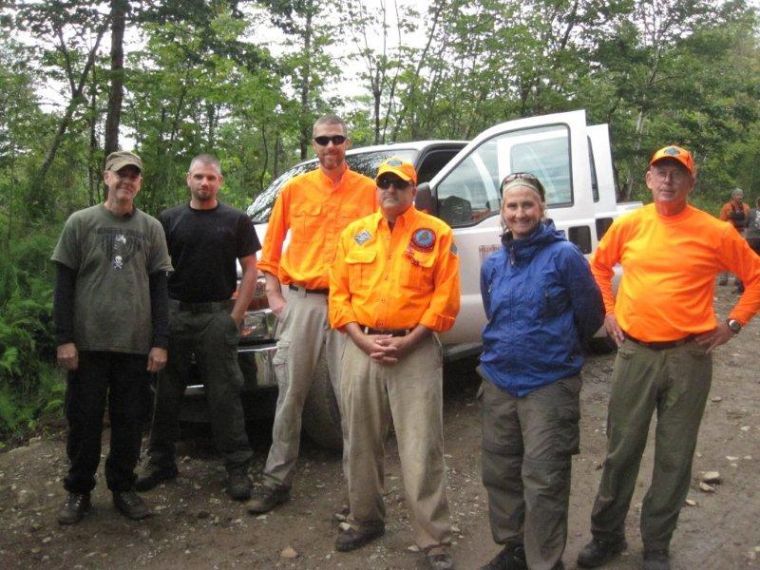 Pine Tree Search & Rescue members, from left, Jim Linscott, Issac Howes, Stuart Thomas, Bryan Courtois, Holly Pickens and Larry De Hof, just before beginning their search for Geraldine Largay near Sugarloaf Mountain Sunday, Aug. 4.
Comments are no longer available on this story