
Editor’s note: This is the first of a three-part series probing local politics and issues in the town of Windham. This week’s article focuses on the proposed sewer.
Windham politics have long been fraught with personal conflicts and division, maybe none so apparent than at recent Town Council meetings at which former councilors, former candidates and council watchers show up weekly to keep tabs on the latest proposals and debate.
Those who have followed Windham politics over the years know the tension started long before the current council members took office. Even so, tensions have spiked in the last six months with three resignations last fall, a multi-million dollar sewer project under debate and public accusations made almost weekly that town leaders are too close to property developers and the business community.
While both sides will debate whether collusion actually exists, one of the major points of contention is the estimated $67.8 million sewer project that hydrogeologists say would rid the North Windham Aquifer of pollutants caused by an overwhelmed and aging network of large and small septic systems slowly leeching into the groundwater.
The sewer debate has regional importance, as well, since the aquifer feeds Sebago Lake, whose water is consumed by more than 200,000 Portland Water District customers.
Those favoring a sewer argue the benefits outweigh the costs and could add commercial development, which in turn could provide needed jobs and stem the rise of local taxes. Sewer opponents, on the other hand, say commercial development may actually increase residential taxes due to a rise in the need for services, and that the project would cost local taxpayers too much in a time when money is already tight.
With these and other questions swirling, the Lakes Region Weekly recently sat down with Scott Hayman, chairman of the Town Council, and Town Manager Tony Plante for an in-depth interview on a range of local issues.
Q: First off, would you agree that sewer is Windham’s biggest issue right now?
Hayman: I wouldn’t say that’s our biggest issue. I think that’s the biggest project. I wouldn’t say it’s the biggest issue Windham has. Windham has many, many issues, whether it be road improvements, middle schools.
Sewer is a huge issue and it needs to be addressed. My big thing is to move forward with it, not necessarily install the sewer, but go as far as we can to get it to a point that at some point in time when our backs are against the wall that we have a way to move forward and not have to start the process from scratch.
To speak in chef’s terms, we’ve got the recipe, we’ve got the ingredients, we’re just not ready to put it in the oven. We need to go as far as we can go with the information as long as the information is pertinent down the road. I’m not pro-sewer, I’m not anti-sewer. I just know at some point in time, the town of Windham is going to have to have something. We’re growing too fast not to.
Plante: Looking at it from a policy perspective, in the early 1990s the council, presumably in response to some concerns in the community, hired consultants to answer the question: What effect is development in North Windham having on the groundwater? And what impact will it likely have over the next 20 years. And they did that. They did the work that was appropriate at the time.
We’ve continued to monitor groundwater quality and what we’ve found are some things that weren’t anticipated by the model; there’s some development that’s taken place that wasn’t part of the assumptions at the time.
What we’ve identified is a problem. And part of what people need to do is ask themselves, how much of a problem do we think this really is, how much of a problem do we think rising levels of nitrates in the groundwater is? How big of an issue do we think this is for resource protection? How big of an issue do we think this is for the future economic development of the community?
Now, there may be people for whom those are very important and others for whom it’s less important. That’s one of the reasons we were asking people those questions in the survey. We weren’t trying to ask people motherhood and apple pie questions. What we’re trying to get a sense of is how important are these issues to you? Not that you like the idea of groundwater contamination, but how important is it to you that we address this.
Hayman: We, as leaders of the community elected by the public serving the public, I think we have a responsibility to the community to at least investigate and prepare ourselves for what’s going to happen down the road, whether we’re still here or it’s our children who are still here. But at some point we, as leaders of the community, have a responsibility to at least prepare for the future.
Plante: Scott’s right, when you look at what our responsibility is, we’ve identified what appears to be a problem. It’s our responsibility as public officials, as stewards serving the public to say, here’s an issue, here’s a problem. In hindsight, of course, you’ll hear Windham has failed to plan adequately for the future. And you can agree with it, disagree with it, the fact is we are where we are today and we need to go from here to wherever it is we’re going to be.
We have what appears to be a problem. We have levels of nitrates that are higher than what was projected by the models created in the mid-’90s. They appear to be rising. We don’t know how far they’ll rise. Even if we were to stop development today and not add an additional gallon of discharge (into the aquifer), what’s going to happen to the groundwater for future generations? Short answer is we’re not sure, but given what we’re seeing and seeing a trend, is it prudent to at least have the discussion of whether we should build a sewer? And, if we should, how should we go about it?
As a master plan it’s $67.8 million to do this. In order to even do all of that, we need to do a smaller part of it, and if we can do that smaller part of it, which may be two-thirds of the cost and maybe solves two-thirds of the problem, then that’s a huge step forward.
Q: Why the recent reduction in the scope of the project, from a $67.8 million project to a $29 million project. Was that some sort of concession or a dose of reality setting in due to the cost?
Plante: No. It’s not a $29 million project. It’s always dangerous to throw numbers out there, but I’m guessing it’s going to be somewhere in the neighborhood of $40 million.
Q: Why the reduction in the scope?
Hayman: Like Tony was saying, that spine (a pipe down Route 302 connecting North Windham, Windham Center and Portland Water Distict’s treatment plant in Westbrook) may be two-thirds of the cost but it’s going to take care of at least, if not more than, two-thirds of the problem.
Q: The problem being North Windham and the schools in Windham Center?
Hayman: Correct.
Plante: If you look at the facilities plan, the $67.8 million estimate assumes we build the entire system at once. That’s the transport, the central collection piece and the pieces off to the side (spurs including parts of Route 115 and Route 35). It wasn’t ever going to happen that way. You’re not ever going to build the central core and then build the entire collection system all at once. More realistically, that’s something that will happen over 10, 20 or more years.
Hayman: If you look at the Portland Water District, they’re still adding water mains and still adding public water to areas. They didn’t do all their water service overnight.
Plante: What this latest round of engineering does is look at this spine, this core, the parts we would need no matter how large the collection system gets. If that’s a $40 million piece, that’s a piece that is going to be necessary no matter what we do with the collection system from there. And more likely, we would chip away at these various areas over time, the ones which are higher priority where there might be more issues with groundwater contamination, where there are more people on private drinking water wells where public water hasn’t already been extended. We also have complicating factors with private roads.
So, it’s not a change in the project, it is a change in the discussion, I recognize that. But when we talked about the facilities plan as a whole at $67.8 million, when we were looking at that we realized in order to get any of it, you need this spine. And we’re not going to build the entire collection system all at once anyway so it really was pointless for us talk about a $67.8 million project when it was really never going to happen that way. It was going to happen in pieces. So it’s an evolution in the discussion.
Q: Water quality is still above safe drinking water standards for the most part, although test well data show it’s gradually trending downward. Some people feel the council is pursuing a sewer for business development and that it is only using water quality as a politically correct excuse. Is that true?
Hayman: I don’t think it’s true. At some point the water quality is going to go down. Is a sewer going to benefit the business community? Probably. Is it going to benefit the water quality? Definitely. Depending on what the business plan is and the policies that future councils and this council decides to go with if in fact we want to put the sewer out to vote, that’s going to be the telltale (indication) whether it benefits businesses.
There are a lot of businesses out there that have septic systems that work fine. Do we force them to hook up? Do we not force them to hook up? I mean, there are a thousand things that have to be looked at once we decide that we want to look at them. But I don’t think there’s a back-door policy that we’re using water quality as an excuse so we can put sewer in. I don’t believe that.
Plante: Let me pose another question. If people view this entirely as a pretext to encourage business development, explain the hundreds of thousands of gallons of wastewater that are being discharged every day and are having an adverse effect on the water.
One of the ironies is the soils in North Windham are good for subsurface disposal systems. That’s the good news and the bad news. The good news is you can put a septic system in up there. The bad news is, you can put a septic system in, and that water has to go somewhere. To say it’s a pretext ignores what is actually happening.
It was only a matter of time given the amount of commercial development that’s taken place in North Windham before this became necessary. The town in one way or another has been exploring this issue for at least the last 20 years, going back as much as 40 years. We have benefited from the development of business in North Windham, providing jobs, providing economic vitality, providing taxable value, though that’s pretty far down the list for economic development. So from a planning perspective, should Windham have had a plan in place long before now? Some would argue that it should have. I might agree with that. But every community reaches an understanding of its needs in its own time and on its own terms.
Windham has seen the development in North Windham take place, we understand what’s happening there, and as Scott said, it was bound to happen eventually. So, pretext? No. Does it enable future commercial growth? Sure. And if we’re looking at the future vitality of the business community and the community as a whole, why wouldn’t we?
Hayman: It’s not the council’s decision whether we have this sewer. It’s not going to be a vote of seven people that says we’re putting sewer in. It’s going to be ultimately up to the citizens of Windham whether we have sewer or we don’t have sewer. All we’re doing is trying to get a plan in place so that when it comes time for the citizens of Windham to decide yes or no, they’re informed, they know what it’s going to cost, and they know the policies.
Q: You’re doing your due diligence for the town?
Hayman: Exactly. At some point a decision is going to have to be made.
Q: How can a sewer help economic development in the near term? Many consider even the public discussion of sewer as scaring off new or existing businesses since the businesses themselves would be required to partly pay for the project.
Plante: We’ve had businesses tell us they wouldn’t come here without sewer. It’s just not part of their model.
Hayman: It’s a double-edged sword. We haven’t come up with any sort of business plan for who and how it’s going to be paid for. So to answer that question, we don’t have the information.
Q: If given the chance, wouldn’t a business locate in a town that isn’t talking about installing a costly sewer system? Is this something the council is thinking about as it openly discusses this project?
Hayman: I think we’d be nai?ve to not be thinking about it.
Q: Are you thinking it’s an unfortunate byproduct of the discussions, that we might lose some businesses in the short run, but in the long run it’ll be better for the town to have a sewer?
Plante: Businesses take a lot of things into account when they make decisions about where to locate. And I don’t think local property taxes or sewer are the one and only factor that play into it. We act as if septic systems are free. They’re not.
If you’re coming in and building a new Wendy’s or Applebee’s for example, and you’ve got to build a $100,000 septic system, that’s not free. You’ve got to have this operating manual, and you’ve basically got to run your own wastewater treatment facility. That’s not what these businesses are in business to do. So, they might do it because they might have to. That didn’t scare them off.
So having to connect their business to a sewer that basically makes the problem go away, is there a regular monthly bill, yes there is. But as opposed to a periodic bill for having septic systems pumped or the occasional significant expense for repair or replacement, I don’t think sewer is the kind of thing that is likely to scare people away. Yes, we’re thinking about it.
Q: Resident Margaret Pinchbeck, who tried to block developer and now Councilor Peter Busque from building a quarry in her Nash Road neighborhood, recently asked whether town councilors who could benefit personally from a sewer project should recuse themselves when the issue of the sewer comes up saying they would have a conflict of interest. Busque answered her by saying that most councilors would benefit: “As far as the conflict of interest attempt by Mrs. Pinchbeck, I won’t be stepping down because of her allegation of that. Because of the simple fact, we’d all probably be a conflict of interest, because we’re all going to have a financial gain one way or the other, because we probably own property on 302 that will be serviced by it now or in the future. So I’m not going to step down, Mrs. Pinchbeck.” Is there a conflict of interest with councilors voting on a project for which they might benefit?
Hayman: I don’t see any conflict of interest.
Plante: If it’s a benefit to the general community, no.
Hayman: It’s not like the sewer system is going straight to Mr. Busque’s property.
Plante: If he was voting on a TIF that would pay for the sewer laterally connecting his property, then yes, that would be a problem. He’d have to step down from that. But when you have a body of elected officials that are a part of the fabric of the community and business community, they do need to be mindful of conflicts of interest. But that’s when there is a decision that directly benefits them and is not a general benefit to the community.
I think it’s fair to say that the council makes decisions on a regular basis that are of general benefit to the community and the fact that they are of a general benefit to the community, does it benefit them? Sure. But that’s not a conflict of interest.
Q: How do you define conflict of interest?
Hayman: I would say Tony pretty much just defined it. If you have a conflict of interest and the decision you make is specific to you or specific to your family, then yes, there’s a conflict of interest. But if it’s a general townwide decision that’s going to benefit you and the town as a whole, then I don’t see it as a conflict of interest.
Plante: There are definitions in the town’s ethics code. There are definitions in statute about what constitutes a conflict of interest. And I would say, as a general rule, when in doubt, disclose it. What people are using for the term conflict of interest, they’re using to describe something different. At least in one case, they seem to be describing is, in their opinion, the town hasn’t looked at all the options and all of the alternatives because the town has a vested interest in something. That’s a different story. That’s perfectly legitimate. Bring it up. If you think we’re missing the boat and should be looking at different alternatives, then say we think you should be looking at different alternatives. But don’t call it something it’s not.
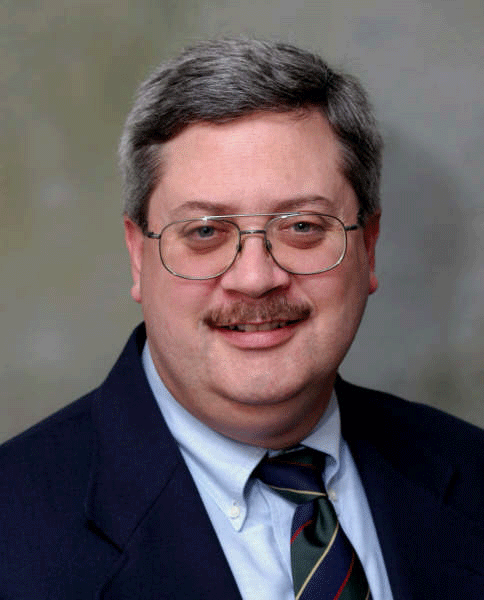 Tony Plante, Windham town manager
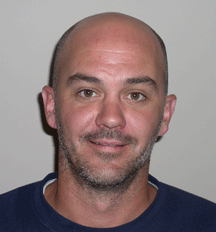 Scott Hayman, Windham Town Council chairman
Comments are no longer available on this story