
When Andy Madura studied automotive technology in the 1970s at Lake Region Vocational Center, it was a state-of-the-art facility.
Now Madura is the director of transportation, facilities and food service for School Administrative District 61, and he’s seen the high school and vocational center lose ground.
“We’ve overused the facility,” Madura said. “We’ve tinkered and tinkered and tinkered, and we’ve just run out of room.”
SAD 61 officials and board members are in the process of gathering input on a draft facilities plan. The last of four public hearings will be held at Stevens Brook Elementary School in Bridgton on Feb. 10 at 6 p.m. After this meeting, the Board of Directors will review input received and revise the plan if necessary.
The facilities plan includes $2.5 million for a school bus transportation facility and $6 million for renovations to Lake Region High School and Vocational Center.
These projects would largely be paid for by consolidating elementary school students first into Songo Locks School in Naples, Stevens Brook Elementary School in Bridgton and Sebago Elementary School, and eventually into just Songo Locks and Stevens Brook. The 10-year projected savings for consolidation is more than $5.3 million. Some Naples students, and eventually all Sebago students, would attend school outside their hometown.
“By keeping our older buildings open, our newer buildings are suffering,” Madura said. “We probably can’t afford to keep small schools open anymore. Status quo isn’t an option anymore.”
State funding for the district has decreased steadily over the years due to increased property values, and Madura said it was unlikely the state would pay for a new facility. Though the district has applied every time it could for a new high school, he said last he knew it was No. 43 on the list.
Renovations to the 40-year-old high school and vocational center would put additions on the front, east and west wings of the school for additional classroom, office and library space. The new transportation facility would house the maintenance department as well as the automotive and construction technology vocational programs.
Work needed at the high school was cited in the 2006 re-accreditation report from the New England Association of Schools and Colleges.
“We found out that the facility needs a great deal of work,” said Principal Roger Lowell. Though it is unlikely for the school to lose its accreditation anytime soon, Lowell said, there are schools in New England that have lost their accreditation because of facilities problems. Colleges and universities do not look favorably on high schools that are not accredited, Lowell said.
Regardless of re-accreditation, the bus garage in its current location in the high school building is unsafe, Lowell said.
“That facility should not be in this building,” Lowell said, adding that the fumes affect air quality, and there is too much traffic behind the building.
The re-accreditation team also found that the school library is too small, and there was not enough planning space for teachers, Lowell said.
The school’s librarian, Debbie Gahm, agreed with the re-accreditation team. “It’s about half the size that it really should be for the population,” Gahm said of the library, adding that she lacks storage space for supplies and audio-visual equipment.
Gahm said the library has been overcrowded for the entire 22 years she has been working there. Since there is no separate instructional space, classes are held alongside study hall students. In the spring, when more classes come to the library to do research, students end up sitting on the floor and in her office, Gahm said, and it can be distracting.
“It’s going to be awesome,” Gahm said of the facilities plan. “It’s going to give the kids more space.”
The transportation facility, too, has needed work for quite some time. District residents voted more than five years ago against a new bus garage, Madura said. This time the plan includes more than just a bus maintenance facility, but also construction and automotive technology vocational programs. Combining the facilities would allow the district to build single ventilation, drainage and hazardous waste systems.
The bus garage and automotive shop are next door to each other now, and both lack proper ventilation and drainage. Since the drains were plugged around five years ago for environmental reasons, maintenance staff has had to vacuum liquids off the floor instead, Madura said.
The two-bay bus garage is not big enough for the more than 50-vehicle fleet operated by the school district, Madura said. Transportation offices are housed in a modular, and 54 workers share one bathroom.
Keeping one bay open for emergencies during the day, the lack of space is holding maintenance staff back from doing what they’d like to do, Madura said.
“There’s enough for us to keep afloat,” said Pat Lettiere, shop foreman, Jan. 29 as he was installing a block heater in a bus. He said he gets held up by the lack of space.
Because of the lack of space and drainage, drivers have to wash their buses outside, which can be unpleasant and dangerous in winter months, Madura said. The proposed facility would include a drive-through wash bay and paint bay. Including space for painting and other more in-depth projects would enable staff to work on buses from other school districts and offer apprenticeships to students.
Renovations to the high school and vocational center would expand the building in order to move students inside from two modular buildings. An expansion to the front of the building would add library, office and guidance space.
Expansions to the east and west wings would house vocational programs and offices and allow for an expanded cafeteria and kitchen. The cafeteria has capacity for 150 students at a time, and Madura said in the winter some students don’t have anywhere to sit and eat their lunches.
Though there has been some controversy over plans to redistrict elementary students into fewer schools, Madura said this wouldn’t be the first time children would be attending school outside their home towns. Until Songo Locks School was built in 1992, some Naples students went to Sebago Elementary School, he said.
That could happen again in order to pay for building maintenance. Over the last 10 years, Madura hasn’t been able to be as proactive as he would like to be with maintenance, and in the long run it costs more to be reactive rather than proactive, he said.
“We need to do something and need to start thinking as a district, instead of as four separate towns,” Lowell said. “We’re going to lose a lot of programs if we don’t do something significant.”
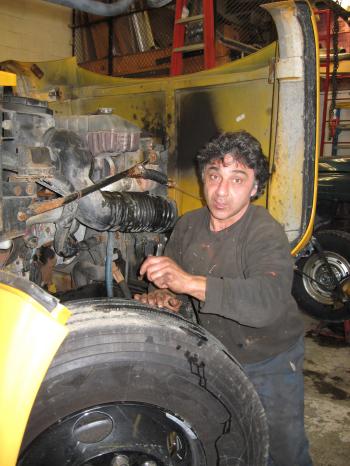 Pat Lettiere, shop foreman for SAD 61, installs a block heater in one of the district’s 34 buses. Due to the lack of space, Lettiere said he can’t do as much maintenance on the buses as he would like to.
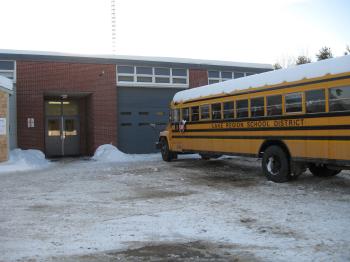 A bus is parked outside the SAD 61 bus garage and next to doors students use to get to a modular building that houses vocational programs. The location of the transportation facility in the high school is a safety hazard, said the facilities director, due to traffic and diesel fumes.
Comments are no longer available on this story