
When Allen Crabtree accompanied Veronica Johnson to her mother’s home in Cedar Rapids, Iowa for the first time since devastating flooding, he said Johnson was shocked by the destruction left by waste-deep floodwaters and mud.
A volunteer with the Red Cross national advanced public affairs team, Sebago Selectman Crabtree, 67, was called to Iowa last week after the Cedar River flooded the city of Cedar Rapids.
“I have time and I have something to contribute and they’re in need,” Crabtree said, adding that hopefully other people will see the example and donate their time as well.
On June 9, Crabtree got a call from the Red Cross and was on a plane that afternoon to Indianapolis, Ind.
After beginning to meet with local media and talk with people at shelters, Crabtree got a call that same night to deploy the next day to Cedar Rapids, Iowa, where residents were experiencing the worst flooding in the city’s recorded history. The Cedar River was at three times its normal flow, 43 blocks of homes were flooded and up to 25,000 people were evacuated, Crabtree said.
Johnson was one of those displaced residents. She had to flee her home June 11 when her house was surrounded by floodwaters. When she finally returned to her home in Cedar Rapids, Crabtree went with her.
“I’ve never been on the front edge of a disaster,” Crabtree said, adding that he is usually deployed during the recovery phase. “That was a completely different ball game,” said Crabtree, elaborating that it was sometimes impossible to get around because roads, and in some cases whole towns, were flooded.
Crabtree said it was a challenge to react quickly to shifting needs, such as power outages at two of the shelters. “It was a very fluid situation,” Crabtree said.
The purpose of the public affairs team is to get the word out about Red Cross services to victims of disasters, as well as to reach out to the media and potential volunteers and donors.
“They’re still at the shock level,” he said of the victims of the floods. “They’re traumatized and in some cases they lost everything they own.” Crabtree said some people were drawing comparisons between this flooding event and the devastation of Hurricane Katrina.
Crabtree, who first volunteered with the Red Cross just after Katrina struck in 2005 and has visited the affected area several times since, said that while the effects of recent flooding in Iowa are much more localized than Katrina, the losses are just as real for the individuals affected. Crabtree foresees a Katrina-style housing crisis, with many homes lost and not enough extra housing for people to live in.
During this trip, Crabtree was in charge of a Red Cross video crew for the first time. The Red Cross made an arrangement with NBC News to upload footage in exchange for being able to use it. Crabtree’s writing and photographs were posted on the Red Cross Web site and he was interviewed for the television and radio news. “It was an exciting time,” Crabtree said.
Crabtree and his crew traveled around Iowa for nine days taking photographs of the flooding, prevention and relief efforts, as well as talking with people at shelters, field kitchens and mobile feeding units. “My job was to find out what was going on,” Crabtree said.
The Red Cross provides food, shelter, cleaning kits and financial assistance to victims of natural disasters and collaborates with other service agencies to provide clothing and other supplies.
Besides talking with shelter residents, Crabtree went to Burlington, Iowa, at the confluence of the Cedar, Iowa and Mississippi rivers, where there was a massive community effort to fill sandbags. Five hundred people filled sandbags to reinforce the levees. Crabtree said the danger of flooding downstream is real and won’t abate for a week or two.
Crabtree said he tries to write stories about real people dealing with hard situations. “Everybody who has been through a disaster has a story to tell,” Crabtree said. “Some of them are so heart-warming.”
Retired now, Crabtree and his wife own an antiquarian book business and pick-your-own blueberry farm. He served in the Air Force until 1971 and afterwards worked for the states of Michigan and New Hampshire and the federal government in environmental enforcement and analysis.
Though he retired in 1998, Crabtree still does some part-time environmental consulting. Just in the past two years he has traveled with the Red Cross to Texas, Oklahoma, Ohio, New Hampshire, Missouri, Indiana, Iowa, and Georgia.
Crabtree stressed that anybody can volunteer with the Red Cross. “If I’m not too old to do it then nobody else is,” Crabtree said. “All it takes is the desire to help people.”
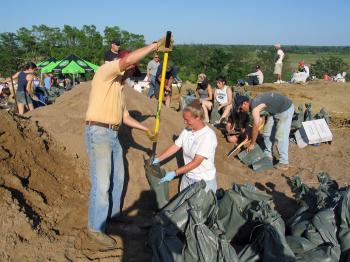 Lana Frank, a nurse who volunteers with the American Red Cross worker doubles as a worker filling sandbags to help protect the levees along the Mississippi River June 17 in Burlington Iowa. Sebago Selectman Allen Crabtree took the photo while volunteering Photo credit: , American Red Cross Burlington, IA June 17, 2008
  The scum line on the front of this home in Cedar Rapids, Iowa, shows how high flood waters from the Cedar River reached. American Red Cross volunteer and Sebago Selectman Allen Crabtree feared the flood damage would create a housing crisis similar to the one faced by victims after Hurricane Katrina in 2005.
  ‘The front edge of a disaster’
Comments are no longer available on this story