
Planting carrots isn’t part of the average kindergarten curriculum, but it’s a growing part of the learning process at Scarborough’s Eight Corners Primary School.
Since late May, students and a few dedicated parent volunteers have been cultivating Eight Corners’ first community garden in two small plots behind the 250-student, K-2 school.
“I thought it would be a wonderful idea,” said Principal Sandra Gorsuch-Plummer, who was approached by parents in March. “It fits in wonderfully with our curriculum.”
Students and parent volunteers are planting celery, carrots, squash, onions, tomatoes, pumpkins and sunflowers, which meshes well with the school’s social studies curriculum: Second-graders study Pilgrims, first-graders study American Indians and kindergartners learn about pumpkins and farming.
But gardening has applications in other curriculum areas, as well, from mathematics to writing, teamwork to hand-eye coordination.
On a recent Friday afternoon, parent Jennifer Leonard, with her daughter, 4-year-old Evelyn Boardman, in tow, was instructing a group of first-graders on planting squash. The children built small mounds in a hillside garden plot, poked a few holes in each hill, and carefully dropped a couple of seeds in each hole.
“Then, you can take your hand and just cover it up gently – like you’re covering a small child,” Leonard instructed.
While one child covered the seeds, Leonard kept the others focused with questions about gardening: “Do you guys have any idea what makes the soil healthy?”
“Sunlight and water,” volunteered first-grader Michael Battista, 7.
That’s right, Leonard agreeed. And who lives in the soil and helps make it healthier for plants?
“Worms!” several young voices respond.
Leonard, whose son, Ethan Boardman, is in second grade, says she sees a garden as a “living laboratory” that can teach children a variety of life lessons, illustrate ecosystems, encourage stewardship and inspire art and poetry. Gardens can also teach children social skills and lessons about themselves: observation skills, patience, gentleness, curiosity, problem-solving, and respect for other living creatures.
“In a time of high food and gas prices, fears about what is in our food (and) the drive to buy local, this was a wonderful opportunity for the children to grow their own food, work together, and really see what can be done when a community pools together,” said parent volunteer Tamara Murray.
Murray, a University of Southern Maine Extension master gardener, said she would like to see the garden expand and incorporate classroom composting in future years.
“Our long-term goals for the project are expansion, expansion, expansion,” she said.
Other contributers include Anthony Montante of Acme Landscaping, who donated labor and the use of his backhoe; Joe Viscone of Highland Avenue Greenhouse, who donated the compost and seedlings, and Ace Hardware at Oak Hill, which donated seeds, onions, a hose, and compost materials.
The parent volunteers said they plan to continue tending the garden over the summer, and hope that squash, corn and other late-season crops will be ready when next year’s students begin studying and preparing for Thanksgiving.
“The children are really excited to be planting and to be gardening,” said first- and second-grade teacher Courtney Grafius. “It’s a great project for us, because there are so many links that we can make to our curriculum.”
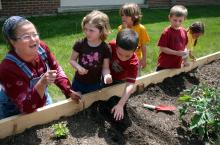 Eight Corners School volunteer Tamara Murray talks about the importance of gardening for young children and what it teaches them Monday afternoon in Scarborough.
Comments are no longer available on this story