
Despite an uncooperative Mother Nature and a double-booked calendar date, syrup producers in the Lakes Region area are preparing for a busy Maine Maple Sunday.
“The weather just hasn’t been nice enough, warm enough, for the sap to really flow,” said Mark Cooper, 44, of Cooper’s Maple Products in Windham. “It’s gotten us off to a fairly slow start,”
To get the sap flowing, maple trees need cold nights immediately followed by warm days. The change in pressure causes the sap to rise and flow through spouts drilled into the trees. The watery sap, which typically has a 2 percent sugar content, is boiled down to a thick, dark syrup using open-topped stoves called evaporators.
This year Maine Maple Sunday, sponsored by the Maine Department of Agriculture, falls on March 23, which is also Easter Sunday. Maine Maple Sunday is held on the fourth Sunday of March, while Easter Sunday follows a complicated formula based on the phases of the moon. Most syrup producers will still hold their annual open house on March 23.
Ted Greene of Greene Maple Farm in Sebago said the heavy snow accumulations have been insulating his trees and keeping them from producing. In addition, he said his trees are located at a higher elevation and as a result less snow has melted away.
“We’re dealing with probably more snow then many producers in southern Maine,” he said. He said in a good year he can make 100 to 200 gallons of syrup in his traditional wood burning evaporator.
“We’ve had three poor years in a row,” said Greene. He said last year the sap only flowed for six days and he attributes it to a string of bad weather.
Dewey Lloy, 45, said he believes the recent poor syrup years are a result of global warming. He and his wife, Sharon, run Balsam Ridge in Raymond, where they sell syrup products and Christmas trees. He said the season where sap can be obtained is normally six weeks long; three days shorter than it was 100 years ago.
“It started as a hobby, a backyard operation, like most people,” said Lloy. He and his wife have been making syrup for 10 years and hope to produce 50 gallons of syrup this year in their oil-burning evaporator.
Mark Cooper said he’s hoping for 200 gallons of syrup this year.
“It’s hard to tell right now. We’re certainly behind,” he said. Cooper’s farm features a large pancake breakfast and an open barn that includes miniature horses, peacocks and ostriches.
Greene said his farm has been run by his family for five generations, and the sixth generation, three children between the ages of 3 and 11, is already pitching in. They also provide syrup for the Sebago Fire Department’s Maine Maple Sunday pancake breakfast held in the town hall.
Greene and Cooper both said they will be open on March 23, while Lloy said his farm will be open on March 22 and 23. None of the producers are fazed by the idea of sharing a calendar date with Easter.
Lloy said he likes being part of the ancient American Indian tradition of producing syrup. The recipe hasn’t changed one bit over the years, it’s still sap reduced by boiling, but the collection methods have improved.
“I’m always trying to find a better way to do it,” said Lloy. He said before the 1950s, producers drilled 7/16 inch holes into trees and inserted metal or wooden spouts that dripped directly into buckets. Today, he uses a cordless drill with a 5/16 inch bit and places plastic bits that feed into a plastic tube highway that flows downhill into large collection tanks.
It takes between 30 and 50 gallons of sap, depending on the sugar content, to make one gallon of syrup. His evaporator makes about 3 1/2 gallons of syrup an hour – triple what most produce. With these large inputs of time and sap, Lloy said the demand for maple syrup is higher than the amount people are making.
Lloy said he sells most of his maple products, which also include maple candy, syrup and spreadable maple cream, on the weekend of Maine Maple Sunday and loves being in the business.
“It’s a lot of work, with long days, but in the end you get a treat,” said Lloy.
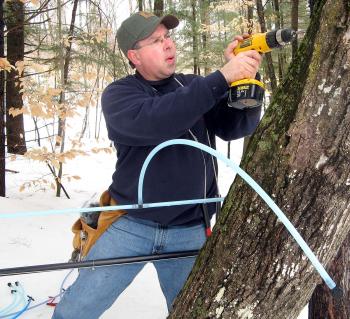 Drilling: Dewey Lloy, 45, of Balsam Ridge maple syrup farm in Raymond drills a 5/16 inch hole at an upward angle into one of his sugar maple trees to collect sap. The blue plastic line will be inserted into the hole and run directly to his sugarhouse, while the thick black line leads to a separate collection tank. “It’s a lot of work, with long days, but in the end you get a treat,” said Lloy.
 Looking up: Dewey Lloy, 45, of Balsam Ridge maple syrup farm in Raymond opens a window in the cupola at the top of his sugarhouse to ventilate the steam caused from boiling syrup.
 Outside: Dewey Lloy, 45, of Balsam Ridge maple syrup farm in Raymond uses a special clamping tool to open a gap in his sap line and fit a new branch to collect sap from an additional tree. “This is really a three-handed job,” said Lloy. He said this also helps tighten the line to keep the sap flowing smoothly.
 On Snowmobile: Dewey Lloy, 45, of Balsam Ridge maple syrup farm in Raymond, uses a snowmobile to haul the tools of his trade to his sugar maple trees. These tools include plastic tubing, a power drill, a variety of hand tools and a pair of snowshoes. “It’s a lot of work, with long days, but in the end you get a treat,” said Lloy.
 Tank: This oil-powered evaporator is new to Balsam Ridge maple syrup farm in Raymond. Syrup collector Dewey Lloy, 45, said this evaporator was recommended by the Proctor Maple Research Center at the University of Vermont and produces three and a half times faster than traditional wood-burning models.
Comments are no longer available on this story