
Maybe there hasn’t been time. Maybe other things have gotten in the way. Maybe it doesn’t run in the family. Or it’s perceived as only for someone older. Or maybe the subject is just too uncomfortable. But, whatever the reason, monthly breast self-examiniations and yearly mammograms could very well save your life or the life of someone you love.
October is National Breast Cancer Awareness Month. In an effort to get the word out about treatments, options and early detection, three courageous Lakes Region women have agreed to share their stories concerning their fight with breast cancer. Stories of sadness, stories of hope, stories that transcend the inherent differences among themselves and among all women facing breast cancer to form a bond of commonality. Or, as one of the women put it, to become “members of an elite club.”
These three women, who represent so many others, have faced their breast cancer, not with fear, but with determination. They know that, although one in seven women has or will develop breast cancer in her lifetime, the five-year survival rate exceeds 95 percent if the cancer is detected early.
And it is because of their determination, not only to fight their own cancer, but to increase the odds of survival for other women by stressing the importance of early detection, that these women talk about their journeys with breast cancer.
Jeri’s story
When Jeri Keane went for her mammogram in June of 2003, she thought nothing about it. And why would she? As a self-described “poster woman for mammograms,” the 54-year-old psychologist from Raymond had been having the tests annually for a number of years.
But in 2003, the results were different.
“I love that letter that says, ‘okay,'” Keane said, “but that year I got a phone call asking me to come in the next day to have further mammogram tests.”
When she looked at the mammogram, even Keane could see the suspicious area on the film – the area that hadn’t been there the year before.
Keane consulted a surgeon, who felt the mass should be removed although she didn’t believe from the mammogram that it was cancerous. So, at the end of July, Keane underwent a lumpectomy, a surgery that removes a tumor or mass from the breast.
A few days later, she received the call. The mass was cancerous and she was diagnosed with ductal carcinoma in situ, the most common type of non-invasive breast cancer. But the good news was, her lymph nodes and surrounding tissue were not affected.
“I was flabbergasted,” Keane said. “Although there is cancer in my family, there isn’t breast cancer and I never thought I would have breast cancer.”
Before the mass was known to be cancerous, Keane’s nurse had asked her, “If you have cancer, what’s most important to you?”
Keane said three things: “I’m not attached to the breast anymore – it’s done what it’s needed to do. I don’t want to worry every time I have a mammogram that the cancer will be back. And I want to see my daughter turn 50.”
Voicing her goals made Keane’s choice of treatment “a pretty easy decision to make.” And her husband’s support helped – he encouraged her to do what she felt was right for her.
For Keane, that meant a mastectomy.
“I was so convinced a mastectomy was what I wanted to do that I never doubted that was the right decision,” Keane said. “The difficult part wasn’t necessarily being without the breast but it was more having to mourn and let go even though I knew I didn’t need it anymore.”
Although Keane said she never experienced a premonition about having breast cancer, in retrospect she feels she prepared herself for the ordeal the previous spring. At that time, she began to exercise more regularly and made a deliberate decision to eat healthy foods. As a result, she had lost 20 pounds.
“I think somehow to go through this I had to be thinner,” she said. “I’m glad I did it. The whole thing with losing a breast and feeling ‘disfigured’ – I was really glad I was feeling healthy and strong and looking good.”
Even so, the impending mastectomy stirred strong feelings in Keene. Although she did not feel anger or question why it was happening to her, she experienced overwhelming feelings of sadness. And she describes the day of her surgery as being “very strange.”
“When you have surgery, they make you mark where it is going to be,” she said. “That was probably one of the hardest things I did – to mark which breast it was.
It’s been two years since Keane had her mastectomy. Although she says she’s not one of those people who bounce out of bed every morning, grateful for another day, she says she does feel a heightened sense of pleasure and gratitude concerning her life.
Keane believes her experience has made her more compassionate and deepened her understanding in her role as psychologist. Her ordeal has also made her look at friendship differently.
“I’d like to think I’m trying to be a better friend,” she said. “Not that I don’t think I was a good friend before – but a more deliberate, thoughtful friend.”
She is grateful to her family and to all of her friends who helped during her ordeal. She is also thankful for her treatment team of doctors and nurses.
As far as her advice to others, Keane says go regularly for mammograms – “early diagnosis is the best thing you can do.” Another piece of advice is not to be afraid to ask questions. “Ask all the questions; get all the information.”
And don’t be afraid to reach out for help. Keane believes an important piece of her recovery and continued success is the love and care she receives from the members of her support group.
“It’s a group I never wanted to join,” she said, “but it’s a great group.
Bevie Jo’s story
On Sept. 10 of this year, Bevie Jo Marquardt, 53, of Windham, was in a hotel room on a business trip with her husband when she casually lifted her arm to scratch an itch. That’s when she first felt the lump.
She sat up and felt again. It was there, and it hadn’t been there for long. Just a few months before, Marquardt had gone for her yearly mammogram, which had shown nothing.
As soon as she returned from the trip, Marquardt visited her doctor. She had a biopsy, a procedure that takes samples of the tumor with a needle and tests them for cancer cells.
Once it was determined that her tumor was cancerous, Marquardt had a lumpectomy, resulting in a diagnosis of intraductal carcinoma. Although this is another name for ductal carcinoma in situ, the same type Keane was diagnosed with, in Marquardt’s case, it wasn’t all contained. Cancer cells were also discovered in the surrounding tissue.
Although Marquardt is willing to have a mastectomy, after discussions with her oncologist, her treatment plan will include chemotherapy followed by radiation.
As the women’s ministries director for the Northern New England District of the Assemblies of God, Marquardt maintains a busy speaking and travel schedule. And because she had spent a year planning a women’s retreat, she is opting to begin her treatment after the retreat’s conclusion.
Her chemotherapy will begin Nov. 8, with a treatment every other week for eight weeks. After a three-week break, she will begin six-and-a-half weeks of daily radiation treatments.
She knows the road ahead will be difficult and taxing, but she is grateful for the support of her husband and family.
“Dennis has been wonderful,” she said. “It has pulled us closer together than ever before. It makes you really realize what kind of love you do have for each other.”
As she talks about her diagnosis, Marquardt realizes it took awhile for it to sink in.
“Looking back,” she said, “I thought I was really strong but I don’t think it had actually hit me. I don’t think I would be as strong as I am without my faith in God. It’s been wonderful to have God’s sustaining power.”
The realization that she will lose her hair has been difficult for Marquardt, who is also a hairdresser. In the past, she has helped clients deal with hair loss from cancer treatments. Now she is on the other end.
“It’s amazing how many ladies are going or have gone through this,” Marquardt said. “One of the days I was sharing about my hair coming out I started bawling, but when I went to get my wig I was fine.”
Kim’s story
“It actually took me a couple of years to believe that I was going to be okay,” said Kim Allen, a Gray-New Gloucester Middle School librarian who lives in Raymond.
Allen, 53, is a six-year breast cancer survivor.
She, too, discovered a lump under her arm in early summer of 1999, only a few months after having a good mammogram reading.
Her physician couldn’t find a lump but thought Allen ought to have it checked, suggesting it might be cat scratch fever.
“A few days after the biopsy I got the phone call,” she said, “so I grabbed my husband and in we went and that’s where the journey began.”
Allen’s surgeon removed a lot of lymph nodes at the initial biopsy and again at the end of the summer. But the doctor was unable to locate the primary tumor.
“The lump did indicate that it had metastasized and there were cancer cells,” Allen said, “so that’s when they went in search of the tumor – it was kind of a backwards look at it.”
But after multiple MRIs, bone scans and a trip to Boston for additional tests and opinions, doctors were still unable to find the tumor, leaving Allen with a rare diagnosis of carcinoma of unknown primary.
Treatment decisions can be difficult when there is no indication of the cancer’s origin. Allen elected to have chemotherapy, which made her very sick, followed by radiation. And six years later, she still takes hormone therapy medication.
“For almost a full year I was going through some kind of treatment and it kind of knocked the heck out of me,” Allen said. “I really had what I call chemo-brain.”
Allen says chemo-brain made her feel like she was in a fog and temporarily affected her vision, as well. She took a leave of absence from her job to be able to continue caring for her children.
When first diagnosed, Allen cried and became very emotional. She found it helpful to take long walks in the woods, listening to her favorite tapes.
“I am of strong faith,” she said. “If I hadn’t believed in prayer, I’m not sure I would have made it. I had a lot of talks with the Lord and that was my underlying strength – my spiritual strength.”
Allen said she was strengthened by the love of her family and friends, as well. And, although she didn’t connect immediately, eventually she joined a support group.
If there is a positive result from Allen’s journey with cancer, perhaps it is the slower-paced life she has determined to follow or her sense of a deeper level of understanding she now has for others.
Or perhaps it is her testimony to other women. Allen is determined to convince them of the importance of performing their own breast exams – not only in the breast area but also under the arms.
“Know your body, do your monthly exam and don’t rely on modern technology fully,” she said. “There is hope – don’t ever give up hope. And for me, I would say to have faith.”
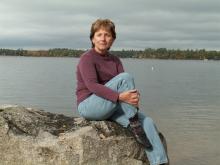 Raymond resident Jeri Keane sits on the shore of Sebago Lake in front of her home. Keane is a two-year breast cancer survivor.
Comments are no longer available on this story