
The REACH School in South Portland, which has catered specifically to preschoolers diagnosed with autism since 1999, will be accepting non-autistic children into their program in the fall.
The three classrooms at the school appear like any other pre-school classrooms – miniature chairs and low tables dot the rooms, reading carpets lie in corners bordered by book shelves, colorful alphabets and pictures hang on the walls – and the 3- to 5-year-old students arriving for school each day appear just like any other children.
A day at the REACH School is designed to mirror a normal day at a typical preschool; the activities and progression of the day is similar, though there is a lot more direct instruction and “a lot of additional structure,” Colleen Foley-Ingersoll, director of the REACH School, said.
Autism is still largely a mystery. What is known is that it is a complex developmental disability that usually appears within the first three years of life and affects the normal development of the brain in the areas of social interaction and communication skills.
However, no one knows what causes the disorder or why it is four times more likely to affect boys than girls – the REACH School only has one girl out of the 22 children in the whole program.
There is no explanation for the fact that it is the fastest growing developmental disability in the United States, with an estimated 10 to 17 percent increase per year according to the U.S. Department of Education and other governmental agencies.
The prevalence of autism is consistent around the globe and there is no connection between any factors such as race, ethnicity, lifestyle, education or wealth. No cure is known.
Different learning styles
Autistic children learn much less about social skills and language than typical children from their natural environment. Autistic children can learn these skills, but it takes a very structured and controlled environment to make that learning possible.
Applied Behavior Analysis, the methodology used at the REACH School is all about setting up that very structured environment to enable a child with autism to learn those social skills necessary to lead a normal life and continue onto kindergarten.
“With typical students you don’t realize all the steps involved,” Jessie Plourde, a teacher at the REACH School, said. “With some of these students we have to start from base one. … You have to teach really small parts of big skills.”
She used teaching a child to use scissors as an example. Normally, a typical child could watch someone use a pair once and copy the act. Autistic children might not be able to do that, though. You would first have to train the muscles in the hand that would hold the scissors, then the motion used and finally teach them to use the actual scissors.
Plourde said as a teacher your patience is being constantly challenged, but “you learn to see success in small ways,” she said.
The school is separated into three classrooms that progress in levels of direct instruction, depending on the needs of the students. The range goes from a one-to-one student-to-teacher ratio classroom for non-verbal children who need to learn to communicate basic wants and needs, to a two-to-one classroom for children with emerging verbal skills and then to a three-to-one classroom where there is more group and peer-to-peer communication and interaction.
Integration
It is the three-to-one classroom that will be integrated in the fall.
Foley-Ingersoll said she has been trying to integrate the school for years. The inclusion of typical students into the classroom will be beneficial for everyone, she said. The autistic children will have age-appropriate role models for proper social interaction, behavior and language skills and typical students will benefit from “learning life lessons they can’t get elsewhere,” such as being exposed at a young age to learning disabilities and peers who progress differently than them.
Laura Casey, assistant director and lead teacher in the one-to-one classroom, said that integrating the three-to-one classroom will not change the structure of the day or how they teach the children, “but it will change a lot of the interactions and the environment in the classroom.”
The earlier a child is diagnosed with autism and can begin a program tailored for autistic children the better chance that child will have to gain those social skills. Some children currently enrolled at the REACH School were diagnosed with autism at 18 months and were immediately enrolled in the program.
Kaleb is one such student and is now in his third and final year at the REACH School. A year ago he was non-verbal – now he is in the three-to-one classroom and is talking and interacting with his peers and teachers. The school asked that his last name not be used, to protect his family’s privacy.
The methodology the REACH School uses means a much higher teacher-to-student ratio than at normal preschools, which Foley-Ingersoll said would be attractive to parents of typical preschoolers. While a typical preschool classroom may have one teacher for 15 children, a classroom at the REACH School would have four teachers for 15 children.
Another benefit, Foley-Ingersoll said, is that teachers at the REACH School are also specially trained in child education and have more experience than teachers at typical preschools, who are often not specially trained and have little to no real experience.
Funded by the state and run by Child Development Services, the families of children diagnosed with autism do not have to pay to attend the REACH School. CDS is a state agency that provides services to children aged birth through 5 years that have been diagnosed with developmental delays or disabilities.
All children diagnosed with an autism spectrum disorder are eligible for a certain number of hours of services, such as developmental therapy or speech and language therapy. Families of typical children will have to pay, but Casey said she has heard from parents that the cost is very reasonable compared to typical preschools.
Foley-Ingersoll said many people in the community do not know the REACH School exists. Parents would only be aware of the school’s existence if they were referred through CDS. Foley-Ingersoll said she hopes that the school will have a higher profile now that typical students will be enrolled. Currently, the only typical students slated to attend in the fall are siblings of children already enrolled and children of staff members at the school.
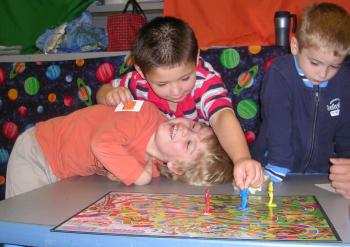 Drew, Ryan and Mason – three students in the three-to-one classroom at the REACH School play Candyland.
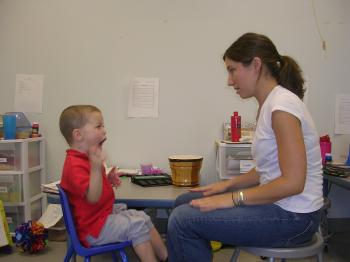 Jamison and his teacher Elizabeth Zook in the one-to-one room.
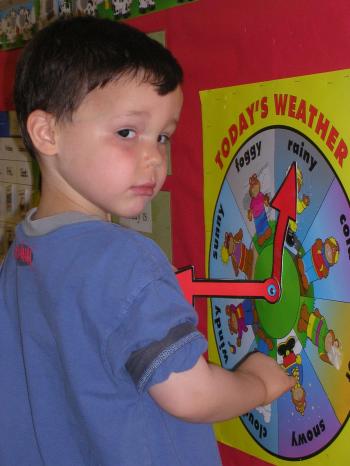 After looking out the window, Ben reports the weather to the rest of his classmates in the three-to-one classroom at the REACH School.
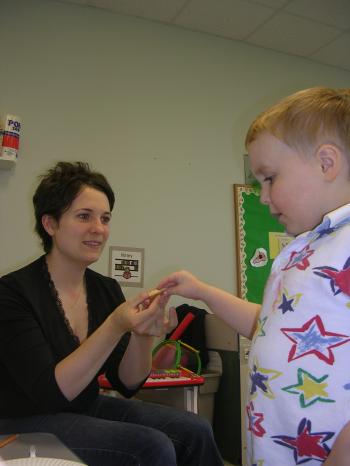 Laura Casey, the assistant director of the REACH School and lead teacher in the one-to-one room, gives a piece of pancake to Lucas, who is non-verbal, as a reward after he successfully asked for some by bringing her a picture of a pancake.
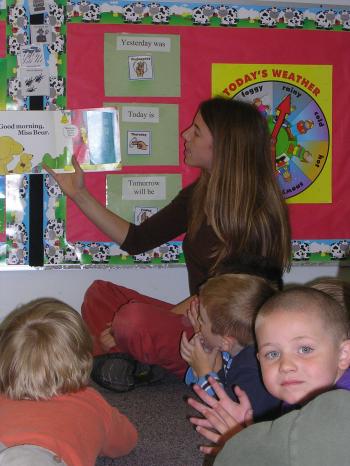 Kaleb looks at the camera while his teacher in the three-to-one room, Jessie Plourde, reads the entire class a story.
Comments are no longer available on this story