
The updated plans for the conversion of the Lighthouse Inn to condominiums were unveiled Monday night and addressed many neighborhood concerns, but some residents still felt the building was too tall.
Lighthouse Inn owners Peter and Nicholas Truman are proposing to renovate the current 22-unit seasonal motel in Pine Point into six condominium units. The building does not conform with existing zoning rules, and in order to move forward with the project the Trumans need several variances from the Zoning Board of Appeals.
The plans have been in front of the board twice and were tabled both times after board members requested additional information. During the meetings several neighbors also spoke out against the project.
In hopes of getting a better public response, Port City Architecture, which is developing the plans, scheduled two community meetings this month to discuss the project with neighbors and get their feelings on it.
Monday was the second meeting and the architects, Andy Hyland and Mark Chaloupecky, presented a new plan that they hoped would alleviate some of the neighborhood concerns.
The new plan contains six units. But rather than renovating the motel office, it would be removed and an addition would be added to the end of the motel nearest the ocean.
The removal of the office allows the developers to put four garages and a small parking lot in the rear of the building, allowing drivers to pull out onto King Street rather than directly onto Pine Point Road. This was a major concern during the zoning board meetings. In addition, the lot would contain a catch basin to better handle some drainage issues in the area.
However, due to the triangular shape of the lot, the developers had to keep the garages and driveways for units five and six in the front of the building, causing those living there to back out onto Pine Point Road.
Currently the inn is two stories high, but in order to include a garage for each unit a third story must be added. Hyland said the garages will add market value to the units and could not say what would happen if the town did not allow a variance to add the third story.
“We’re hoping the neighborhood supports the project and we won’t have to go there,” Hyland said, adding that if the project received neighborhood support he hopes the zoning board would accept the proposal.
One of the major concerns throughout the entire process was the building’s height. To help address the issue, Hyland presented a plan that broke up the roof alignment to create a building that gives the feeling of individual homes rather than a large condominium.
“That will break up the faA?§ade,” Hyland said.
Neighbors seemed to appreciate the changes in the roof alignment, but many felt it was still too high and said the size of the building be reduced.
“I really believe this is going to be an unprecedented height in Pine Point,” said John Thurlow. “To me it’s going to be a monstrous structure that dominates the vista.”
As presented during the meeting, the roof’s height is technically at the town’s maximum of 35 feet, but due to the way this figure is calculated the top of the roof is actually 42 feet off the ground.
Hyland said some changes to the roof could be made such as reducing the dormers and roof pitches, which will help decrease the overall size of the building. He would not present a flat roof plan to the Planning Board because it would probably not be approved.
“There are still things we can do on that and be in conformance,” Hyland said. “I think we could design a very beautiful, compelling piece of architecture.”
Hyland said if the plan was getting close to what people wanted then he could further refine the plan and present it again to the neighborhood. However, there is only so far he could go and keep the project to six sizable units.
“If we’re getting close we can probably bend a little more, but we can’t bend a lot,” he said.
Also included in the plans is the proposed land swap, or as the developers prefer to call it, a road relocation between the town and the Trumans.
The swap, which was proposed by the town, would involve the two sides trading about the same amount of land. It would allow Pine Point Road to move 18 feet away from the inn and provide enough room to add a small yard in front of the building. It also would allow the removal of the seasonal barricades.
“There are a lot of advantages to that, I think,” Hyland said.
Another possibility being considered is somehow building a cul-de-sac at the end of Pine Point Road to allow visitors a better turnaround area. This would require cooperation from the town, which owns some of the land where it is proposed.
The architects will host another community meeting during the summer, but the meeting has not yet been scheduled.
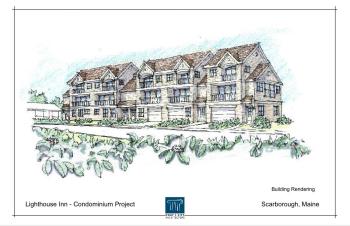 A draft drawing of the completed Lighthouse Inn after it is renovated into condominium units.
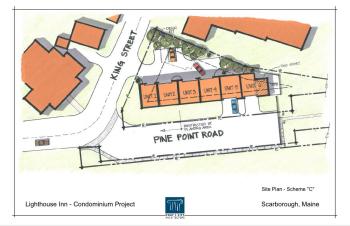 The revamped site plan for the Lighthouse Inn depicts only two driveways entering onto Pine Point Road.
Comments are no longer available on this story