
South Portland resident James A. Sheppard didn’t realize the significance of his actions when he hopped on a New York subway just days after his 18th birthday in 1942 and applied for training at a newly built all black Air Force base in Alabama.
He didn’t know that decades later historians would dub he and 14,000 other black men trained on the base, “the Tuskegee Airmen.”
More than 60 years later, Sheppard is one of about 3,000 Tuskegee Airmen still alive. Sheppard recently spoke to Ted Jordan’s U.S. History class at Cape Elizabeth High School.
Prior to 1941, the military refused to allow blacks to train as pilots. Though black soldiers were dying in combat, they were barred from flying planes, until the all black Tuskegee air force training base was opened in Alabama in 1941.
At the start of World War II in 1939, Sheppard was still in high school, but he had read about the Tuskegee training base in the newspapers. Boys were being drafted all over the country and rather than wait to be drafted, Sheppard picked Tuskegee. “I didn’t want to go into the infantry or any of that other nonsense,” he said.
So he trekked down to the recruiter’s office in New York City and put in his request.
Where Tuskegee was the first training base for black pilots and pilot technicians, Sheppard expected there would be stiff competition for a spot. Trained as an aviation mechanic at a vocational high school in New York, Sheppard discovered he was a prime candidate for a spot on the base. He was easily accepted as a plane technician. “They were happy to see me,” he said.
After a year of training in Alabama, Sheppard was sent overseas to what was then referred to as the “Mediterranean Theater of Operations,” which included Italy and North Africa.
Sheppard and his group assumed they were heading to London, which they were anticipating with pleasure. For most, it was their first voyage out of the country. The prospect of England was encouraging and made the war more appealing. “This war is not too bad,” Sheppard said was the feeling of he and his fellow soldiers.
Sheppard and the 332nd Fighter Group arrived after nearly a monthlong journey, not in London, but in the Mediterranean with their fleet of 80 liberty ships. They quickly discovered the severity of war when German planes attacked soon after they docked. “They came down shooting everything they could,” said Sheppard. “Now we knew for the first time what it was like to be in the war.”
Stationed in Italy, the 332nd invaded German bases throughout Italy by plane. As a crew chief, Sheppard saw some men leave in fighter jets, and never return. Sheppard said that pilots were heralded as senior invaders after surviving one or two battles.
To launch their fighter planes, the military set up makeshift runways on people’s farms and in their fields. They confiscated personal property to use as grass runways. “Imagine oil and gasoline scattered across your farm…there were times when sheep and goats would run across the runway,” said Sheppard.
The 332nd Fighter Group was training to invade Japan, but Sheppard and his group never made it there. In 1945, two years after sailing to Italy, they returned home. The war was over, but the 332nd sailed home counting 100 men lost to battle and 35 who were captured as prisoners of war. “That was one of the saddest days I can remember,” said Sheppard.
After the war, Sheppard made a career as a plane mechanic, working for airlines in New York, and then joining the Federal Aviation Administration in 1957. He retired from the FAA in 1987.
Sheppard was first asked to speak about his Tuskegee experience for Colby College in 1996 and recently returned from a weeklong speaking engagement in South Carolina.
 Cape Elizabeth seniors Rosemary Ehlers and Spencer Howe chuckle during World War II vet James Sheppard’s presentation in Ted Jordan’s history class recently. Sheppard was one of about 14,000 men trained at the first black air force base in Tuskegee, Alabama. Before Tuskegee, the military refused to train blacks as pilots. Sheppard worked as an airplane technician.
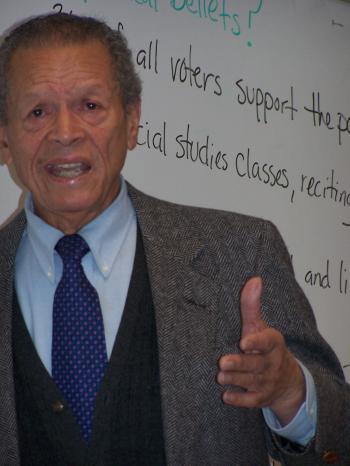 South Portland resident James A. Sheppard, a graduate of the first training base for black pilots and technicians, talks to Ted Jordan’s U.S. History class at Cape Elizabeth High School.
Comments are no longer available on this story