
WINDHAM – Since introducing his Sebago Farms project to the Windham Planning Board Jan. 9, a proposal that drew stunned praise from many in the greater Windham area, John der Kinderen has been working mainly with state officials to bring the massive greenhouse project closer to fruition.
As unveiled, the project would erect three large greenhouses each with a series of pools used for raising fish and growing hydroponic lettuce, carrots and peppers. The greenhouses, one of which would be 2,000 feet long, would be built in the Quarry Ridge Business Park off Route 302 in North Windham.
While der Kinderen presented an initial sketch plan to Windham to kick off the planning process early last month, since then he’s been working with state regulators regarding various permits the project requires.
“I’m in very close contact with the town of Windham. They have been wonderful, very supportive. It’s a real team effort,” the Arundel resident said when asked about the process so far. “I’ve been in regular contact with the state, (Department of Economic and Community Development) specifically. They have continued to be great. So I have no complaints whatsoever. Everything is going the way – actually better – than we were expecting it to.”
‘There’s a process’
According to Windham Planning Board Chairman Jim Hanscom, the board’s role is to act as a check and balance, making sure the state has signed off before granting Sebago Farms the local construction permit.
“There’s a process, and we make sure the process is being followed,” Hanscom said. “The (company has) to make sure the process is being done, but we do, too. We’re kind of a checks-and-balances board. We make sure they’re doing what they need to do, and the permits are where they’re supposed to be, and when they get all that stuff together, there may be other things that we may need to ask of them.”
Once the state permits are in place, the company can submit a “final plan” that would be reviewed by the Windham planning department and Planning Board. If everything aligns with town ordinances, the Planning Board can approve the project.
What could lengthen the process, and bring the Town Council into play, is Sebago Farms’ plan to have 37 acres of buildings on a 72-acre site, which would violate the town ordinance that requires no more than 50-percent building coverage on a property in the Economic Development zone. As proposed, Sebago Farms’ greenhouses and offices would cover about 55 percent of the lot.
There are three ways around this regulation, however. Der Kinderen could either purchase more land from property owner R.J. Grondin, downscale the size of the buildings or lobby the council to amend the acreage stipulation of the Economic Development zone.
In addition to the zoning requirement, which is solely a local issue, Sebago Farms has several permits it needs to obtain before getting the final OK from the Windham Planning Board.
The Maine Department of Environmental Protection must sign off on a storm water management plan that shows Sebago Farms can handle significant rainfall or similar flooding, and the department will also review the company’s air-quality plan on account of the large, natural-gas-fired generators the company plans to install to control the climate in the greenhouses.
Der Kinderen has not yet begun to work with the state agency, according to the department’s southern Maine project manager Jim Dusch.
“We haven’t actually seen the proposal yet,” Dusch said. “As far as the DEP’s involvement in it, what would happen is that (company representatives) would come in and have a pre-application meeting, essentially before you file an application (we would) review the plans and make sure everything looks like it’s in order.
“So what we’re trying to do at this point is arrange for a pre-application meeting, and that’s really up to the applicant to tell us when they want to do it. We’re ready to do it.”
From Dusch’s discussions with Sebago Technics, the design consultants for Sebago Farms, Dusch said “they’re evaluating their preliminary plans, making sure they’re ready to come in for the meeting.”
In addition, der Kinderen needs a permit from the Department of Transportation regarding traffic impact. With several companies already located along Enterprise Drive, the Quarry Ridge Business Park is close to triggering installation of a traffic light at the intersection of Enterprise Drive and Route 302. The massive scope of the Sebago Farms project would probably require a new signal.
“That’s a potential outcome of this,” Windham Assistant Planner Ben Smith said. “It’s a situation where the next big development in that business park would likely result in an increase of traffic that would result in a light.”
Helpful hand
It’s rare when a company has positive things to say about working with government regulators. However, der Kinderen said he is upbeat about the state permitting process, thankful to be assigned a staff member with the Maine Department of Economic and Community Development who is ushering him through the red tape.
“In the past, it was the attitude of, get in line and maybe we’ll get to you, maybe we don’t. Now the attitude is, how can we help you?” der Kinderen said. “They are actually calling me and going out of their way to help this project along. It is a total difference, and the governor has to get a lot of the credit because it’s not easy to turn a bureaucracy around like that.”
When asked to expand on the help the state is offering, der Kinderen said, “It’s not anything special that they’re offering; what they’re offering is just assistance. If you’ve ever been through that bureaucratic maze, it’s just horrible. So what they’re doing is, they’ve assigned me a personal liaison for this project to make sure I see the right people at the right time, to make sure things get done the way they are supposed to get done. So, it’s not so much incentives, and it’s not so much any kind of breaks, it’s just helping us navigate that process.”
Der Kinderen’s comments are welcome affirmation, says Gov. Paul LePage’s press secretary, Adrienne Bennett.
“That certainly is great to hear. We know that we have been trying to change the attitude with our departments so it’s great to hear some of the businesses are getting to see those results,” Bennett said. “We, as a government, need to understand that the Maine people are our customers, all of them, whether they are citizens or business owners. And we need to do whatever we can to help them through a process. And that’s not to say it’s automatically granting someone a permit. It’s just being there to help them through, answering their questions in a timely manner and giving them a clear outline of the expectations in the permitting process.”
Deb Neuman, deputy commissioner of the state economic development department, was the one tasked with adopting the new approach of ushering applicants through the regulatory process. She has been working on the Sebago Farms proposal since the fall.
“Part of what we’ve done, and part of why I was brought on board last summer, was to create a team of governor’s accounts executives,” Neuman said. “Their primary focus is to work with businesses to help them in whatever way they need. And in John der Kinderen’s case, they bring the right people to the table from within state government and outside of state government to work on the project with him so the business owner doesn’t have to figure out (the regulatory process). Basically the whole idea is to streamline the process for businesses, so they can focus on what they do best, and that is run their business or start their business. And we can make the process of working with state government a lot more user-friendly.”
Fast track
That aid isn’t only coming from state government, but from local government, as well.
Once der Kinderen laid out his plans at the Jan. 9 meeting of the Planning Board and indicated he’d like to get a plan approved by May 1, Hanscom, the board chairman, said the board would “fast-track” the project to include additional meetings if the company so requested.
Hanscom, as chairman, has the authority to call special meetings in addition to the two the board already holds each month. The additional meetings, if necessary, would allow local review to occur more quickly. In Sebago Farms’ case, however, the Planning Board can’t do anything until the company gets through the state review process and submits the final plan.
“We’re just kind of in a holding pattern at this point,” said Smith. “The applicant definitely has a lot of engineering and a lot of work to do and a number of things to satisfy the state permits they need. And the way our ordinance reads is they can’t get their final municipal approval until they get their state approvals.”
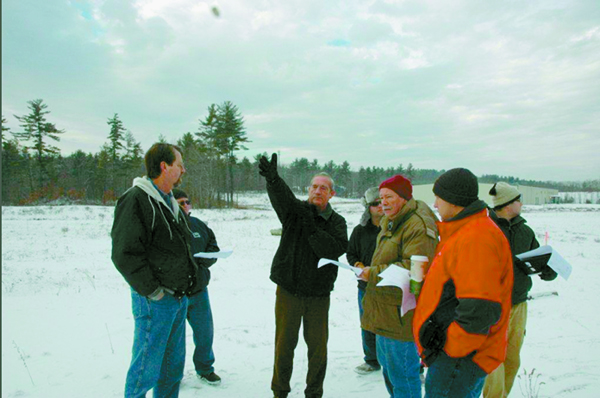 Windham Planning Board members walked the proposed site of
Comments are no longer available on this story