
Editor’s Note: Since this article was published, there has been a development in the story. In response to feedback regarding a proposed public access plan posted by the Cape Elizabeth Land Trust March 10, the land trust is now considering an alternative approach that would allow off-leash dogs in Robinson Woods II from sunrise to 10 a.m. and in Robinson Woods I after 4 p.m. daily. This alternative would allow limited hours at both properties. The Canter Way Trail between Cape Elizabeth United Methodist Church and Robinson Woods II, and the Robinson Woods I Wildflower Trail, would require dogs to be on leash at all times. Off-leash access is now prohibited in Robinson Woods I and II after 9 a.m. daily. See the March 26 edition of the Current for a full story.
Dog walkers are criticizing a plan by the Cape Elizabeth Land Trust that would extend morning and afternoon access for off-leash dogs on 80 acres of the Robinson Woods Preserve, located off Shore Road, but forbid off-leash dogs on the other 65 acres of the property.
The parcel has about 3 miles of trails in total. Under the public access plan, which will be implemented later this spring, dogs would be allowed off leash from sunrise to 10 a.m., and from 4 p.m. to sunset, on the 1.5-mile Robinson Woods I loop trail. However, leashes would be required at all times on the 1-mile Robinson Woods II trail, as well as a dirt access road, the quarter-mile Robinson Woods I Wildflower Trail and the Shore Road parking lot.
Hinging on stipulations in the land trust’s Robinson Woods I and II conservation easements – and in response to public forums this winter – the land trust developed a temporary plan on March 10 that aims to balance public use of the 145-acre parcel with the organization’s obligation to preserve the property’s natural features and ensure the safety of visitors.
Some Robinson Woods users say that the land trust failed to compromise with the dog walkers in creating the new public access plan. A link to the plan, posted on the Cape Elizabeth Land Trust’s Facebook page last week, garnered several responses from residents, including that the proposal “is a big disappointment and unfortunately will result in even fewer supporters” of the land trust. One resident said the town invested a lot of money into Robinson Woods II, only to result in “no off-leash time at all” on the 65-acre parcel.
Prior to the most recent changes, the land trust had imposed a rule beginning Dec. 1 that restricted off-leash dogs in Robinson Woods to sunrise to 9 a.m. daily and required owners to keep their animals under voice control. According to land trust representatives, the change in policy is a response to at least five separate incidents on the property involving unleashed dogs that bit, chased or attacked users. Other contributing factors included the increase in dog waste on and off the trails, and the impact of off-leash dogs on wildlife.
In the wake of that policy change, more than 100 people gathered at two community roundtable discussions in January to voice their opinions about the new rule and offer alternatives. Since then, the land trust has considered the cumulative impact of all Robinson Woods users to help create a plan that is intended to “ensure an enjoyable visit” for everyone and to protect the natural habitat and wildlife.
Cape Elizabeth resident Don Clark, a regular user of Robinson Woods, said he is in favor of increasing public access in Robinson Woods, particularly for dog walkers. However, he sees the revised plan as “a plan to limit further public access,” he said.
“The first proposal was no off-leash (dogs) after 9 a.m. A lot of people objected to that,” said Clark. “We tried to offer as many constructive ideas as we could, and the second proposal was a step backward.”
Clark, who has lived in Cape Elizabeth for 19 years with his wife, Anne, said he and his family have supported the Cape Elizabeth Land Trust. However, he does not support the land trust’s proposed public access plan, calling it “disadvantageous” to dog walkers.
Before the policy change, 90 percent of the people Clark used to encounter in Robinson Woods were dog walkers, he said. But due to the off-leash restrictions, Clark now uses other nearby properties, such as Fort Williams, to walk his dog, Charleston.
“To call it a compromise is not accurate,” said Clark, of the public access plan. “If you’re going to knock out even more of Robinson Woods to dogs off leash, you’re basically limiting options people have for walking dogs. I’m against that.
“If you have problems with waste issues, you educate people, you change behaviors. It works very well in Fort Williams,” Clark added.
Clark isn’t alone in his objections.
“The most recent proposal is, from my perspective, even worse than the current situation,” said resident Jim Williams, who runs with his black lab, Pirate, off leash in Robinson Woods II. “First, (the land trust) went from no limitations to a very small window from dawn to 9 a.m. Now (they) are proposing cutting off access to the trails that I have enjoyed for 19 years.”
Williams said that in nearly 20 years, he has not witnessed any incidents in Robinson Woods where people were chased or attacked by dogs. But, he said, it angers him that owners with aggressive dogs would allow them off leash.
“It obviously gives those of us who are responsible dog owners a bad name and leads to controversy like we have seen at Willard Beach, Scarborough beaches and now Robinson Woods,” Williams said. “If this proposal stands, the land trust will no longer have my financial support.”
Anne Carney, land trust president, said the organization expects to finalize the public-access plan by the end of March, which will be in effect for a one-year trial period. Carney wasn’t sure when implementation would begin, but the land trust is shooting for late spring.
“We’d like to see how this plan works through a full cycle of seasons,” Carney said.
Other new dog-related rules include keeping off-leash dogs within sight, carrying dog waste bags and a leash, removing all dog waste, keeping dogs out of ponds and vernal pools, and limiting a person to three dogs. In addition, the property does not allow commercial dog walkers. The land trust plan also warns bicyclists to yield to pedestrians and avoid bicycling at high speeds.
“People tend to get off the trail for the bikes,” said Carney. “The rule for the property will be the typical rule for the road – that bicyclists yield to pedestrians rather than the other way around.”
Land trust officials see the new rules as an expansion of public access, however. While allowing off-leash dogs from 4 p.m. to sunset in the wintertime is restrictive due to the lack of daylight, Carney admitted, dog walkers in the summertime would now have another five or more hours to walk their dogs off leash. The new rule means off-leash dog walkers would not have access to the Robinson Woods I trail system for only six hours out of the day, she said.
“We felt it was quite an expansion of the access,” Carney said. “In the (January) forums, a lot of people said the early-morning off-leash time didn’t work for them. And what we heard loud and clear from people was that they really wanted some afternoon off-leash time.”
And not everyone who uses the system wants to share the trails with off-leash dogs. The land trust has heard from many users of Robinson Woods who prefer to walk, run or bike in a place where they won’t confront an off-leash dog. What’s more, Robinson Woods is interlaced with hundreds of vernal pools and contains several sensitive wildlife habitats, Carney said. And several kids use the Robinson Woods II trail system to bike or walk home from school.
“Just like the off-leash advocates want to have prime morning and prime evening walking times, we also wanted to give people who didn’t want confrontation with off-leash dogs to have the same parallel opportunity,” she said. “We tried to meet the needs of everybody – people have conflicting needs that can’t all be addressed.”
The land trust will eventually install signs on the Robinson Woods property announcing the new access rules and provide educational materials to inform the public about the property’s unique ecological features, Carney said.
Some walkers say the land trust is in a difficult position trying to please all users. While walking her goldendoodle, Dooley, in Robinson Woods Monday morning, South Portland resident Christine Koch said she likes having the opportunity to walk Dooley off leash from sunrise to 10 a.m. And while she does not agree with prohibiting off-leash access in Robinson Woods II altogether, she recognizes that non-dog walkers also have a right to enjoy the property to the fullest.
“If you’re afraid of dogs, it can really be intimidating,” said Koch.
Nava Spaulding, another South Portland resident who was walking with Koch earlier this week, agreed.
“It’s important for people to realize that other people have an interest in the place, too,” he said. “We’ve somehow got to find a way of helping everybody still get some enjoyment out of it. It’s not going to be perfect.”
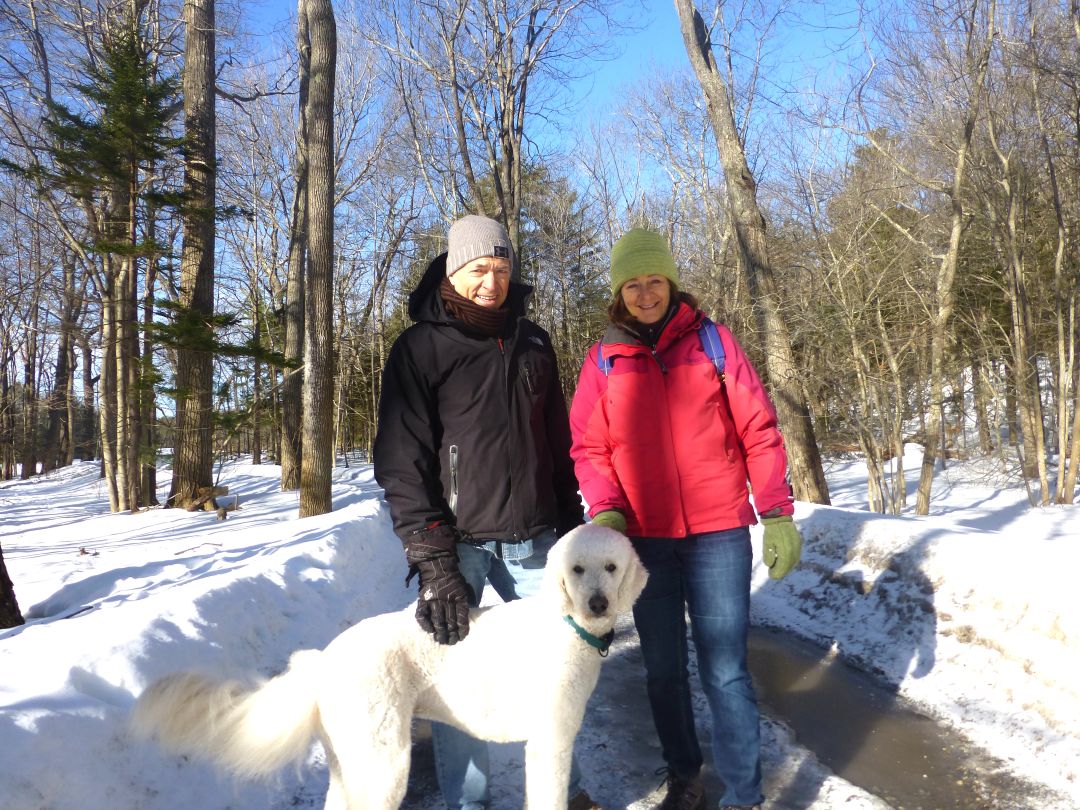 South Portland residents Nava Spaulding, left, and Christine Koch take a break from walking their goldendoodle, named Dooley, off leash in Robinson Woods before 9 a.m. on Monday. Staff photo by Kayla J. Collins
Comments are no longer available on this story