
T-Mobile’s plan to build at a South Portland graveyard, in a residential zone, is the subject of a hearing next week.
Allowing construction of a 120-foot cell tower, with its associated 30-year land lease, could help the Highland Memorial Cemetery on Highland Avenue in South Portland continue to operate, according to Arthur Smith, president of the cemetery board.
In order for the cell tower project to move forward, however, the Board of Appeals must first grant a series of variances because the cemetery, located at 881 Highland Ave., is in a residential district and the city’s land use ordinances generally disallow cell towers in residential neighborhoods.
The board will hold a public hearing on the cell tower proposal at 7 p.m. on Wednesday, March 25, but City Attorney Sally Daggett has already warned the Board of Appeals that it cannot deny the tower based on health concerns regarding radio frequency emissions.
In a letter to the board, Daggett said the board’s only job is to determine whether there is “a significant gap in coverage” in that area of the city and whether there are any “feasible alternatives” to the proposed cell tower site, which would be owned and operated by T-Mobile.
She also said the local board must comply with the Federal Telecommunications Act of 1996, which gives cell companies broad rights, while limiting the “regulation and bureaucracy that stood in the way of a steady and rapid expansion of personal wireless services.”
Overall, Daggett said, the Board of Appeals in South Portland has very little control over the location and construction of cell towers, although the variance application must still meet the definition of a hardship.
In addition, an independent consultant hired by the board earlier this year, IDK Communications in Massachusetts, has found there are coverage gaps in South Portland for T-Mobile, specifically in the targeted areas between Evans Street and outer Highland Avenue.
Highland Memorial Cemetery is adjacent to the transfer station and located near the intersection of Crestview Drive and Highland Avenue. It was founded in 1925 as a public cemetery. However, due to financial problems, the private association that governed the cemetery broke apart and the site became severely neglected.
In 1976, the South Portland Lions Club cleaned up the cemetery as a community project and decided to continue with the upkeep. In 1985, the Lions Club gained control of the cemetery.
Then, in 1986, ownership of the cemetery was deeded to a newly formed organization, Highland Memorial Cemetery Inc., which has its own board of directors and has maintained and operated the cemetery ever since.
In a letter to the Planning Board and the “people of South Portland,” Smith said the cemetery is located on about 14 acres of land. The seven acres closest to Highland Avenue have been developed, while the remaining acreage, which is heavily treed, has stayed undisturbed.
The plan would be for the new cell tower to be located on the back wooded acreage, about 50 feet from the transfer station property line and about 291 feet from the rear property line.
The Portland Pipe Line owns the parcel to the rear of the cemetery and has received a notice regarding next week’s public hearing, as have all abutters within 500 feet. In addition, South Portland’s Greenbelt Walkway also runs nearby, on its way to the Wainwright Recreation Complex.
In his letter, Smith, who spends the winter in Florida and won’t be on hand for the March 25 Board of Appeals meeting, said, “Our expenditures far surpass our income. We need income and we have found a source in T-Mobile to help provide our financial needs.”
Steve Andrade, the senior development manager for T-Mobile in New England, said the company does not “typically disclose” how much it pays for land leases, so it’s unclear how much the cellular company would give the cemetery association to lease a 2,500-square foot, fenced-in area.
In his letter, Smith said the operating budget for the cemetery, which is open seasonally from April 1 to Dec. 1, is $30,000 a year, but the cemetery association’s income, which mostly comes from the sale of plots and burial fees, is about $15,000 less than that.
The cemetery association employs a part-time superintendent, but Smith’s letter said it’s unable to offer him a “just salary” and it’s only the superintendent’s dedication that keeps him on the job.
In prior years, Smith said, the cemetery association was able to rely on donations from the Lions Club to help out with costs, but he said the club is experiencing “dwindling membership” and an “inability to raise money” so it’s no longer able to provide financial support.
Smith added that the cemetery association has made regular appeals for donations to the family members of those buried at the cemetery, as well as to local businesses, to no avail.
“We need a continued income source and that’s what we would get from T-Mobile,” his letter states. “There is so much more that we would like to do” to improve and expand on the services offered, he added, but there is simply no funding available.
Ricardo Sousa, an attorney with Prince Lobel Tye in Boston, is representing T-Mobile in front of the South Portland Board of Appeals and in his application to the board argued that the cell company’s request for a new tower does meet the test for hardship.
In the application, Sousa said the tower would be in the monopole style and would include nine panel antennas and three remote radio heads. Andrade added that the 120-foot height of the new tower is based on the “coverage objectives,” as well as the terrain.
Sousa said the new cell tower “will not have any adverse effect on the value of land or buildings in the neighborhood” and that it would “promote the general welfare of the inhabitants of the city of South Portland by enhancing telecommunication services.”
Sousa added that the cell tower “will not produce an undesirable change in the character of the neighborhood” and said the tower would be “located away from the road and toward the back of the cemetery” and be shielded by vegetation.
In the application for the variance required for the cell tower, he also said that “no other feasible alternative” is open to T-Mobile and argued that the new tower would not “unreasonably adversely affect the natural environment.”
Sousa said that not allowing the variance would result in “significant economic injury,” not only to T-Mobile, but also to the cemetery association, adding that the proposed new tower is the “least obtrusive solution” to T-Mobile’s existing coverage gap.
Andrade said that T-Mobile only builds new towers when it has a need, and “we don’t build more than we need to.” He said if the Board of Appeals approves the project, the goal would be to have the cell tower up and operational by the end of the year.
This week Patricia Doucette, South Portland’s code enforcement director, told the Current that T-Mobile’s application for a variance is complete and the Board of Appeals “has all the information it needs to make a decision on the 25th.”
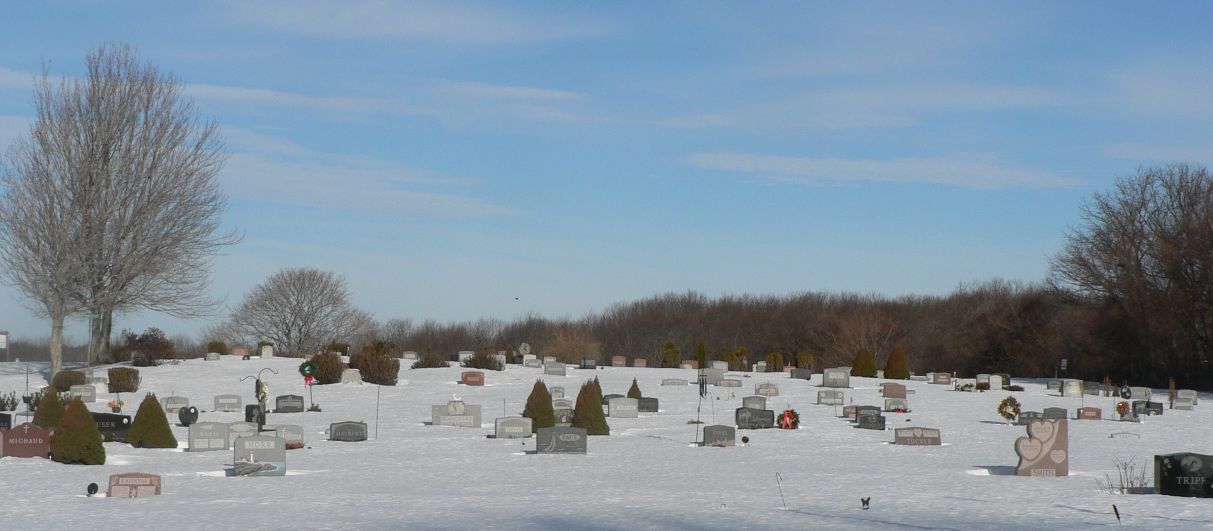 The Highland Memorial Cemetery, located at 881 Highland Ave. in South Portland, could be the site of a 120-foot telecommunications tower if the Board of Appeals approves the application. Staff photo by Kate Irish Collins
Comments are no longer available on this story