

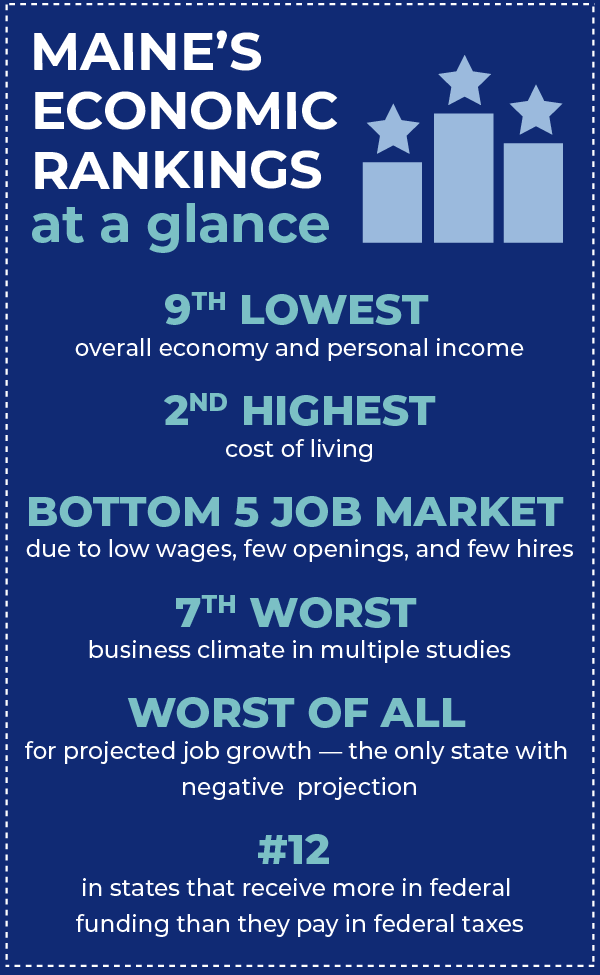
 It’s a fact: Maine’s economy ranks poorly and, without change, it will only get worse.
New data shows that Maine has the slowest-growing economy in the nation—so slow, that it is the only state to show negative job growth over the next three years. Over the last few decades, Maine has lost tens of thousands of good-paying jobs, its workforce is shrinking, it attracts less investment, and sees fewer business startups than almost every other state.
However, none of these are forces outside of Maine voters’ control. With a nonpartisan, strategic plan to help turn things around, Maine people can create a distinctive economy that will put them in healthy competition with other states and global partners.
But first, it’s important to understand how Maine found itself at the bottom of so many economic indicators.
The high cost of operating a business in Maine
At present, Maine struggles to attract new businesses because of high taxes, high energy costs, high healthcare costs and limited resources. The job sectors that are growing are predominantly in service industries, which have lower wages and smaller economic impact. This makes it difficult for families and other job seekers to get ahead, and they start looking beyond the state’s borders for opportunity. It’s a complex cycle that must be broken.
Because of how these issues intersect, Maine needs a concerted strategy to overcome these obstacles. Cities and other states have implemented strategies to create jobs, attract investment and talent, keep young people, and improve the quality of life.
Steps to make Maine’s business climate more competitive
The state cannot expect to attract new businesses if existing employers cannot thrive here. Regulatory reform and stability can give businesses confidence that they will be able to recoup the investments they make in creating jobs, investing in equipment, and expanding their operations.
When new businesses do come the state, the most valuable ones are those that create and grow foundational jobs. Foundational jobs add value to Maine’s economy by producing goods and services or bringing money from outside the state. These jobs drive business expansion, increase tax revenue, and support public services like education, infrastructure, and law enforcement. Without foundational jobs, sustained economic growth is unattainable.
Maine could also make its tax structure less burdensome and more in line with what people pay in other states. Part of Maine’s high tax rate is that the government cost per capita is substantially higher than many other states. When new public programs or costs are added, little, if anything, is done to implement efficiencies or find cost reductions. It should be a nonpartisan issue that public services be administered efficiently with maximum value for the dollars spent.
Getting back in the game as a team
Fixing Maine’s economy is not going to be easy, but the only radical change needed is compromise. The way to turn things around and move Maine up these rankings is a strategic, nonpartisan plan that is comprehensive, long term, data driven, and results in measurable improvements. Working together to create good paying jobs, attract new businesses, and invest in workforce makes Maine a more appealing place to work and live for everyone.
The Alliance for Maine is a non-partisan, community-based effort to educate Mainers about the state’s economic challenges and the need for a plan to repair and grow the economy.
Comments are not available on this story. Read more about why we allow commenting on some stories and not on others.
We believe it's important to offer commenting on certain stories as a benefit to our readers. At its best, our comments sections can be a productive platform for readers to engage with our journalism, offer thoughts on coverage and issues, and drive conversation in a respectful, solutions-based way. It's a form of open discourse that can be useful to our community, public officials, journalists and others.
We do not enable comments on everything — exceptions include most crime stories, and coverage involving personal tragedy or sensitive issues that invite personal attacks instead of thoughtful discussion.
You can read more here about our commenting policy and terms of use. More information is also found on our FAQs.
Show less