
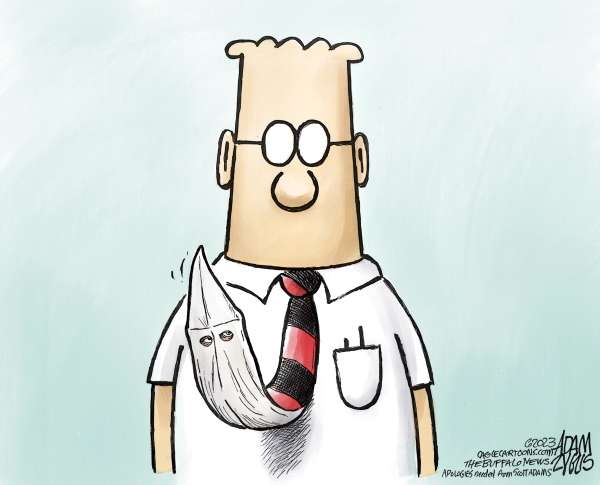
It’s been over a week since Dilbert creator Scott Adams was canceled by hundreds of newspapers across the nation, as well as Canada, for racist tirades he unleashed on his own YouTube show.
Adams, who is white, suggested that white people “get the hell away from Black people,” referring to Black Americans as a “hate group.”
“It makes no sense whatsoever as a white citizen of America to try to help Black citizens anymore,” Adams said. “White people trying to help black America for decades and decades has completely failed. And we should just stop doing it. [Because] all we got is called racists.”
Tell us how you really feel, Scott.
During the Feb. 22 episode of his YouTube podcast “Real Coffee with Scott Adams,” the cartoonist was attempting to comment on a Rasmussen opinion poll that posed the following question: Is it ok to be white? Seventy-two percent of respondents answered “yes,” including 53 percent of Black respondents. Twenty-one percent of Black respondents said they “weren’t sure,” while 26 percent said “no.”
This was not the first time the former comic strip artist has waded into controversy. In 2011, he argued women are treated differently by society for the same reason as children and the mentally disabled — “it’s just easier this way for everyone.” He also said 2016 GOP presidential candidate Carly Fiorina had an “angry wife face.” Detecting any sexism here?
It didn’t take long for personalities on the right to take to their social media platforms to whine about Adams being “cancelled” by “oversensitive leftist snowflakes.” This typical response of attacking the messenger is a tactic frequently employed by the right (and in some cases, the left) to sinisterly scrutinize and weaponize against opponents in a effort to discredit them.
This reductive tactic of levying the charge of cancel culture against one’s opponents is getting old. Most rational folks understand people are expected to take responsibility for their behavior. Do you have the right to free speech? Yes, you do. However, with free speech comes both responsibility and potential consequences.
Perhaps those who are rushing to defend Scott Adams, like Twitter owner Elon Musk and right-wing podcaster Charlie Kirk, should take a few steps back and ponder why they’re so quick to defend those who offer such callous views. A long, hard look in the mirror is overdue for Adams, Musk, Kirk and others of their ilk. Do you hear me, Tucker Carlson?
What is even more troubling is the fact people like Adams want our nation to remain mostly segregated and balkanized along racial lines, and for white people who live in racially diverse communities to “get the hell away from Black people.” While his viewpoints are offensive, they represent a segment of more than a few white Americans who harbor such regressive values but would not dare utter, in fear they too would jeopardize their careers.
Such disturbing and distressing comments made by Adams and his fellow kindred spirits demonstrates that while we have made progress in our nation as it relates to racial issues, we still have quite a way to go.
Elwood Watson is a professor of history, Black studies, and gender and sexuality studies at East Tennessee State University. He is also an author and public speaker.
Comments are not available on this story. Read more about why we allow commenting on some stories and not on others.
We believe it's important to offer commenting on certain stories as a benefit to our readers. At its best, our comments sections can be a productive platform for readers to engage with our journalism, offer thoughts on coverage and issues, and drive conversation in a respectful, solutions-based way. It's a form of open discourse that can be useful to our community, public officials, journalists and others.
We do not enable comments on everything — exceptions include most crime stories, and coverage involving personal tragedy or sensitive issues that invite personal attacks instead of thoughtful discussion.
You can read more here about our commenting policy and terms of use. More information is also found on our FAQs.
Show less