
My general policy is to ignore Donald Trump’s rallies, in part because his narcissistic freak shows are merely a cry for help. But mostly because his lies mount up with such rapidity that it’s impossible to knock them all down.
But one particular defilement, uttered at last weekend’s gathering of the willfully deluded, does peeve me greatly. It definitely rates a fact-check before it’s inevitably forgotten. It concerns a deceased president who’s not here to defend himself.
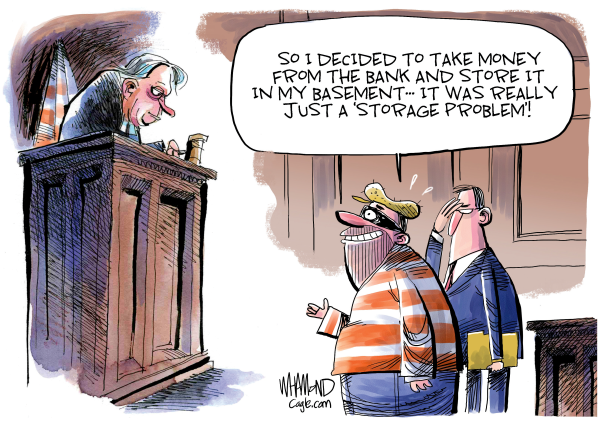
Trump is clearly spooked by the prospect of being indicted for stealing classified documents from the government that owns them, so naturally his instinct is to slime innocent people as a way to somehow absolve himself. Here’s what he tried the other night:
“George H.W. Bush took millions of documents to a former bowling alley and a former Chinese restaurant where they combined them. So, they’re in a bowling alley slash Chinese restaurant… A Chinese restaurant and a bowling alley. With no security and a broken front door. Other than that, it was quite secure. And there was no security.”
His suckers reflexively chuckled, having no clue what he was talking about, but they probably figured that if their grievance god was saying it, then surely it must be gospel. But alas, it was just another grift:
1. When presidents leave office (as the senior Bush did in January 1993), documents are always initially stored in large, converted spaces. Ronald Reagan’s material was initially stored in a former pasta factory. Bill Clinton’s material was initially stored in a former car dealership.
2. The senior Bush did not “take” the documents. The National Archives and Records Administration took the documents, supervised the documents, and sifted the documents to ensure that any classified material would be kept from prying eyes. Ten NARA archivists did that job for three years. NARA did that job for Reagan, Clinton, the junior Bush, and Obama. That’s how it’s supposed to work. Those temporary sites are always NARA-managed facilities.
3. According to the voice in Trump’s tooth fillings, the senior Bush’s documents had “no security and a broken front door.” But here’s what the Associated Press reported on June 26, 1994: “Uniformed guards patrol the premises. There are closed-circuit television monitors and sophisticated electronic detectors along walls and doors. Some printed material is classified and will remain so for years; it is open only to those with top-secret clearances.”
4. Even Trump’s use of the present tense – “they’re in a bowling alley slash Chinese restaurant” – was a quarter century out of date. All of the senior Bush’s NARA-vetted documents have been housed at the George H. W. Bush Presidential Library & Museum since it opened in 1997. Those libraries are always the final resting place, after NARA completes initial work in the temporary warehouses. And by the way, the senior Bush never diverted any documents to his personal residence.
But even if my instinct is to ignore Trump’s rallies, I do hope the Justice Department’s prosecutors are paying attention – because every so often he admits that he broke federal law. (Actually, numerous laws.) From his Sunday freak show: “I had a small number of boxes in storage… They should give me immediately back everything they have taken from me, because it’s mine.”
No, thief. It’s not yours. It’s ours. And can you at least let Poppy Bush rest in peace?
Dick Polman, a veteran national political columnist based in Philadelphia and a Writer in Residence at the University of Pennsylvania, writes at DickPolman.net. Email him at dickpolman7@gmail.com
Comments are not available on this story. Read more about why we allow commenting on some stories and not on others.
We believe it's important to offer commenting on certain stories as a benefit to our readers. At its best, our comments sections can be a productive platform for readers to engage with our journalism, offer thoughts on coverage and issues, and drive conversation in a respectful, solutions-based way. It's a form of open discourse that can be useful to our community, public officials, journalists and others.
We do not enable comments on everything — exceptions include most crime stories, and coverage involving personal tragedy or sensitive issues that invite personal attacks instead of thoughtful discussion.
You can read more here about our commenting policy and terms of use. More information is also found on our FAQs.
Show less