
WESTBROOK — A 180-year-old mural painted by famed Maine artist Rufus Porter could be returning to the city after close to 20 years.
Mayor and Westbrook Historical Society President Mike Sanphy and Economic Development Director Daniel Stevenson are looking for a place to mount the mural, which has been offered to the city by its owner.
Sanphy said he’s looking for a spot easily accessible to the public year round.
The director and curator of the Rufus Porter Museum in Bridgton said the right home for the mural, which she called “absolutely gorgeous,” is in Westbrook.
“If (it) could be brought back to Westbrook, to my mind, that would be ideal because it’s part of Westbrook’s history,” Caroline Grimm said.
The mural depicting Portland Harbor dates back to the 1830s and was painted on the four walls of a room at the old Trickey Farm at 649 Saco St. When the farm property sold, the house was purchased, dismantled and relocated. A Massachusetts art collector bought all four sections. The house, Sanphy said, was never reconstructed and is in storage in Falmouth.
The house was one of the oldest in the city. The property, which included a working farm, was home to the Trickey family from the 1700s until 1906. In 1911, Frank Chick purchased the property and lived there for close to 50 years, selling it to Alphonse Boivin in 1960. Boivin, who died in 1999, was the last occupant of the house. Victoria Drive and The Hamlet are now located on the site.
Wayne Chick, who was a teenager when his grandfather sold the farm, said the mural was in a hardly used back room, which they called “the painted room.” The room was thought to be part of the original farmhouse.
The mural was painted during a time when Porter, a noted artist and inventor, traveled throughout New England painting murals at inns and residences.
The current owner, who prefers to remain anonymous, had offered the mural to the Porter Museum in Bridgton, where the artist lived for a time as a youth. The museum didn’t have room for it.
“We already have a few murals in storage,” Grimm said.
Chick said it was during a visit to the museum that he heard about the owner’s offer, and through the description realized it was the mural that had graced his grandfather’s dairy farm. Chick said he knows the farmhouse’s mural was painted by Porter because it features a man in a top hat on a sailboat, a signature element of Porter’s paintings.
Grimm said it is difficult to put an exact value on the mural.
“I have documentation about the Trickey murals from 2002 from an auction house that states a number of buyers were interested at $75,000-$100,000, but that the owner had paid more than that and so wasn’t interested in selling at that price,” she said.
Sanphy and Stevenson are working to find a display site, but where that will be is up in the air.
Sanphy had considered the Walker Memorial Library as a “good, safe space,” but Library Director Rebecca Albert said she told Stevenson there’s no room in the space first-floor space. She said she’s optimistic a site can be found.
Sanphy said he doesn’t want the mural in a school because access to the public would be limited during summers and vacations. He also said he’s trying to fund the project through private donations and grant funding so as to not rely on taxpayer money.
Chick said once a location is secured, he would like to donate his great-grandmother’s flax wheel and fireplace irons made by his grandfather. Both items were in the painted room.
Porter was one of the most noted muralists in the early 19th century, creating murals in homes and businesses all over New England, including the former Chase Tavern in Buxton, which now is home to RHR Smith & Company, an accounting firm.
According to the museum, “from about 1825 to 1845, Rufus Porter along with his son Stephen Twombly and his nephew Jonathan D. Poor, traveled around New England painting wall murals in people’s homes. These murals depicted landscapes of classic New England scenes, painted using a scientific approach developed by Porter.”
Between 1940 and 1980, Jean Lipman documented more than 100 homes that had Rufus Porter paintings.
“Rufus Porter’s mural paintings, like his inventions and his scientific journals, were pioneer products, far ahead of their time,” she wrote in her 1980 book “Rediscovering Rufus Porter.”
“They represent our first native landscape school, and are among the most original and important artistic achievements of 19th-century America. It is imperative to save them from destruction now and to ensure their future preservation.”
Michael Kelley can be reached at 781-3661 x 125 or mkelley@keepmecurrent.com or on Twitter @mkelleynews.
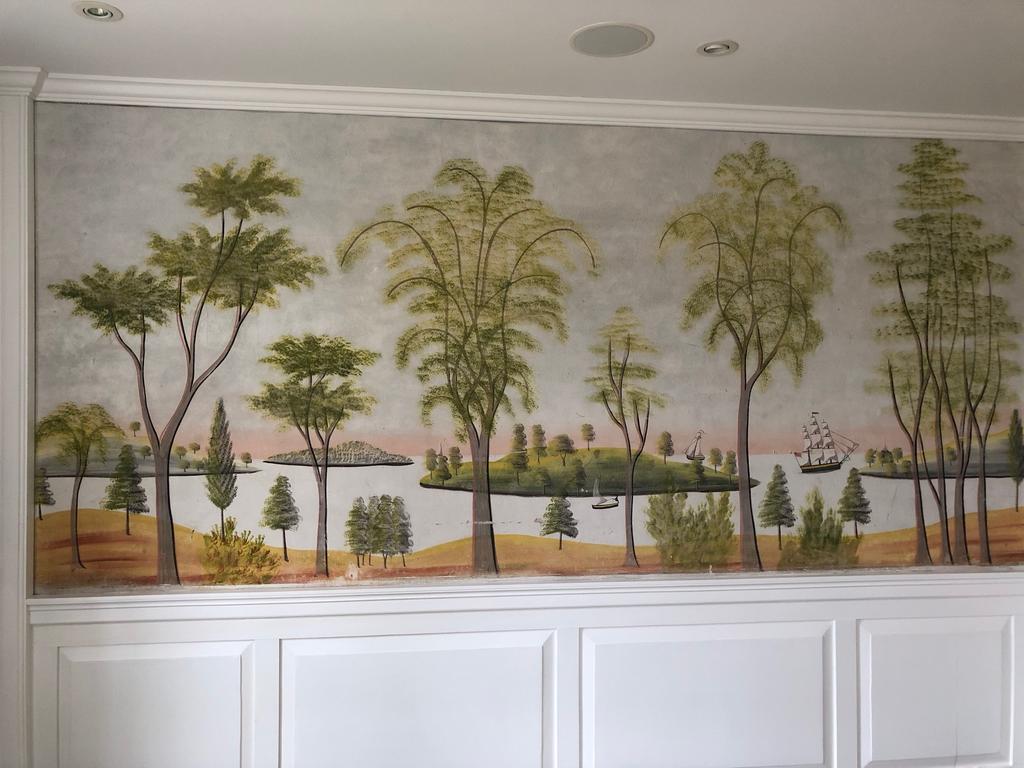
An 1830s Rufus Porter mural of Portland Harbor that once covered the walls of a room at the Trickey Farm on Saco Street has been offered to the city.
Comments are no longer available on this story