
AUGUSTA – Two groups looking to secede from the town of Gray were dealt a setback this week when a legislative committee voted overwhelmingly against bills that would allow them to proceed with the secession process.
The Committee on State and Local Government voted 11-2 to recommend that two legislative resolves, LD 618 and LD 619, “ought not to pass” when they go before the full Legislature. The resolves would allow the Gray Secession Committee and the smaller Mount Hunger Shore Secession Committee to move forward with referenda to gauge local support for their proposals.
The resolves now will go to the full Legislature for a vote, but the strong committee vote against them indicates that approval there is unlikely.
“The committee didn’t really address the process, the legal process of which the Legislature had set forward. They were more interested in throwing their opinion about whether they liked or disliked the whole ideal,” said David Getchell, vice chairman of the Gray Secession Committee. “Their own counsel, their analyst, sat right there and told them, ‘these are the steps, and you are now in charge of this next step,’ and they really neglected that, and that’s our take on it.”
“But we’re not going anywhere, just to let you know,” added Jennifer White, the chairwoman and spokesperson of the Gray Secession Committee. She acknowledged that the odds of the resolves being passed by the full Legislature were slim, but said her group has a plan B, which she declined to elaborate on.
The Gray Secession Committee wants an area of about 2.8 square miles west of Little Sebago Lake, which they say includes about 160 residential households, to become part of Raymond. The Mount Hunger Shore Secession Committee wants a smaller, approximately 194-acre area also on the west side of the lake to become part of Windham.
Though they hope to secede to different towns, the two groups share many of the same concerns and stated reasons for wanting to leave Gray. Those include a feeling of geographic disconnection from the center of Gray, concerns about access to public safety services and long bus travel times for schoolchildren. The larger group wants to join Raymond, and the Mount Hunger Shore group wants to join Windham.
Town officials and other residents, however, oppose secession and have expressed interest in addressing concerns at the local level.
The State and Local Government Committee heard arguments from both sides during a March 27 public hearing, which informed their vote this week.
“We’re in a position right now in our state, where we should be looking to regionalize … get together and try to see what we can do about sharing services with other towns,” Rep. Richard Pickett, R-Dixfield, who supported the motions to defeat LD 618 and 619. “I think that’s the spirit of what we need to be doing in the state, that’s my own personal opinion, and therefore because of that, I have a real difficult time voting for part of a town to secede from a town.”
Rep. John Spear, D-South Thomaston, was one of two committee members that opposed the motions to defeat the resolves. He said that he would like the process play out further to see more details.
“I felt that these folks are not looking to create a new town, they are simply looking to join a another town where they feel a stronger sense of community,” Spear said. “This is really a very beginning step in the process, and I understand that the boundaries were there since almost 1735, but things do change with time. And I really got the sense that these folks are not chasing mil rates. They’re looking for a sense of community and where they belong.”
Rep. John Madigan, D-Rumford, said that he felt the Gray town officials had demonstrated a willingness to address some of the issues raised by the secession groups. Madigan voted for the motions, essentially opposing the secession efforts moving forward.
“I felt very strongly that the municipal officials that were here testifying from Gray showed that they had attempted to resolve some of these issues. The mere fact that they are able to go in there and plow what are really private roads by means of a legal easement is really above and beyond what most municipalities would be willing to do,” Madigan said.
Madigan was referring to agreements the town has with local residents to help provide plowing services on private roads through a public easement signed by the homeowners. Several committee members seemed surprised by those arrangements.
“The biggest problem I see that the petitioners testified on is education and their access to schools. I read some testimony where there’s been no effort recently to meet with the new superintendent of schools. I think that if they made an effort to meet with the superintendent, and address their issues there, that is an option that they should pursue,” Madigan continued.
Gray Town Attorney Bill Dale provided an update on the committee’s work session during this week’s town council meeting, and said it was “likely” that the full Legislature would follow the committee’s recommendation of “ought not to pass” for the secession resolves.
“I think a lot of the senators and representatives in Augusta see the increasing burden on local taxpayers for local government services. That seemed to be, I thought, a big point for the committee members: that we ought to be talking about joining together, not breaking apart,” Dale said.
Matt Junker can be reached at 781-3661 ext. 123 or mjunker@theforecaster.net. Follow him on Twitter: @MattJunker.
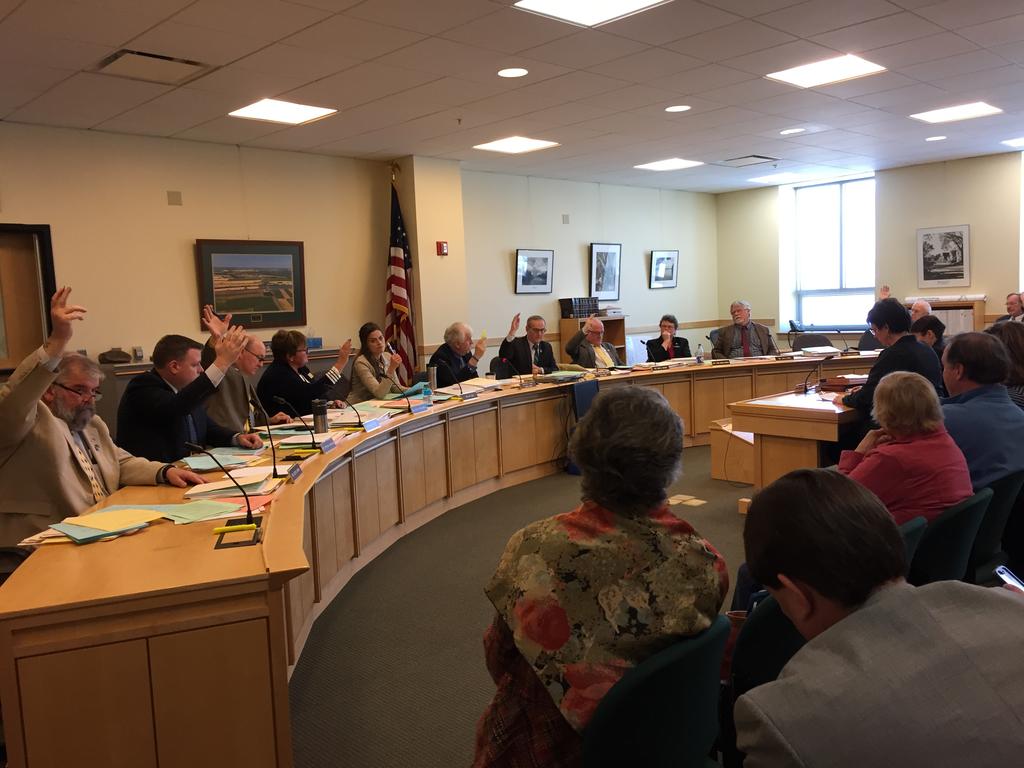
Members of the Committee on State and Local Government vote overwhelmingly in favor of a motion recommending that one of two Gray secession legislative resolves “ought not to pass.” Both Gray secession resolves received that same recommendation, which mean the two Gray secession groups face long odds in Augusta.
Comments are no longer available on this story