
Freeport Town Manager Peter Joseph and representatives of the Island Rover Institute will confer within a week or so, to begin the process of ironing out a new agreement for removal of the giant schooner from its Freeport construction site, followed by a launch.
Joseph said that the Town Council on Oct. 18 authorized him to negotiate a new agreement with the Island Rover Institute, which owns the 113-fot steel topsail schooner, Island Rover, that Harold Arndt began building on Bucknam Road two decades ago. The council already has granted the foundation three extensions of a 2007 deal that the boat be finished and removed from the property. Freeport resident Carter Becker has offered to build a launch on property he owns on nearby Shore Road, but neighbors have objected to a permanent launch there, and the Town Council has decided against that proposal.
“The major part of that was whether or not to restrict launching of the vessel from Shore Drive, which residents are concerned about,” Joseph said. “Any agreement cannot include a launch on Shore Drive. That’s the major change.”
When Arndt made the move to a nonprofit in the early 2000s, Island Rover went out of compliance with the town’s zoning laws for a residential neighborhood. In September, Maine Superior Court approved a consent agreement that gives the town the ability to automatically take the title to Arndt’s property and the boat because he didn’t meet a final Sept. 9, 2016, deadline to launch it.
Joseph said he will work with Island Rover Institute officials on another deadline to remove the boat and get it launched. Most councilors favor a new deadline of a year or less, he said.
Constructed from surplus naval shipbuilding materials, the Island Rover will be used by the foundation as a platform to facilitate educational programs for youth.
Tom Godfrey of Pownal, executive director of the Island Rover Institute, said last Friday that he and other foundation members have looked at several alternative launch sites.
“Shore Drive was the latest, but the neighbors were uncomfortable with that,” Godfrey said.
Road conditions are one obstacle to moving the 200-ton boat, and the cost a moving the vessel 26 feet high from keel to deck, are another, Godfrey said.
“There are limited windows when you are taking something that heavy down the road,” he said. “The road has to be dry or frozen. The boat launch site could raise the ante on fundraising. Going three to four miles down the road instead of a quarter mile adds up. You must drop cables and put them back up, because the boat is much higher than the standard 14 feet of wires crossing the road. Companies such as (Central Maine Power Co.), Fairpoint and Comcast would have to drop their wires and put them up, at some expense. That’s the most dramatic and obvious expense.”
As for a launch site, the institute has identified options, Godfrey said. But still, the boat would need to cross private property. A temporary launch – more suitable to people living nearby – is possible in some locations, he said.
“We have no set alternative plan at this point,” he said.
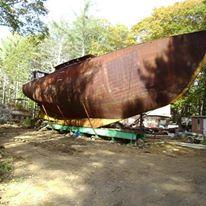
The town of Freeport and the Island Rover Institute are entering into new discussions toward an agreement to move the boat.
Comments are no longer available on this story