
John Mann, chairman of the Maine Ulster-Scots Project, and Pam Crane, a historical archaeologist with Crane and Morrison Archaeology of Freeport, will present a program on 18th-century Scots-Irish settlers on Thursday, Oct. 20, at the Freeport Community Library. The presentation, sponsored by the Freeport Historical Society, begins at 7 p.m.
“Lost Colonies and Fading Footsteps; An Archaeological Investigation of Ulster-Scots on the Maine Frontier” will feature ongoing archaeological work and research in the local area related to 18th-century Scots-Irish settlers. Such family names as Anderson, Armstrong, Mann, Means, Patten, Rogers, Dunning, Chase, Jamison, Campbell, Hewey (Huey), Phinney, Martin, Given and McKeen are among those who settled the area.
Mann, a Bowdoin resident who grew up on Wolfe’s Neck in Freeport, is the author of “Ulster-Scots on the Coast of Maine, Volume 1, The Means Massacre, Background & Location.” He and Crane are working with he Maine Ulster Scots Project to find more information on the lives of Scot-Irish settlers on the coast of Maine. The Maine Ulster Scots Project was organized in 2005 to commemorate the 250th anniversary of the Means’ Massacre on Flying Point. The organization is working on a symposium to coincide with the 300th anniversary of the first settlers to arrive in 1718 from the North of Ireland.
Mann, a professional land surveyor and historian with the Saint Andrews Society of Maine, is a descendant of the Thomas Means family. He and his wife, Val, moved to Bowdoin in 1979, and raised three children on their small family farm.
He answered questions on the Scots-Irish settlers and their history, as well as the Means Massacre, for the Tri-Town Weekly.
Q: Where did most of the Scots-Irish settlers locate, and when?
A: The majority of the Ulster-Scots, also referred to as Scots-Irish or Scotch-Irish, began arriving in large numbers in 1718 and continued arriving into the 1760s. They arrived first in the Falmouth and Brunswick-Topsham area, but were soon occupying land along Maine’s coast from Biddeford to Belfast and beyond. During these years the Ulster-Scots became the dominant culture in what is now Maine’s midcoast region. The mass influx of people looking for homestead land after the close of the French and Indian War and after the American Revolutionary War eroded that cultural dominance. Much of the information regarding the Ulster-Scots in Maine has not been thoroughly studied or written about until just recently.
Q: How will the documents be useful?
A: The goal of the Maine Ulster-Scots Project is to save and share the stories of Maine’s Ulster-Scot families. Finding and preserving documents, stories and artifacts of daily life during the Colonial period helps to expand our knowledge of who these people were and how they influenced and adapted to their new American environment. It also helps create a central archival location for people seeking information about their ancestors. Through the saved research, descendants and academics can inquire, receive data, and share their own family stories for the benefit of others.
Q: Maine Ulster Project was organized in 2005 to commemorate the 250th anniversary of the Means’ Massacre on Flying Point in Freeport. You wrote of it in your book “Ulster Scots on the Coast of Maine, Volume 1. The Means Massacre, Background and Location.” Can your summarize that event?
A: At the onset of the French and Indian War, several Ulster-Scot families, closely associated with the larger settlement in Brunswick, had purchased land at Flying Point and were busy clearing land, building houses and raising families. Thomas Means, his wife and three children had purchased land at Flying Point, cleared several acres and built a small home. Thomas Means and a helper named Martin were busy at farm chores. Thomas’ wife Alice was busy raising three small children with the help of her visiting sister, Molly Phinney. Means and other landowners in the area of the Kennebec River had expressed concern for their vulnerability to Indian attack to the Massachusetts General Court. He relocated his family to Flying Point, further away from the Kennebec River and closer to the protection of a Block House at lower Flying Point. Despite these attempts at securing his family, in the early morning of May 10, 1756, the Means family was attacked by an Indian raiding party looking for hostages to transport to Quebec, where there was a lucrative market for New England captives. In the resulting confrontation, Thomas was shot and scalped. His infant son Robert was shot and killed while still in his mother’s arms. The sister, Molly Phinney, was taken captive to Quebec. One of Means’ daughters was also initially captured, but managed to escape when Martin fired on and wounded one of the Indians. Mrs. Means, after assessing the damage and discovering her two daughters had escaped capture, moved her reduced family to the Block House nearby. There, a few months later she delivered a son, Thomas Means Jr., who would become an important figure in the American Revolutionary War and a leading citizen in the future town of Freeport. Molly Phinney was rescued from Quebec by a leading Ulster-Scot citizen of Falmouth, William McLellan, whom she would later marry. The Means’ story is representative of the various struggles and successes of the numerous Ulster-Scot families throughout the former District of Maine. The Maine Ulster-Scot Project is trying to find and preserve as many of these stories as possible before they are lost.
Q: You are a descendant of Thomas Means. How far back is that in your family tree, and when did he live? What did he do?
A: Thomas Means’ precedes me by about seven generations. He lived from 1723 to 1756. His parents arrived in Falmouth harbor in 1718. Thomas Means and his son Robert are buried at the First Parish Cemetery on Maquoit Road in Brunswick near the home of his wife’s family, the Phinneys. His wife remarried Col. George Rogers and is buried at the Flying Point Cemetery.
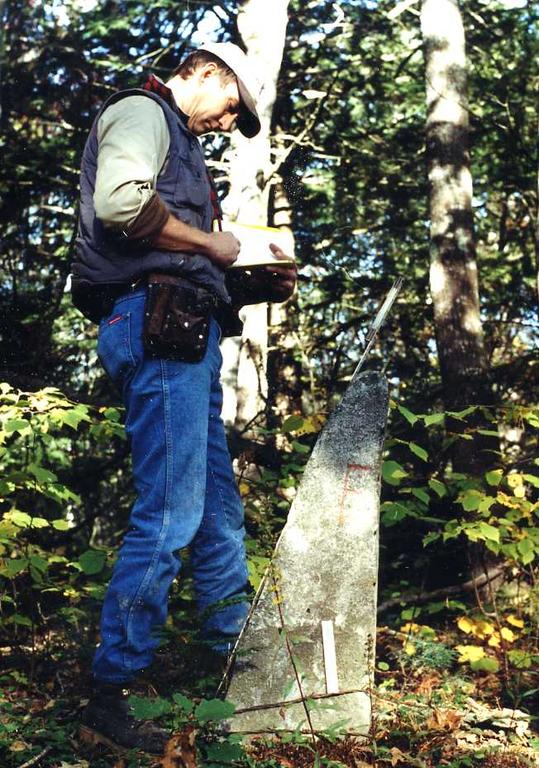
John Mann of Bowdoin, an expert on the Scots-Irish settlers of the midcoast area, will join historical archaeologist Pam Crane in a presentation scheduled for 7 p.m. on Thursday, Oct. 20, at the Freeport Community Library.
Comments are no longer available on this story