
A summer resident of Higgins Beach, poet and retired Harvard professor David McCann will host two poetry sessions at the Scarborough Public Library next week.
The first event is a reading from McCann’s latest book of poetry, “Same Bird.” The second is a poetry writing workshop for those interested in learning more about the art form.
McCann is a recognized expert on the Korean form of poetry, called sijo, which is a counterpart to the Japanese poetry form of haiku. He started teaching at Harvard in 1997 when he became the school’s first Korea Foundation Professor of Korean Literature.
For most of the year McCann and his wife live in Watertown, just up the Charles River from Boston, but their summers are spent a cottage on the beach where McCann said, “I love to just go out and sit on the front steps in the morning and see what the beach and the water and the waves and the sky lead me to write.”
He has two grown children and three grandchildren and met his wife while they were both working for the Peace Corps in Korea. He’s written seven books of his own poetry and collaborated on eight books of poems by modern Korean poets. McCann has also done an anthology of modern Korean poetry and a collection of pre-modern Korean poetry with interpretive essays.
He spoke with the Current recently about his love of poetry and why it can be enjoyed by the masses and not just the intellectual elite.
Q: How and why did you first get interested in Korean sijo?
A: I was in Korea with the Peace Corps back in 1966 and teaching English at a high school down in the countryside. At that time, I got very interested in 20th-century Korean poetry, especially the poet Kim Soweol, who was known as “the folksong poet” for the shape, rhythms and subjects of his poems. After two years in Korea, I went to graduate school at Harvard and discovered that sijo is one of the traditional verse forms that modern Korean poetry is based on. I had done many translations of such poems, but only began to write sijo when I started teaching a new course, called Writing Asian Poetry.
In that class I offered classical Chinese, the haiku and then the sijo, with the participants writing their own poems following those forms and practices. One day I was sitting in a favorite restaurant in Harvard Square and just grabbed a napkin, took out my pen and wrote a sijo in English about the lobsters in the tank by the door. I kept at it over the next year or two, and eventually a collection of my sijo poems, “Urban Temple,” was published by Bo Leaf Books in 2010.
Q: Can you describe sijo and what makes it special?
A: The sijo is sort of a counterpart to the Japanese haiku. It’s longer, and written in the more vernacular language, rather than the more ruling-class, classical Chinese. The haiku, as most everybody knows, is very brief. The sijo, with three lines and a sort of twist in the third line, gives a little more room for the poet to maneuver. Here’s an example of a sijo poem, from the 16th century. It’s by a scholar-official named Cheong Cheol, and from a time when the Confucian government and its officers were pushing very hard against Buddhism and its influences.
“A shadow falls into the water.
A monk is crossing over the bridge
‘Hey you monk! Stop right there!
Let me just ask, Where are you going?’
With his staff he just points at the white clouds
and keeps on his way, not turning to look back.”
In the first line, there’s the movement, looking down to notice the shadow, then turning to look up at the bridge where the monk is crossing. The second line is like a voice recording from centuries ago, the Confucian scholar-official calling out that monk. But then the third line handles the challenge, as the monk keeps on his way.
Q: What form do your own poems take?
A: My own poems seem to use a variety of forms – the Korean sijo, the Japanese haiku and the Chinese classical quatrain. Most of my poems seem to just evolve and are not created from a choice of form or even subject that I consciously make. I have also written sonnets and other English-language forms. But my poems usually seem just to take shape themselves, sort of the way the clay on a potter’s wheel takes shape as it spins.
What I also like is the way a poem might seem to be about one subject or another, but then the reader can pour into it their own sense of its meaning. I often do that as a translator of Korean literature, when I see other meanings in Korean poems that have been treated as being about a specific event or situation in Korean history that I may not have any personal connection with.
Q: In terms of writing poetry do you have a favorite style or topic?
A: These days, I seem to write a lot about Higgins Beach, where our family has summered for five generations. I’m also working on a sequence of poems about the trip my wife and I made to Spain in April. And, I seem to still be trying to come up with some sort of haiku answer to the Japanese poet Basho’s poem about the pond: “Old pond/frog jumps in/the sound of water.” I haven’t come very close yet, although my new collection of poems has a section of haiku, which I like pretty well.
Q: What would you tell people about reading poetry?
A: There’s all kinds of poetry out there, from so many different languages, so many different poets, so many different times and places, that it can be a bit daunting. When I want to read poetry, I tend to just grab one and have a look, and maybe a poem will catch me. Another trick is to ask friends if they’ve found poems or poets they like to read. But my best advice is to just keep browsing.
Q: And about writing poetry?
A: Just go for it. Then let it sit for a bit, and read it out loud. Find some friends you could ask to take a look, and listen to what they say about it. Start a poet’s group, and get together a couple of times a month to read and talk about your own poems, or poems by others that you like. I’ve found that writing poetry is totally natural and a lot of fun.
Q: Is this workshop and reading something you enjoy and do often?
A: I’ve done a number of workshops over the years and it’s fun to help people explore the haiku and sijo forms of poetry. I also like to feel the energy when folks read their own poems, the ones they’ve just written in the workshop. It serves to reminds me of how poetry is something that’s alive. It’s like a cup or a glass. Fill it up, and somebody say ‘cheers.’
A closer look
The Scarborough Public Library will welcome poet David McCann for two sessions. A poetry reading will be held at 6:30 p.m. on Wednesday, Aug. 24. The second, a poetry writing workshop, will be held at 6:30 p.m. on Thursday, Aug. 25. Pre-registration is required for the workshop. Call 883-4723, ext. 4, or email askSPL@scarboroughlibrary.org to sign up or for more information.
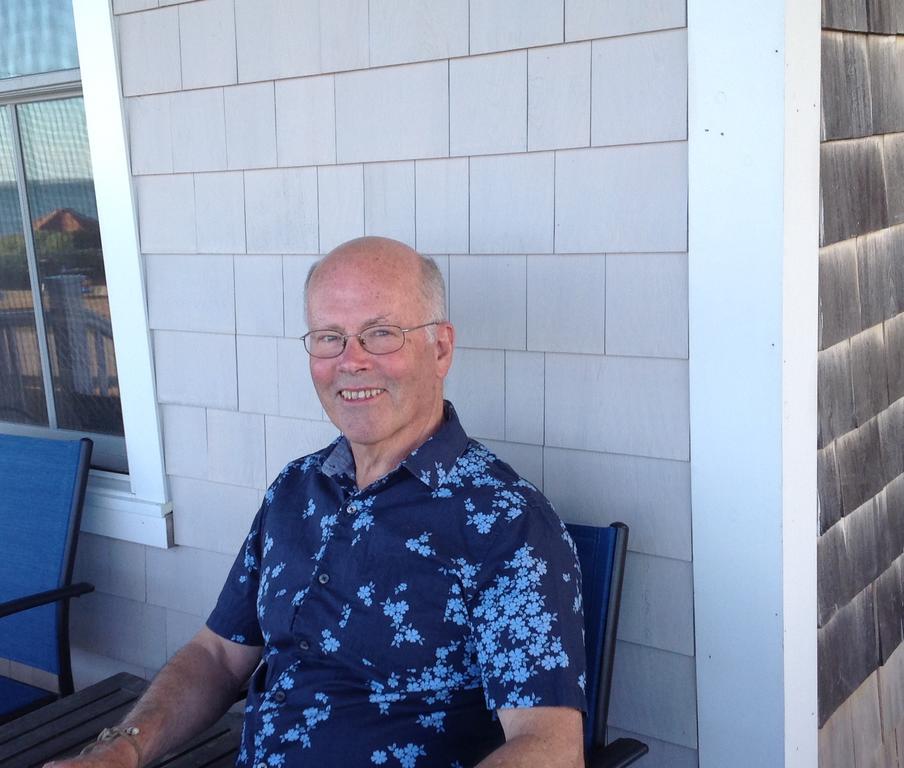
“These days, I seem to write a lot about Higgins Beach, where our family has summered for five generations,” says David McCann, who is giving two workshops next week at the Scarborough Public Library.
Comments are no longer available on this story