
Sara Randall, a Freeport native and environmental consultant, will speak from 6:30-8 p.m. Wednesday, Nov. 18, in the latest installation of the new Wednesday Wisdom series at the South Freeport Congregational Church. Randall will give a speech titled “The Tides of Change: How Climate Change and Development is Impacting Freeport’s Marine Resources.”
Randall has worked with Brian Beal, a University of Maine at Machias ecology professor, in an effort to determine ways to protect the area’s shellfish resource from predation. She grew up along the banks of the Harraseeket river in South Freeport and attended Freeport public schools. After graduating from college, she moved to Lake Tahoe in northern California. A short time later, Randall joined the AmeriCorps Watershed Stewards Project and worked on watershed restoration and education on a remote reservation in Mendocino County on the Eel River.
She then moved to San Francisco and became the director of programs for the fishermen-led nonprofit Institute for Fisheries Resources, where she oversaw the institute’s programs to protect and restore commercial fish populations and healthy aquatic habitats.
After moving back to Maine in 2011, Randall obtained a graduate degree in international environmental policy from the University of Maine. She moved back to Freeport in 2013 and works as a consultant specializing in identifying, understanding and providing solutions to marine environmental and social challenges.
Randall recently won election to the Freeport Sewer District Trustees. She answered questions on the topic of her talk at the church, and her work, for the Tri-Town Weekly.
Q: In a nutshell, how are climate change and development affecting Freeport’s marine resources?
A: Climate change is causing our waters to warm. A recent study published in Science Magazine finds that over the last decade the sea surface temperatures in the Gulf of Maine have increased faster than 99 percent of the world’s water bodies. Locally, these increased water temperatures have resulted in higher predation rates on our shellfish populations. For example, the invasive European green crab, a predator originally from the Mediterranean, thrives in warmer water. Nowadays, much of Casco Bay’s juvenile shellfish are consumed long before they ever reach a harvestable size. Continued development in Freeport has put an increasing strain on water quality due to increased contaminants found in run-off. Additionally, increased shoreline development has eliminated many points of traditional land-based access to vast stretches of our coastal waters.
Q: What’s the best way to combat the devastation green crabs are having on soft-shell clams?
A: The best way is to shift shellfish management methods toward protection of juvenile shellfish populations. For example, using protective netting or cages to shield juvenile shellfish from predators.
Q: Tell us about your work with Brian Beal and what you learned.
A: For the past two field seasons I have worked as the local scientific coordinator for the Downeast Institute for Applied Marine Research & Education’s Freeport soft-shell clam experiments. These experiments are a series of large-scale field trials set up in Freeport coastal waters to examine the effectiveness of different methods to protect shellfish from green crabs and other predators, and how to restore soft-shell clam populations. In 2014 we had six separate experiments set up at eight different sites and this past year we had seven different field trials at 34 different sites. Both years we conducted green crab trapping in the Harraseeket River and raised seed clams in an upweller at the town wharf. We’ve learned many things from the field trials. One key finding is that there is still clam spat settling on our intertidal areas, and the problem is that they aren’t surviving to harvestable size due to predation.
Q: The Freeport Shellfish Conservation Commission worked for many months to come up with a proposal for an amendment to the town’s shellfish ordinance to create town-leased clam flats. How will this help the local clam harvester?
A: I have worked closely with the Shellfish Commission on several issues including conducting a scientifically accurate stock assessment using the core sampling method, as well as a comprehensive overview of Casco Bay shellfish programs, which included recommendations on how to transition already existing resources to better meet the needs of modern shellfish management. However, I was not involved in the drafting of the proposed leasing ordinance that the Shellfish Commission approved. In general, I do support the concept because it helps transition shellfish management toward protecting juvenile shellfish.
Q: How could clam farming be a game-changer?
A: I see “clam farming” as a management tool for municipal shellfish management – programs to use to combat the declines in productive shellfish acreage. Adapting shellfish-management programs to the changing environmental conditions is essential for the long-term survival of viable soft-shell clam populations.
Q: Congratulations on your election to the Freeport Sewer District Trustees. How can the sewer district be a good neighbor to people making their living in the mud flats?
A: Maine’s fishing families depend on clean water, and the sewer district plays a very important role in keeping our local coastal waters clean. The sewer district provides and maintains an infrastructure that we as citizens rely on to protect local water quality and community health. It’s basically the environmental nerve center of the town and I’m very happy to have been elected to serve as one of its trustees.
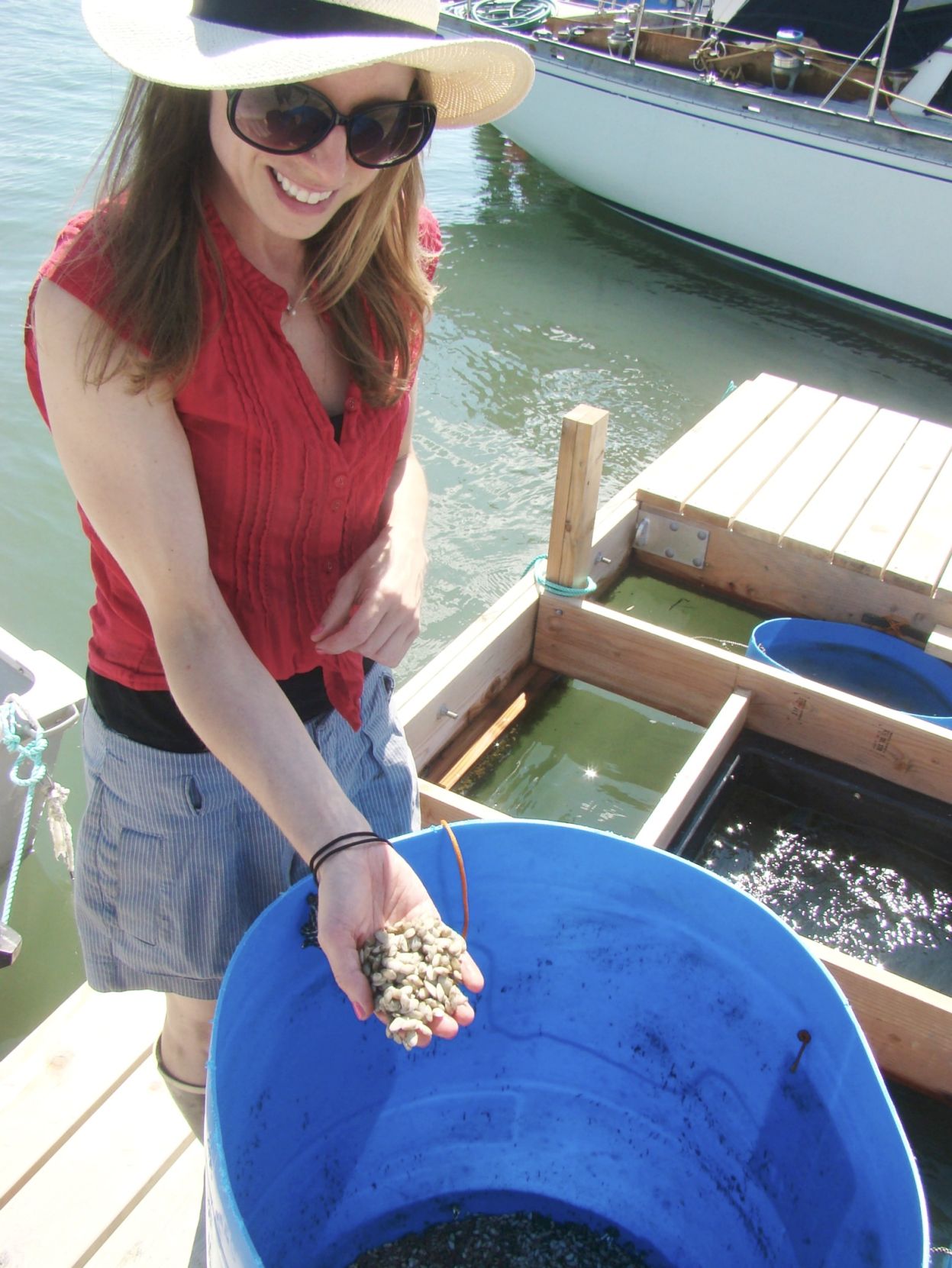 Sara Randall lifts baby clams from an upweller, or growing tank, at the town wharf in South Freeport.
Comments are no longer available on this story