
There are big changes at Westbrook High School, which is forging ahead with a new curriculum model.
In Amy Troiano’s sophomore honors biology class last week at Westbrook High School, students wore bright-colored goggles, poured various substances – including blended liver – in and out of glass beakers, and recorded the results.
The classroom atmosphere appeared no different from years past, but the way students were being evaluated for their work was. Troiano’s students were all working to fulfill their “structure and function” standard within the Next Generation science standards. In order to be deemed proficient in the standard, students must show they know the material in a variety of ways, which in this case means graphing data, completing lab reports and creating models.
Troiano says her students know exactly what is expected of them.
“Where in a traditional system they might just get points for different aspects, here there’s a rubric that says ‘if your lab report looks like this, you’ve met the standard. If you do this, you’ve gone beyond,’” she said.
While the Westbrook School Department has been rolling out what is called “proficiency-based education” for several years, this year’s freshman class, the class of 2019, will be the first in Westbrook to graduate with proficiency-based diplomas. With the changes come growing pains in and outside the school.
Other area high schools are also in the midst of switching to the proficiency-based model, including South Portland and Gorham.
In 2012, the Maine Legislature passed a law requiring Maine schools to award diplomas based on proficiency of the Maine Learning Standards, which are achieved through locally determined learning standards. This means that Westbrook developed its own specific standards based on the state’s requirements.
When the law passed, it was designed to be enacted for the class of 2018, but the Maine Department of Education allowed school districts to request extensions through the class of 2020. Westbrook initially requested the extension, but decided to enact the model for this year’s freshmen class.
With the new system comes a new grading system that has caused confusion with parents – a problem not unique to Westbrook.
Peter Lancia, Westbrook School Department’s director of teaching and learning, said recently that the most common question from parents is: “Where is my kid in comparison to other kids?”
The grading scale used within the proficiency-based model is a big change from the traditional letter-grade scale.
Westbrook, as well as other districts, uses a 4-point scale of proficiency – 4 for “advanced,” 3 for “proficient,” 2 for “partially proficient” and 1 for “needs improvement.” Lancia compared the scale to the GPA system used in college. In Westbrook, grades 10-12 still use the letter grade scale for now.
“Rather with comparing with the rest of the class, you’re really comparing with yourself,” he said.
He used the example that if a student is getting a 2.2 after the first quarter, there’s no need to panic. However, he said, if a student is still at a 2.2 in March, some extra instruction, or “intervention,” is needed.
The proficiency-based model is also relatively new to school staff, meaning there’s still a learning curve for teachers and administration. For Lancia, this means how to best communicate to parents how the system works.
In response to parent concerns, the school department has designed a more in-depth report card for students and parents. The district is also using new grading and report card software. Lancia said the report card uses gray boxes to better show where the student is and should be by the end of the school year. The school department is planning public meetings for parents in order to discuss grading.
Lancia has created a section of the school department’s website with dozens of documents about Westbrook’s proficiency-based learning model, including snapshots of the specific standards for each grade. He said he plans to add short video explainers on the site soon.
There have also been questions from parents about the standards themselves.
“Some of the standards are pretty challenging,” Lancia said. “Kids are being asked to think more deeply than they have in the past.”
Under the standards-based model, students follow a continuum beginning in kindergarten and culminating in 12th grade, adding levels of complexity as they meet proficiency targets throughout the grades.
Lancia recently used the example of mathematics in describing the continuum. In Westbrook, under the mathematics subject area, there are five standards – number and quantity, algebra, geometry, statistics and probability, and functions.
“We teach algebra starting in kindergarten, all the way through high school,” he said. “It looks different, but the same standard is there. In order to graduate from high school, kids have to show proficiency in all five of those areas.”
According to the Westbrook School Department website, standards are written for the subject areas of English Language Arts, Math, Science, Social Studies, Modern and Classical Languages, Visual and Performing Arts, Health and Physical Education, and Career Preparation. Also included are standards for the “Guiding Principles,” which include standards such as “a responsible and involved citizen” and “Habits of Work,” standards based on factors such as assignments completed and attendance.
Westbrook’s learning standards are aligned with Maine’s Learning Standards, which follow the Common Core state standards in English and math, the Next Generation science standards in science, and Maine Learning Results in the other disciplines.
Lancia added that most of the challenges with the system have come from being so new. But students, he said, are picking it up more quickly now that the department has had more time to roll it out.
A big proponent of not further delaying the shift in Westbrook was longtime School Committee member Alex Stone, who also serves as chairman of the district’s Educational Programming Committee.
Stone said recently that a lot of the confusion surrounding proficiency-based learning is its association with the Common Core, which became a divisive political issue. Stone said the core standards – made law by the federal government – have shaped the learning outcomes, but don’t dictate how individual states or school districts decide how to get there.
Stone, who has been on the School Committee for eight years, said in the past, Westbrook’s test scores have caused him to question teaching methods in the district.
“With this, we can say, ‘This is the standard that we’re not doing well, let’s figure out a way to teach that better,’” he said.
When the proficiency-based model was first rolled out, Stone said, he wasn’t a fan.
“They had to make me understand it,” he said, adding that he kept an open mind – something that he hopes parents, and even teachers also do.
However, he said, he knows there are still issues, including the report card system.
“Once it’s tweaked a couple more times, I think it will be better,” he said. “I had the same concerns though. I know this information and I look at the progress reports and say, ‘What does this mean?’”
Stone, who also has children in the district, said that parents should be able to “supplement” what the student is doing and in order to do that, need to fully understand the standards, the grading and report cards.
In Troiano’s classroom last week, students were conducting a lab to look at how cells maintain homeostasis. One student was placing blended pig liver into a beaker.
Troiano, who lives in Westbrook, began teaching in Poland, which was one of the first districts to adopt the standards-based model. Moving back to Westbrook, she said, she had to relearn the traditional model before switching back again.
“At first I was relieved,” she said, referring to the ease of grading assignments in the traditional 0-100 scale.
While Troiano said standards-based teaching is more work for the teacher, she quickly saw the difference in students.
“You’re looking at each student and asking, ‘Does all this evidence in front of me prove that the student met this standard?’ It’s not just crunching numbers,” she said.
Lancia said parents are also concerned about how colleges view the new model.
“Colleges are telling us they get transcripts from around the world, and they take every transcript and evaluate it individually,” he said, adding that each college will receive a clear description of what a diploma from Westbrook High School means.
In Gorham, Superintendent of Schools Heather Perry said the school department still has a long way to go toward fully implementing their system. She said they have not yet made concrete plans on how they will report grades, but Gorham’s elementary schools have already been using the 1-4 scale.
“We need to spend time talking with parents and community members about what we want our (proficiency-based learning) system to do for our students, what we want it to look like, and feel like, and what we want our ultimate outcomes to be for our learners,” she said in an email.
Perry said the need for an updated system stems from the fact that the world has changed.
“Gone are the days when you needed to memorize lists of information,” she said. “Welcome to the world where everyone has a smartphone and can simply Google most information.”
In Westbrook, Troiano said some teachers are still getting used to the system, but for some younger teachers, the proficiency-based model is all they’ve ever known.
Brian Adams, a math teacher at Westbrook High School, received his teaching certificate from the University of Southern Maine in 2013.
“I’m a big proponent of proficiency-based learning because I believe the model pushes students to become accountable for their own education,” he said in an email last week. Adams said the grading system allows students to “reassess previous mistakes.”
“Rather than giving a student a 70, we give them a 2.0 (or Approaching Proficient), and then we ask them to make that grade up to the 3.0 (or Proficient Level),” he said. “By doing this, we are ensuring student comprehension.”
Adams said a common misconception with this model is that “education has become completely individualized and ‘self-paced.’”
“That is not the case,” he said. “Instead, my colleagues and I are working toward creating an atmosphere where students truly own their own education. We are trying to teach students that Approaching Proficiency is no longer good enough, and they must independently seek out support and feedback to reach that Proficient level in all of their classes.”
Lancia said that because students can demonstrate their proficiency in multiple ways, some avenues will work better for different students. If a student bombs a test, he said, they can’t simply forget it and move on.
“They have to have a re-assessment plan,” he said. “They’ll have to keep going back to it, and it could be in multiple ways.”
The ability to have a re-assessment plan leads to some confusion, Lancia said, which includes rumors that students can’t receive a zero on an assignment. That rumor, he said, is untrue, because passing in assignments, attendance, tardiness and other factors are included in the “Habits of Work” standard.
Allowing for students to tackle a subject in multiple ways also puts some added pressure on teachers. Troiano said it may take more time, but she’s noticing the difference in students.
“They know exactly what they need to do to meet the standard,” she said, adding that students are also told what exceeding the standard looks like. “If they want to go beyond, it’s right there in front of them, they just have to do it.”
Reporter Robert Lowell also contributed to this story.
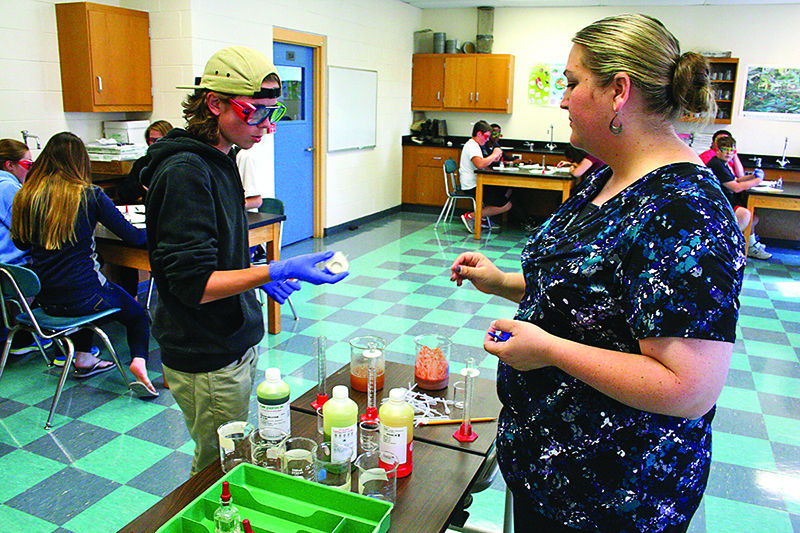 Sophomore Ryan Shackley exchanges materials with his teacher Amy Troiano last week during a biology lab at Westbrook High School. Staff photo by Andrew Rice
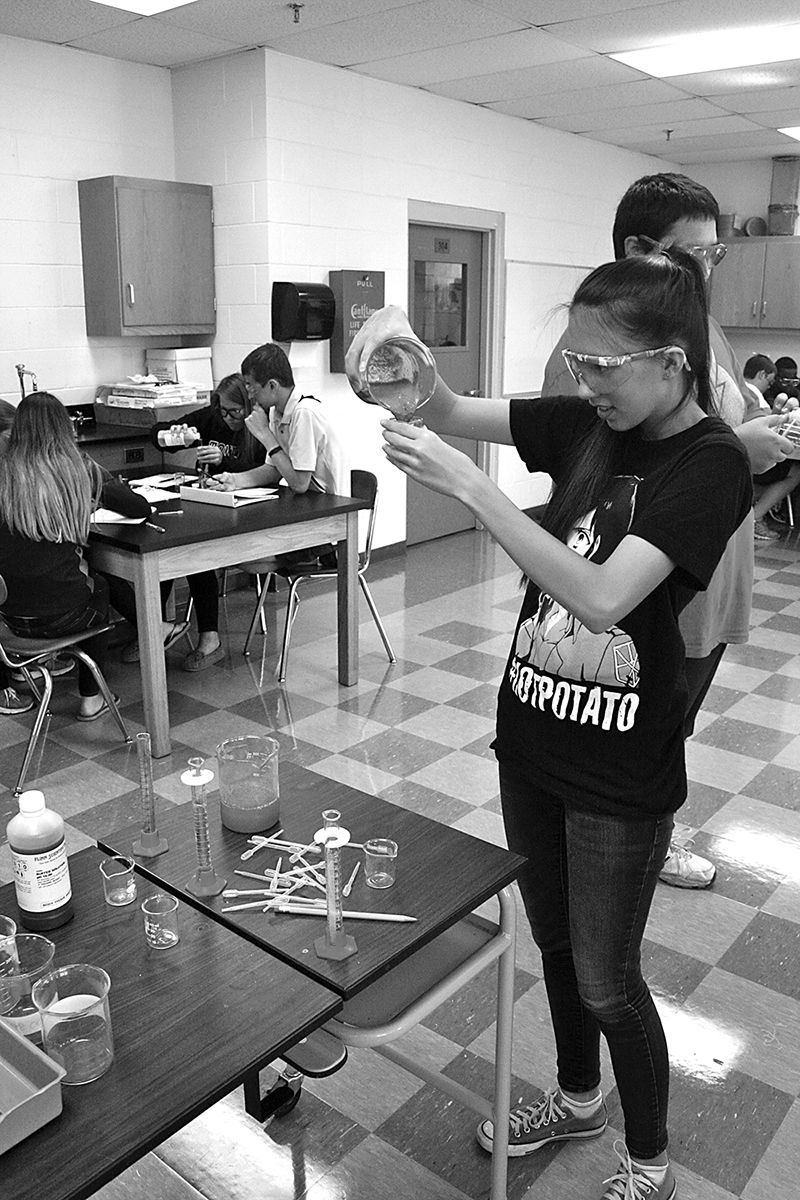 Dalena Bennett, a Westbrook ?High School ?sophomore, fills a beaker with blended liver last week during a biology lab. Under the standards-based model, the class was working toward the “structure and function” standard in? ?science. Staff photo by Andrew Rice
Comments are no longer available on this story