
Following a recent renovation, the University of Southern Maine Art Gallery is now under review by the Maine Historic Preservation Commission to determine whether the building qualifies to retain its historical status.
The art gallery, built in 1821, is in the U.S. Department of the Interior’s Register of Historic Places.
Kirk Mahoney and Christi Mitchell of the commission staff saw the art gallery first hand in a tour on Sept. 3.
“We don’t have a specific deadline,” Mahoney, assistant director of the commission, said about a decision before touring the site.
Glenn Cummings, university president, accompanied by two of his staff, spoke privately with Mahoney and Mitchell while touring the art gallery’s exterior.
The university appears hopeful of being granted more time, if needed, to meet historical qualifications. Cummings expects to hear details of the review from Mahoney and Mitchell, who is the architectural historian and national register coordinator.
“We’re going to make this historically accurate,” Cummings vowed following the meeting.
The art gallery, a former Gorham town house, is one of several buildings in a historic district on the Gorham campus. A forerunner of the university, Gorham State Teachers College, acquired the art gallery building in 1961 for $1 from the heirs of Toppan Robie, a Gorham benefactor.
The restoration of the landmark generated some public criticism last year when the university stripped vintage clapboards from the art gallery and planned to replace them with vinyl siding. But to satisfy preservationists, the university scrapped plans for the vinyl, installed wooden clapboards and appeared to have agreed to a plan to proceed.
But in July this year, Adam Ogden of Gorham, a historical researcher, as a resident requested the state’s commission review the project.
According to its website, the commission is “responsible for the identification, evaluation, and protection of Maine’s significant cultural resources as directed by the National Historic Preservation Act of 1966.”
“As a public university of higher learning, it should always exhibit in its image and works a best practices ethic,” Ogden said in an email statement Tuesday to the American Journal. “What an educational institution does and accomplishes is in large part a statement to the greater world that this is how things are done and taught correctly. USM cannot possibly point at the art gallery project and say it has fulfilled that role.”
During last week’s tour, Mitchell photographed several details of the building that the commission staff could evaluate for historical accuracy.
Among his concerns, Ogden, who was not present for the state’s review, pointed to the steps and deck boards that he said are of composite material, “fake hardware” on shutters, plastic moldings and trim, along with inappropriate wooden column bases.
The university had previously said the bottoms of the columns were rotted, but Ogden refuted its claim. He said he has images and salvaged wood that shows the bases were not rotten,
“The cultural heritage and fabric of the building has already been lost,” Ogden said.
Several of the windows that were removed were placed in storage while a few windows were restored and re-installed in the building. Cummings said that Mahoney and Mitchell liked the clapboards and the window exposures.
The university claimed it has invested more than $400,000 in the art gallery project. Cummings said if another $50,000 to $100,000 would be required it could be done in 12 months.
But, Cummings said that if costs exceeded that amount it could take the university up to 36 months.
“They’re trying to work with us,” Cummings said. “This is part of our heritage and pride.”
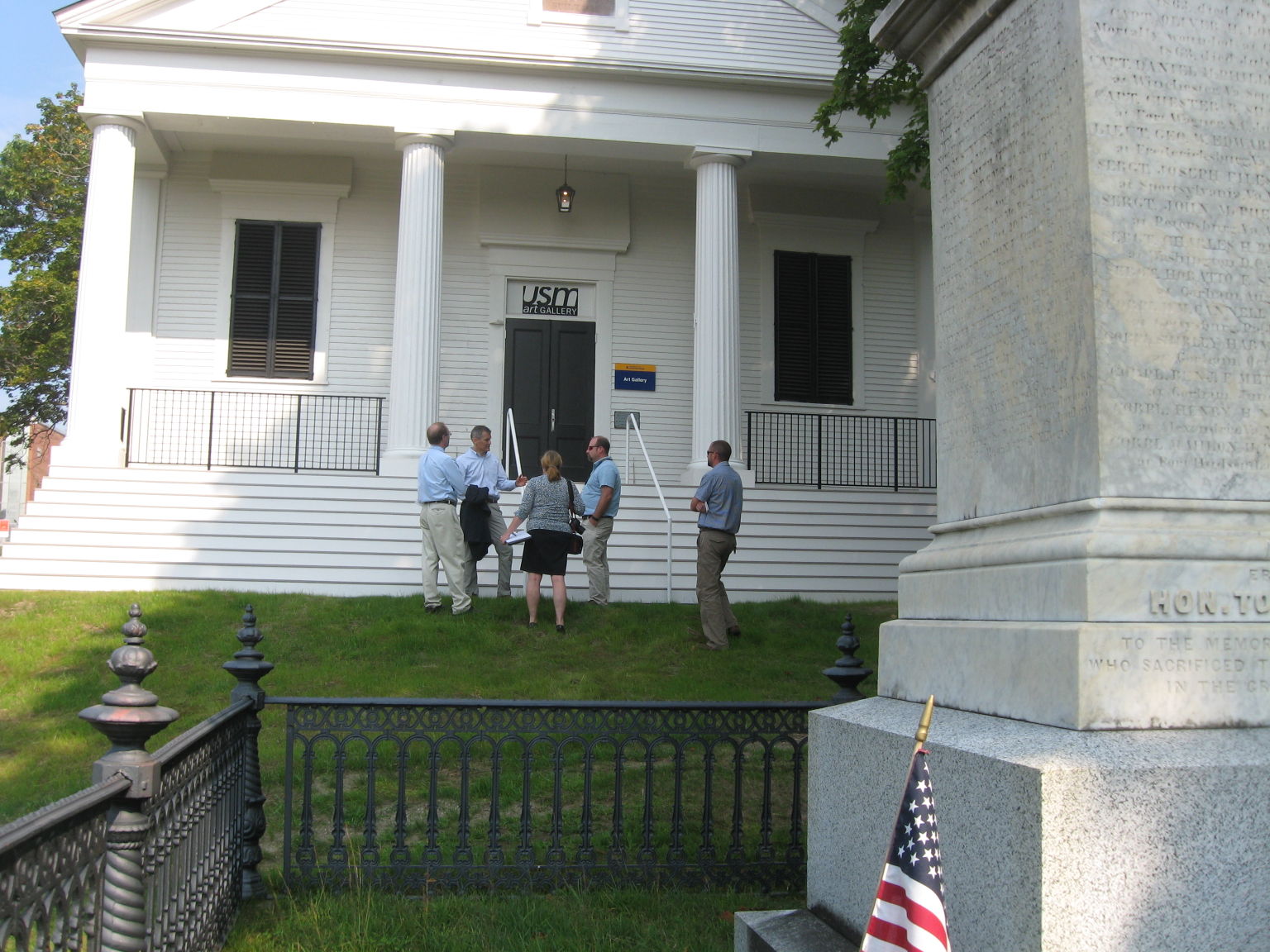 University of Southern Maine President Glenn Cummings last week points out restoration details at the university’s art gallery on the Gorham campus to Maine Historic Preservation Commission staff. Pictured, from left, are Kirk Mahoney, assistant director of the commission; Cummings; Adam Thibodeau, interim university facilities director; Tim Braun, university project engineer; and Christi Mitchell, architectural historian at the commission. Staff photo by Robert Lowell
Comments are no longer available on this story