
Andrew Collins of Freeport, who recently received his master’s degree in earth sciences at Ohio State University, has traveled twice to Antarctica as part of a team studying the effects of glacial melting on the movement of the earth’s crust. He was elected to Phi Beta Kappa in his senior year at the College of Wooster, where he earned his undergraduate degree.
Collins, 25, is the son of Malcolm and Susan Collins of Freeport, and a 2008 graduate of North Yarmouth Academy. Interest in science runs in the family, as younger brother Chris, a Freeport High School graduate, is studying oceanography and marine geology. Collins also has a lifelong interest in music, playing in bagpipe bands and having played percussion in the Portland Youth Symphony Orchestra his senior year. He taught Nordic skiing to a few of his fellow researchers during down times at McMurdo Station in Antarctica. He still enjoys both Nordic and Alpine skiing.
He answered questions regarding his adventures in Antarctica and his scientific findings for the Tri-Town Weekly.
Q: What sparked your interest in glacial melting?
A: I don’t study the process or drivers of glacial melting. I study the signatures of glaciers on the landscape. I’m very interested in the way in which all the aspects of the earth’s systems interact. For example, glaciers can both preserve and erode mountains and valleys depending on the temperature of the ice itself. The work I did in Antarctica integrated seismographs and very high-precision GPS to find out how and why the crust and glaciers above it are moving.
Q: What are the effects of that on the earth’s crust, and what does that mean to all of us?
A: We’re still studying how the crust and glaciers affect each other. But the data we’re gathering will enable new studies of tectonic plates, Earth’s climate and weather and our atmosphere. The more we learn about these things, the more we’ll understand about our planet and its future. Knowing about tectonics helps us understand earthquakes; understanding how ice and the atmosphere interact can help us preserve our climate system. The more we know about these things, the more potential we have to deal with them. We also get unexpected information sometimes – last year seismic data for our project revealed the existence of an under-ice volcano! That was pretty cool.
Q: What do you say to the naysayers of climate change?
A: Someone I work with recently put it this way. It’s hard for a group of people – be it scientists, congress, a town council or even a few friends – to agree on a plan, policy, or whatever. The Intergovernmental Panel on Climate Change, in their most recent report, stated that warming of the Earth’s climate system is “unequivocal.” This wording was approved, based solely on scientific (not political) testimony, by a panel consisting of over 350 scientists and politicians from over 100 countries. It was approved unanimously. Regardless of your politics, there is too much evidence to ignore.
Q: Practically speaking, what can we do?
A: We can do our best to be respectful of our planet and its resources. That’s for our sake. The Earth can handle the change, but we as a species will run into a lot of trouble. We need to utilize our resources in a way that’s manageable over the long term. This means sustainable energy and industry, and we can all help by choosing our packaging, our food and our energy sources a little more carefully. If we still want to deny climate change, do these things anyway, and just think of it as making the world a little better just because we can.
Q: How do you plan to use this experience?
A: It was a phenomenal opportunity for so many reasons. I made great friends and connections, I learned what makes good science, and I gained some valuable extreme weather field skills. And, of course, I got a slightly better appreciation for how our world works. These are all valuable across disciplines, but they’re definitely beneficial for an aspiring field geologist.
Q: You’ve traveled recently from Alaska to Scotland for a bagpipe competition. Tell us about how that all came about.
A: While in graduate school at Ohio State, I joined a bagpipe band called Capital City Pipes and Drums. I’d been playing since college and was looking for an outlet. It’s a wonderful group of dedicated people. They were kind enough to invite me to compete with them at the World Pipe Band Championships in Glasgow this summer, even though I had moved to Alaska to work at Denali National Park and Preserve. I was excited for the opportunity, and I accepted. In fact, I’m writing this from my hotel room in Scotland.
Q: What are your plans?
A: I love working for the National Park Service and being able to talk to people about the wonders of our world on a daily basis. I’d like to work in more parks before I firmly establish myself, but I really hope to continue doing geology in our national parks. They’re some of the most amazing places in the world and there’s always more to learn from and about them.
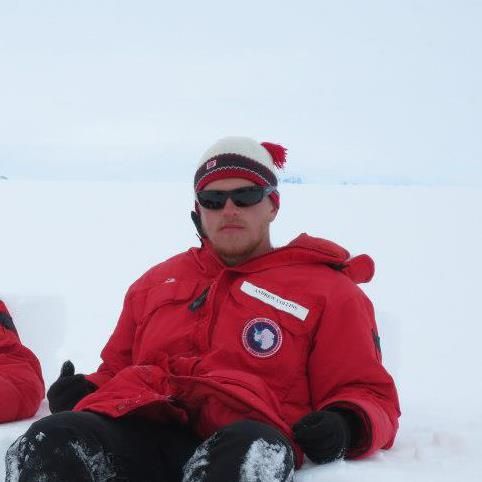 Andrew Collins of Freeport has made two trips to Antarctica to study the effects of glacial melting on the earth’s crust.Courtesy photo
Comments are no longer available on this story