
When veteran Windham lobsterman Bill Coppersmith Sr. caught a rare bright-orange lobster last Wednesday, it wasn’t the first time he had reeled in a highly unusual crustacean and then lavished with media attention.
Most living lobsters have black upper shells that are green hued. According to Coppersmith, about 1 in 30 million are bright orange.
But orange lobsters are abundant compared to an albino lobster, which Coppersmith caught in 1997. It was the first reported albino lobster ever caught. The odds? One in 100 million, according to Coppersmith.
Coppersmith received international media attention for the albino catch, and this week has been the subject of news reports around the world, in newspapers and on television.
“My home phone was ringing off the hook,” he said. “It was a pretty big deal… This one was pretty cool, too, but the albino still has my attention,” Coppersmith added.
Coppersmith was working on Casco Bay with his sternman, Brian Skillings of Casco, on the afternoon of July 22, when he caught the orange lobster. After steering his 42-foot lobster boat, the Billy & Andy, back to shore, Coppersmith transported the rare lobster to the Fishermen’s Catch in Raymond, which is owned by his son, Bill Coppersmith Jr.
The orange lobster has been on display since. Coppersmith’s son said he doesn’t attribute his father’s catch to any particular talent.
“He’s been fishing for about 40 years, so it’s just a matter of probability,” he said. “That’s probably what it comes down to, I would guess.”
Coppersmith agreed.
“I’ve been doing it since I was a teenager. Now I’m pushing 60 so I’m bound to see some pretty crazy things out here and catch some pretty cool stuff,” he said.
Robert Bayer, the executive director of the Lobster Institute at the University of Maine, said it’s hard to verify the probabilities cited by Coppersmith.
“Nobody knows if those are accurate,” he said referring to the 1-in-30-million claim.
Bayer said that while the albinos are extremely rare, the orange lobsters are comparatively common.
“We see these every year,” Bayer said. “And we see a variety of genetic variants every year. We see red ones and blues and calicos.”
“There’s a lot of public interest in this,” Bayer said. “It’s always baffled me.”
Coppersmith said that the bright-orange lobster is basically lacking coloring on its upper shell.
“What it really comes down to is it’s missing the darker pigmentation on the upper side,” he said. “If you flip a lobster over they’re all orange on the under side.”
Coppersmith plans to return the lobster to Casco Bay after a month’s display in Raymond.
“Hopefully, it’s learned its lesson and it won’t crawl into any more traps, and it can stay out there and grow into a bigger orange lobster,” Coppersmith said.
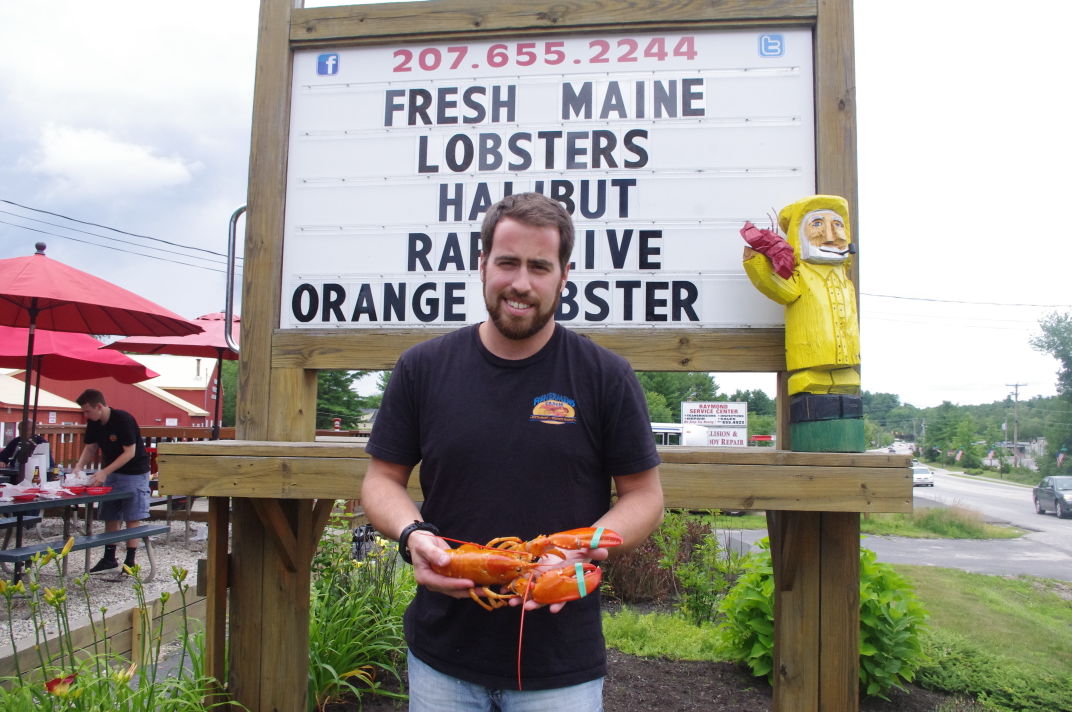 Bill Coppersmith Jr., the owner of the Fishermen’s Catch restaurant in Raymond, holds a rare, bright-orange lobster caught by his father, Bill Coppersmith Sr. The lobster is living at Fishermen’s Catch for a month, before Coppersmith Sr. returns it to the ocean.Staff photos by Ezra Silk
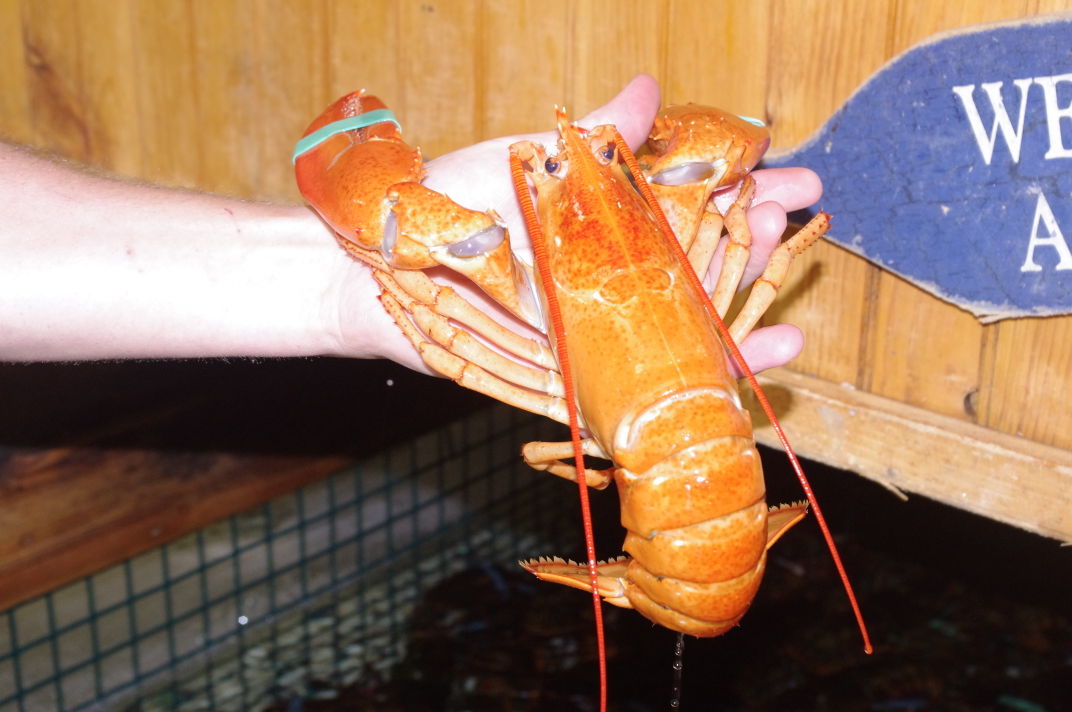 The upper shells of live lobsters are usually black with a green hue. Bright-orange lobsters lack pigmentation on their upper shell, according to Windham lobsterman Bill Coppersmith Sr.
Comments are no longer available on this story