
A Standish native has become caught up in a national media controversy about shark fishing and conservation.
On July 16, Marisa Butler, 21, a 2012 graduate of Bonny Eagle High School and a Miss Maine USA hopeful, was the subject of a positive profile in the British tabloid, The Daily Mail. The piece featured several pictures of a bikini-clad Butler, who is dating a well-known shark angler, Elliot Sudal, posing with and reeling in sandbar sharks in order to tag their dorsal fins for the volunteer National Oceanic and Atmospheric Administration cooperative shark-tagging program.
“Miss Maine USA contestant catches sharks and drags them ashore with her bare hands so their fins can be tagged,” the article’s headline read.
Two days later, Butler’s moment of fame began to turn into notoriety, when a reporter for the website GrindTV.com quoted a man, Drew Scerbo, who had criticized her on Facebook in response to the Daily Mail piece. Although Scerbo’s primary shark-related credential is his affiliation with a closed 7,075-member Facebook group called “White Shark Advocacy,” the GrindTV reporter described him as a “shark expert.”
“This isn’t about conservation at all – tagging is an excuse/justification for pleasure fishing,” Scerbo wrote on Facebook. “It’s not volunteerism either. Anyone can get those tags and put them on sharks. Literally anyone. Let’s not call recreational shark fishing ‘conservation.’”
On July 23, ABC’s “Good Morning America” picked up the story, running a two-minute segment, “Beauty contestant Marisa Butler faces criticism over shark tagging,” that featured Butler and two critics – Scerbo and Jim Abernethy, who owns a commercial scuba diving company in Florida. Abernethy said that Butler was diminishing the sharks’ chances of survival by dragging them onto the beach.
In an interview, Butler said that it’s been “really hard” to absorb the wave of hostility that has come her way since the two pieces appeared.
“That GrindTV segment and the ‘Good Morning America’ segment have resulted in me receiving death threats and people telling me to kill myself and saying they hoped the shark took a bite out of me,” she said. “Most of the time it’s people who saw a picture with the article and didn’t bother to read it. They even say, ‘How dare you be killing these sharks,’ when I clearly stated I am not killing these sharks. A lot of the times it’s people – they don’t even have proper grammar.”
Furthermore, Butler said, the criticism is unfounded. Butler said she has been fishing for sharks with Sudal since last fall, when Sudal, who is known as the “Nantucket Shark Wrestler,” was working on a show for National Geographic television called “The Raft” in Puerto Rico. In Puerto Rico, Sanibel, Fla., and Nantucket, Mass., Butler said she has been assisting Sudal in his efforts to tag primarily sandbar – or brown – sharks, which are one of the biggest coastal sharks in the world and have become vulnerable due to over-fishing. She said she has reeled in about 30 sharks, in total.
Sudal and Butler volunteer for the 52-year-old NOAA Cooperative Shark Tagging Program, which has some 7,000 volunteers. They use a rod and reel to catch the sharks, and then implant numbered “dart” tags in the base of the sharks’ dorsal fins. They send NOAA information about the date and location of the catch, as well as the size and sex of the shark. Between 1962 and 2013, more than 243,000 sharks were tagged through the program. The data helps the agency monitor shark migration patterns, growth rates, abundance and other information meant to assist rational resource management.
Butler said the couple has tried to stay within the formal guidelines established by the NOAA program. They first cast out a large chunk of bluefish, typically on an 80-pound test line. It usually takes about 10 minutes to reel in the sandbar sharks, which are generally about 5 feet long and weigh around 200 pounds, Butler said. Once they are reeled in, Sudal drags the shark by the tail onto the surf in order to gather data, she said. Onlookers often gather around the couple and take photographs.
“We do not put them on dry sand, which is advised against by NOAA,” Butler said. “We get them just enough out of the water so it’s safe enough for us to gather the information. We remove the hook, determine a gender, and then we try to get it right back in the water. We shoot for having it out of the water for less than two minutes. NOAA recommends having it out of the water for less than five.”
“It’s kind of a balancing act between getting the necessary information and minimizing any traumatic experience for the shark,” Butler added.
The NOAA guidelines advise program volunteers to only tag robust sharks more than 3 feet in length, to “minimize physical handling,” and “avoid dragging the fish on dry sand.” It also advises volunteers not to sit on the sharks “or hold their mouths open for pictures.”
In two of the photos published in the Daily Mail, Butler is holding sharks by the nose, with their mouths open. Butler said she regrets holding the sharks that way, since it looks like “a hunting photo.” In the future, Butler said, she will try harder to pose with the sharks in ways that do not appear reckless.
NOAA spokeswoman Connie Barclay declined to comment on the controversy.
“We’re a federal agency and we would not get into discussing individuals,” Barclay said.
Dean Grubbs, a volunteer with the NOAA program who is also the associate director of research at the Florida State University Coastal and Marine Laboratory, said he had reviewed some of the articles about Butler.
“The pictures I saw of the sharks being all the way up on the beach – that could definitely be causing harm if the sharks are out of the water for more than one or two minutes,” Grubbs said. “I saw one article where she said the sharks are out of the water for less than a minute and a half, and if that’s really true, then the amount of harm to the sharks is probably relatively minimal.”
Grubbs, who wrote his graduate thesis on sandbar sharks, said the data collected through the NOAA program is very useful to his work.
“That’s the shark species that the commercial shark fishery really concentrated on in response to the Asian shark fin market,” he said. “That population was severely over-fished in the late 1980s and 1990s. It’s been heavily managed with more and more strict quotas since 1993 and it’s now actually a species that’s prohibited from being retained. You can’t retain it and eat it or anything.”
“We need more information on the population size structure, the number of animals out there, and their migration patterns,” he said. “The tagging work provides two pieces of data that are useful.”
Butler, who is tagging sharks on Nantucket with Sudal this summer, said she does not regret cooperating with the Daily Mail reporter who indirectly provoked the controversy that has led to her life being threatened over the Internet.
“Would I have been a little more cautious about it if I knew it was going to turn into this?” she said. “Yes.”
“Even if I’m getting a lot of bad negative backlash on this, we’re getting people talking,” Butler added. “There’s 70 to 100 million sharks that are being killed annually by humans and yet there are less than five – on average – shark attacks annually. We’re getting the word out that this is a serious issue. These sharks need to be protected. We need to learn more about them to protect them.”
Butler is a rising senior at Stonehill College in North Easton, Mass. She is studying economics, with an inter-disciplinary minor in sports, science and psychology, as well as a minor in business.
She was the first runner-up in the 2011 Miss Maine Teen USA competition, and was a runner-up in the Maine state competition for the Miss America contest three years in a row, from 2012-2014. Butler is registered to compete again in the Miss Maine USA pageant in November.
In Standish, Butler was a soccer player, lacrosse player, and cheerleader at Bonny Eagle High School. She said she hopes to work on a yacht with Sudal for a year after graduating in order to pay off her student loan debt, and then study environmental economics at a graduate school.
Butler grew up on Oak Hill Road, where she was struck by lightning at the age of 6. She uses the anecdote to demonstrate why shark fishing is not as dangerous as it may sound.
“These type of sharks are very docile,” she said. “You’re actually more likely to be struck by lightning than bit by a shark. I’m living proof of that statistic.”
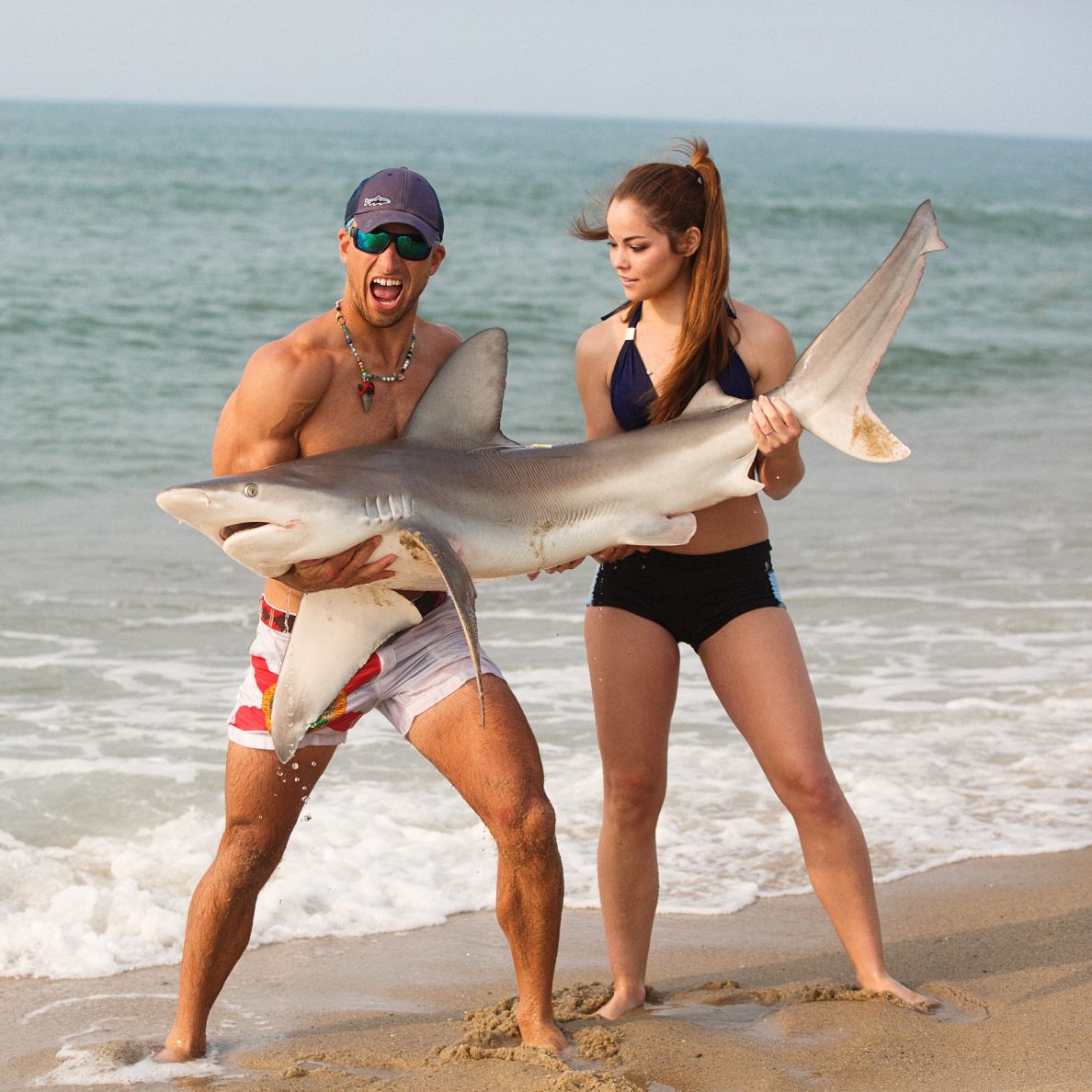 Marisa Butler and her boyfriend, Elliot Sudal, hold a shark on a beach in Nantucket. Online critics have sent Butler death threats as a result of media stories questioning the way the couple handle sharks. Photo courtesy of Elliot Sudal
Comments are no longer available on this story