
A state plan to temporarily install a picket weir on the Crooked River during salmon spawning season has run into opposition from Sebago Lake anglers.
The Department of Inland Fisheries and Wildlife is set to install the $17,000 portable weir on the lower portion of the river toward the end of this summer. The 58-mile Crooked River, which extends from Songo Pond in South Oxford to the northern shore of Sebago Lake, passes through Naples and Casco and is the prime spawning area for landlocked salmon in the lake.
The weir weighs about 6,000 pounds, and is about 80 feet wide and 6 feet high. It is composed of hundreds of pieces of pipe and angle iron arranged like a picket fence. The weir, which the department plans to install in late August or early September and remove in early November, will prevent upstream and downstream salmon passage during salmon spawning season on the Crooked River. Department staff will temporarily capture the blocked salmon, collect information about their health, size and age and then place them on the other side of the weir afterward.
According to Francis Brautigam, a regional fisheries biologist for the Department of Inland Fisheries and Wildlife, the weir will be installed during the spawning season once every three to five years. Every 10 to 15 years, department staff will strip eggs from some salmon trapped at the weir in order to maintain the genetic vitality of the department’s salmon brood stock program, which stocks fish across the state, Brautigam said.
The Crooked River has been a popular spawning ground for wild salmon since the last ice age, but the construction of dams starting in the late 18th century progressively cut down the length of the river accessible to salmon, according to ecological historian Doug Watts, a member of the advocacy group Friends of Sebago Lake.
Until a few decades ago, salmon only had access to the lower third of the river, limiting their ability to spawn. Since the 1970s, a number of dams have been removed from the river, re-opening full salmon access to the entire river, and causing a boom in the wild salmon population. The number of salmon traveling from Sebago Lake to north of Harrison during spawning season has doubled since the late ’70s, according to Brautigam.
To Watts and some Sebago Lake anglers, the department’s plans to install a portable weir will unnecessarily interfere with the salmon spawning season.
Stephen Sparaco, a longtime Standish fly fisherman, delivered a petition signed by 73 anglers protesting the weir plans and critiquing other aspects of the department’s fishery management. The petition, which argues that “the Crooked River salmon spawn is too vital to chance interfering with,” led Brautigam and Commissioner Chandler Woodcock to hold a public information session at the Standish Town Office on May 6, which was attended by 35 people.
“We oppose this proposed fish weir because it’s going to be placed this fall on the Crooked River and it’s going to interrupt the free and clear passage that the spawning salmon currently have,” Sparaco said. “It’s going to act essentially as a dam.”
Sparaco said he is concerned that a number of salmon will die as a result of the weir installation. Some will die due to stress when handled by department staff, he said. Since department staff will not likely be able to monitor the weir every hour of the day due to financial constraints, salmon that are blocked by the weir will also be eaten by predatory minks and otters, he said.
Another potential problem, Sparaco said, is that the weir will be cluttered by leaf buildup during fall foliage, and will become dislodged as water pressure builds up and forces it downstream. The weir will also block boaters, he added.
Watts said he would like the department to provide much more information on the weir plan. The only written public material on the plan is a one-paragraph summary included in the recommendations of the department’s September 2014 Sebago Lake Management Update. Watts said he was not satisfied with the department’s responses at the May 6 meeting and, in particular, the fact that officials have not yet identified where precisely the weir will be placed on the river.
“At the meeting which we had on May 6 at Standish Town Hall … the consensus of everybody that was there was that the fish should be allowed to freely swim up the Crooked without being stopped and they should just be allowed to do what they have been doing for the last 9,000 years,” Watts said. “Putting up a big fence there to block them and then to take each and every fish and anesthetize it and then to measure its length and to weigh it and to take a scale sample – this is not necessary and it’s not going to give us any scientific information that is really essential. It’s going to interfere with their natural behavior.”
The department’s description of the weir plan acknowledges that “there are some challenges to install and maintain a successful weir on the lower Crooked River, and initial efforts will focus on troubleshooting.”
But Brautigam dismissed Sparaco and Watts’ criticism, arguing that the weir will not harm the wild salmon population and will also provide necessary data for the department.
“The way we manage natural resources in this state, whether it’s fisheries or wildlife, is through data collection to assess the health and the condition of those fish and wildlife populations,” Brautigam said. “The weir will also allow us to conduct various research initiatives to better understand the salmon migration and life history in the Crooked River system.
“If I went to the public and I said, ‘I don’t have any data but I talked to my good buddy, Dave, and my other buddy, Jeff, and one of them said the fishing wasn’t really good and another said the fishing wasn’t so good,’ what I do with that information?” he added. “Is that really the basis for credible decision making?”
Brautigam said the department plans to use a floating resistance panel to allow leaf pack buildup to pass over the weir. Staffing will be maintained at appropriate levels, he said.
“People have a lot of ideas and thoughts on what should or shouldn’t happen,” he said. “I’ve explained to folks that the staffing will largely be influenced by the progression and the size of the run and as more and more fish utilize the structure.”
Watts has suggested that the department use an electronic fish counter, instead – a technology that does not require the installation of a weir. According to Watts, Sebago Lake anglers have offered to purchase a fish counter for the department’s use, but Brautigam has rejected the offer.
That’s because the department needs to collect much more information than the size of the wild salmon population, Brautigam said.
“There are some technologies that allow you to track fish that migrate,” Brautigam said. “But those technologies do not provide biological data. They don’t provide weight, length and age information on salmon.”
Sparaco, who calls the weir a “monstrosity,” is not convinced the department will install the weir infrequently.
“We’re trying to kill this right now because once this weir goes in, it will be an annual thing,” he said.
Not so, said Brautigam.
“A lot of the concerns that have been expressed suggest that there’s going to be some sort of a permanent barrier,” Brautigam said. “That’s not the case.”
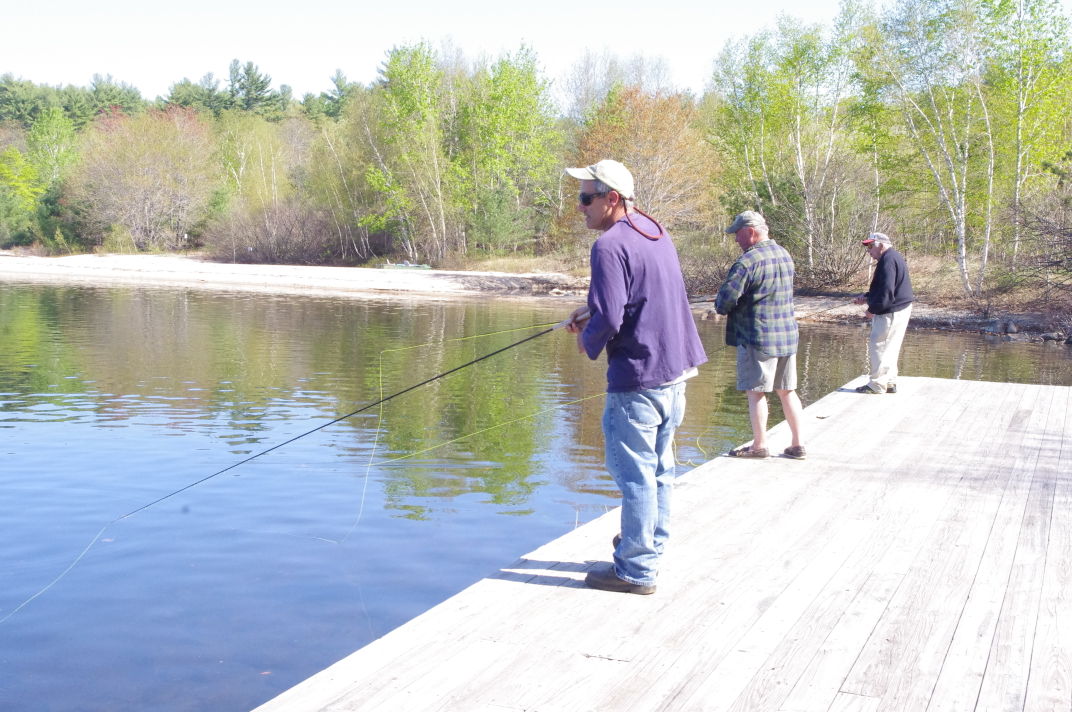 Anglers, from left, Stephen Sparaco of Standish, Elmer Farley of Buxton and Al Seamans of Windham fish near the Sebago Lake boat launch on Thursday, May 14. Sparaco submitted a petition signed by 73 anglers in early May expressing opposition to a state plan to seasonally install a weir on the Crooked River. Staff photo by Ezra Silk
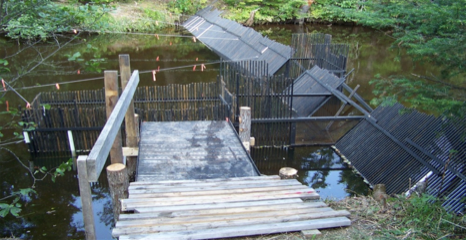 A picket weir installed by the Department of Inland Fisheries and Wildlife near Greenville. The department plans to temporarily install a $17,000 portable weir on the lower portion of the Crooked River toward the end of this summer.Courtesy photo
Comments are no longer available on this story