
Connor O’Neil of Freeport wins an award from Colby College for his thesis, which outlines sustainable aquaculture techniques.
Just as he did as a child growing up in Freeport, Connor O’Neil catches green crabs.
But the Colby College senior, who will graduate on Memorial Day weekend with a degree in environmental policy, doesn’t catch the shellfish predators for fun anymore. For clammers and others who make their living in the fishing industry, dealing with green crabs is deadly serious.
O’Neil doesn’t plan to be a clammer, but he does want to find ways to fight the invasive green crab. Earlier this month, O’Neil, the son of Chris O’Neil and Beth Ahearn, earned a $1,000 award from Colby for his Capstone Thesis, entitled, “Green Crab Mitigation Proposal.”
All Colby environmental policy majors are required to complete a Capstone Thesis, in which they investigate the causes of, and solutions to, selected environmental issues. In his thesis, O’Neil concludes that municipal leasing of clam flats, which would encourage clam farming by providing for private plots, as well as finding a market for green crabs, could be solutions to the green crab problem.
Clammers in Freeport and around the state are looking for ways to reduce the population of green crabs, which prey upon clams. There is not yet a market for the crabs, nor has clam farming taken root, though Freeport is at the forefront.
“The sustainable aquaculture techniques I proposed is why I won the contest,” O’Neil said last week, as he prepared for a day of classes. “I focused on intertidal zones, and the case species was green crabs. Green crabs have eaten all the wild mussels, which sit on the surface. The intertidal mussel bars along the Harraseeket River in Freeport are now just dead shells. The last clams are in the high, high intertidal areas. They’re the farthest away from the channels, which is where the green crabs come in from after the winter.”
During summer break between his sophomore and junior years at Colby, O’Neil, a Cheverus High School graduate and four-year starter on the Colby men’s basketball team, worked with Brian Beal, a University of Maine marine ecology professor who is studying green crab mitigation for the third year along the shores of the Harraseeket. O’Neil was what he called a “paid volunteer” in the summer of 2013, when the town commissioned a $100,000 study of green crabs. Beal is on the second year of a two-year, $200,000 University of Maine grant, to follow up and expand on the 2013 study. In 2014, O’Neil worked alongside Beal and others as a paid intern by the Downeast Institute for Applied Marine Research & Education. Beal is director of research for the institute.
O’Neil has worked alongside many of the clammers he grew up knowing in Freeport, including Chad Coffin, president of the Maine Clammers Association.
“I have had the great pleasure of working with Connor,” Coffin said. “To me, and many others in the local shellfish industry, he is known as ‘Thorgaard the Viking Warrior’ of marine resources at Colby. This guy has enlightened me to the importance of finding ways for the next generation to enter into Maine’s largely closed-off marine fisheries. Research and education are certainly the keys to providing both this and the next generation the tools to adapt methods and techniques to the changing environment.”
O’Neil wrote in his thesis that municipal leasing is needed. Nets would be placed over shellfish seed, to protect them from predators.
“Green crabs have had control of our intertidal resources for far too long and it is time we take them back,” O’Neil wrote. “The only way to do that is to encourage people to be stewards. If I am correct, the state can’t charge more than $100 an acre (for leased flats). The cost of a roll of netting (enough for an acre) and toggles (so that the nets don’t lie flat and choke out the shellfish when the tide comes in) is also quite low, so theoretically you could be catching and protecting wild spat (like we did in Freeport) in no time.” Spat is the term for baby clams.
Beal, who began his third year on the Freeport flats earlier this month, said that municipal leasing has been legal in Maine since 1911. It would take an ordinance change – with the blessings of the Freeport Shellfish Conservation Commission and the Town Council – to institute municipal leasing in Freeport, Beal said.
“Freeport has 800 acres of clam flats,” Beal said. “Two or three acres for a lease is doable. Leasing can’t be more than 25 percent of the flats; 75 percent must remain wild. I’ve been hearing that there’s a lot of people in Freeport who don’t want to see it happen, just because they’re against it.”
O’Neil’s second suggestion for green crab mitigation is to develop a green crab fishery.
“You could use blue mussels grown on leased flats (or suspended in the water column, or even grown in an upweller) as bait to power the fishery,” he wrote. “Wipe out the crabs with something they thought they already destroyed. It might seem far-fetched, but it would certainly be more sustainable than using herring or other fish.”
O’Neil said last week he’d like to see a market for green crabs. The chief obstacle is a price structure that would make it worthwhile for people trapping them, he said.
“They’d have to get over a dollar a pound. Now, it’s about 40 cents. Let them make a liveable wage.”
Processing plants would have to be built, as well as a transportation system, O’Neil said. Downeast Institute for Applied Marine Research & Education is seeking out grants to develop the “market side” of the solution, and O’Neil would like to dive right into the effort soon, as in right after graduation. He would like to spend his summer at the institute, located in Jonesport-Beals.
“I’d like to take samples out of DEI, from June to June,” O’Neil said. “I’d be collecting green crabs, taking them back to the lab and analyzing stomach contents. We’re looking for a better understanding of the species and how to manage them. Their living and feeding habits are important to understand if a fishery is established, for a resources manager.”
O’Neil said he didn’t think the green-crab problem would be solved “if only clammers feel they’re the stakeholders. They don’t have the resources to fight this alone. The only place in the state you’re seeing anything is in Freeport and Brunswick.”
Beal said that aquaculture is a “reasonable means” of dealing with clam predation.
“The only way to get our way out of the green crab problem is to eat our way out of it,” he said. “I’m talking human consumption, possibly in Asia. They use everything except for the shell when they eat a scallop. They make candy out of the eyes.”
Beal said he does not know what a reasonable price would be for a pound of harvested green crabs. The effort would be concentrated on the baby crabs, he said.
“They would be the size of a dime to a quarter,” he said. “When you pop that thing into your mouth, you can chew it and swallow it in good order.”
As for O’Neil, a month from graduation, he’s sure of just one thing when it comes to his career.
“I want to be outside, whether it’s in natural resources management or what,” he said.
The recognition for his thesis can only help, O’Neil figures.
“It was a great experience for me,” he said. “It was good in terms of credibility.”
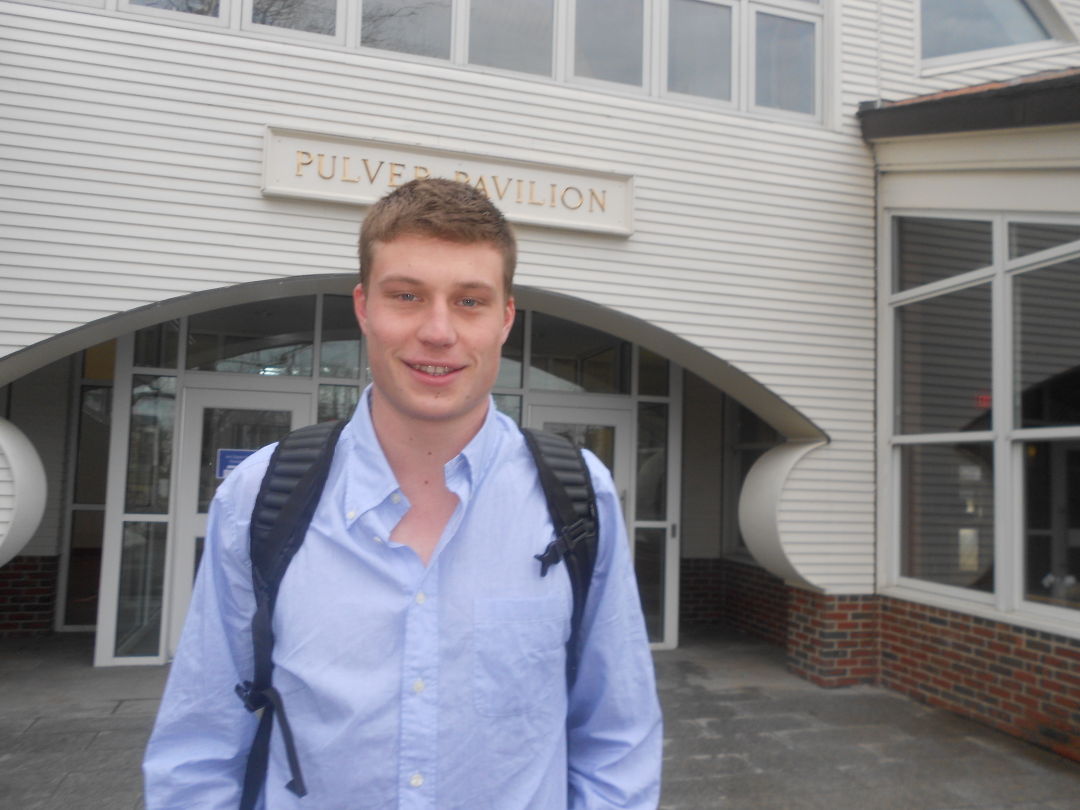 Connor O’Neil of Freeport, a senior at Colby College, stands in front of Pulver Pavilion, which includes the Cotter Student Union, on the Waterville campus. Colby gave O’Neil a $1,000 award for his senior environmental policy thesis, “Green Crab Mitigation Proposal.” Staff photo by Larry Grard
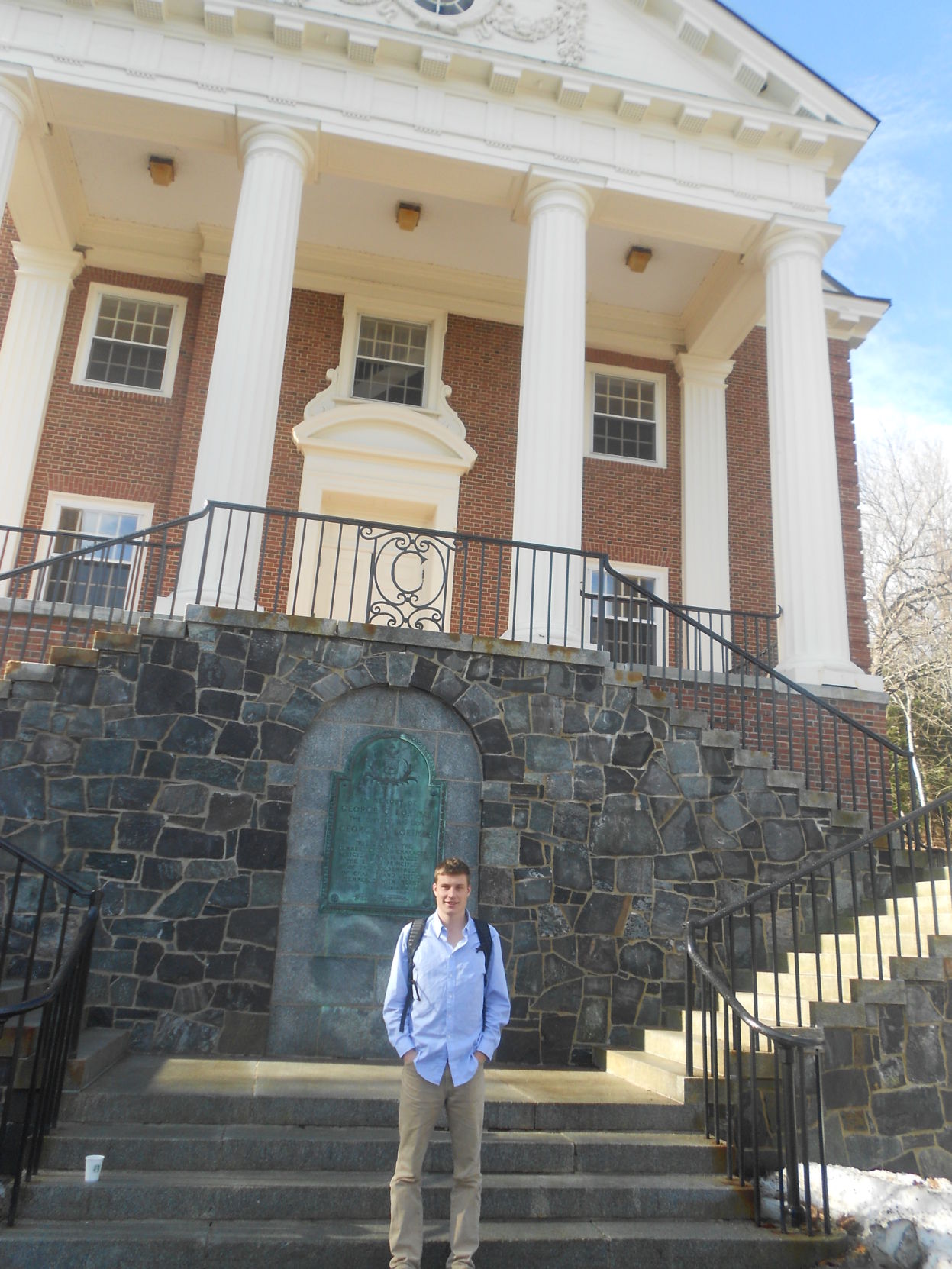 Connor O’Neil of Freeport, a senior at Colby College, stands in front of Lorimer Chapel, a landmark on the campus of the Waterville school. Colby gave O’Neil a $1,000 award for his senior environmental policy thesis, “Green Crab Mitigation Proposal.”Staff photo by Larry Grard
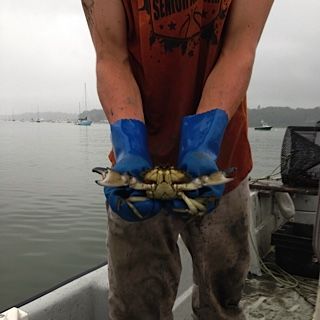 Connor O’Neil holds a big green crab he caught along the shores of the Harraseeket River in Freeport in 2013. Courtesy photo
Comments are no longer available on this story