
Durham Community School has potential engineers in its technology and engineering class for kindergartners. Yes, kindergartners.
Recently, Deb Bartlett’s kindergarten students, working on iMacs, as the older students do, made 3-D boxes, using connectors and following diagrams.
“Kids have gone from playing games to creating games,” said Will Pidden, Durham Community School principal. “It’s a rudimentary look into simple machines. We’re hoping they become interested in the made world around them. It’s all in essence three-dimensional problem-solving. That’s what it comes down to.”
The technology and engineering classes at the Durham school are part of what is called 21st Century Learning Initiatives – a widespread change in the educational system. Common Core set national standards for learning, and proficiency-based education takes Common Core a step further by requiring students to demonstrate knowledge and show proficiency. The 21st Century Learning Initiatives expands curriculum to incorporate those concepts.
The 21st Century Learning Initiatives includes the STEM (science, technology, engineering and mathematics) classes that Bartlett teaches. The hope is students who graduate from high school with 21st Century Learning Initiative skills will be better prepared for the modern-day workplace – perhaps to take jobs as engineers, which is part of the STEM block of studies every school has in place.
“It’s an approach to teaching and learning that I’ve seen in the majority of classrooms that I’ve visited,” said Jay Collier, program director for Educate Maine’s Project Login. “It mostly emerged from the (Partnership for 21st Century Learning Skills) with critical thinking, problem-solving and collaboration.”
Project Login was created by businesses that want to help college graduates “get engaged, get educated and get employed,” said Collier, who is a Freeport resident. Project Login is a program of Educate Maine, which champions college and career readiness.
Educate Maine’s goal: All of Maine’s K-12 students will graduate from high school prepared for success in postsecondary education and the workplace.
“In order to be a good employee in any field,” Collier said, “you have to have some of those 21st-century skills. The students who have mastered the 21st-century skills are better prepared across the board.”
The Partnership for 21st Century Skills, founded in 2002 as a coalition of business and education leaders, along with policymakers, set out to position “21st century readiness” at the center of K-12 education. According to the Partnership for 21st Century Learning Skills website, every child in the U.S. needs 21st-century knowledge and skills to succeed as effective citizens, workers and leaders. This can be accomplished by fusing the “3 Rs” and “4 Cs.”
According to the website, the 3 R’s include English, reading or language arts; and reading, writing, and arithmetic and the 4 C’s are creativity, critical thinking, communication, and collaboration.
On task in Durham
Pidden proudly speaks of programming at the school that has evolved with 21st Century Learning Initiatives.
“Twenty-first Century Learning Skills, is what I call it,” Pidden said. “A lot of it has built around information-age technology pieces, like collaborative learning skills and technological literacy. Our old computer class is now a technology and engineering class. It’s a curriculum that can evolve.”
Kindergarten teachers from half a century ago could not have anticipated today’s education, Pidden said.
“There are integrated components to education that are very important,” he said. “The manner in which things are taught continues to evolve.”
For instance, students in a computer class from 21 years ago would have been working with Apple IIs, Pidden said. The computers had a monochrome screen and limited software. Now, there’s a three-dimensional software program called “SketchUp,” which gives students young and old the tools to build things.
“Six years ago, when this school was being designed, the Maine Learning Initiatives Program provided seventh- and eighth-graders with laptops. Then there was a program called ‘SketchUp.’”
SketchUp allows students to draw lines and shapes, push and pull surfaces to turn them into 3-D forms. They can stretch, copy, rotate and paint to make anything they like. SketchUp provides an onscreen blueprint to build something.
And SketchUp is not just for kids.
Carpenters are using the tool to construct buildings, Pidden said.
And, he said, “the architect who designed this building used SketchUp, and they were blown away to see that students had SketchUp on their laptops.
“Six years later, our second-graders use SketchUp. What was a computer class is now technology and engineering. We need that ability to have the programming as the opportunities evolve. The new science curriculum has engineering as part of it. Each grade level, K through 8, does engineering,” he said.
In fourth grade, Pidden said, a student in a science class might study human body systems.
“In engineering, they apply that to design a knee brace,” he said. “For me, when I see work that was being done by seventh-graders similar to what is now being done by second-graders, that’s a good indication.”
Using language properly helps children work better together on projects, Pidden said.
“Reading and writing are all subject matters (for 21st Century Learning),” he said. “There’s an opportunity for children to talk to each other on claims and evidence, and to build upon each other’s thinking. That’s a key skill. Kids are taught to collaborate and communicate, and to extend their learning. That’s happening in reading and writing and math.”
Bartlett, a Pownal resident, is in her 34th year teaching science at Durham Community School. She started engineering classes for grades 7-8, and is in her third year teaching it from K-8.
“The third-graders this year are much more into the thinking part of engineering,” Bartlett said. “There are more ideas. It’s OK when it doesn’t work the first time. What I see it as, is the ability to solve a problem. It lets them do it wrong a while and give them time to fix it.”
Textbooks are becoming less and less important.
“I don’t use textbooks,” Bartlett said. “This lets them make things hands-on. Kids used to give up on the first try.”
Bartlett said that some students are more into computers than the engineering room. The 21st Century Learning Initiatives are intended, in part, to sort that out.
Stem at Freeport High
David Smail teaches STEM electives at Freeport High School, including physics, engineering programs and robotics. Smail, who has been teaching for 18 years, resists what he calls labels, such as 21st Century Learning Initiatives.
“In my big scheme of things,” Smail said, “when I look at a graduate there’s certain things I expect to see from them, and they’re not necessarily 21st-century goals. I look for problem-solving and tenacity.”
Still, life and career skills are a component of 21st Century Learning Initiatives. There’s a push in Maine, Smail says, to maintain a younger population of workers with a broader base of skills.
“Kids need challenges, as always, and need to solve them with a minimum of direction,” Smail said. “You make a mistake and you learn from that.”
Smail said that new teaching techniques are bearing fruit.
“It’s helped us quite a bit,” he said. “In the past, students would build a mouse trap out of a block of wood. Now we’re using robotics to do the same thing.”
Smail said that his students now need to develop both hardware and software solutions to problems.
“With kits and tools at their disposal, kids can prototype more rapidly,” he said. “The ease of coming up with solutions for simpler problems leads to the ability to solve more complex problems.”
Smail cautioned that a better learning environment doesn’t necessarily provide students with better life and career skills.
“It does give them a better background in solving problems,” he said, adding that “iPads give flexibility for kids. Kids are more comfortable. It gives me a chance to back off a little bit on the teaching of the technology and move into what the technology is telling them.”
Smail said he would like to see more mixed-gender STEM classes.
“Girls are very underrepresented,” he said. “We’re looking for ways to rectify that. We don’t even know the reason.”
Collier said he’s not sure why girls tend to be less interested in STEM subjects, but he can think of a possible solution.
“Boys and girls are both interested when the subjects are taught with an application as to how they apply in everyday life,” Collier said. “When science and math and other STEM subjects are taught with applications, then you see more of both boys and girls. If they work on projects meaningful to them, girls are more engaged and interested. Most teachers are doing that now.”
Collier said the 21st Century Learning Initiatives and programs such as Project Login are helping to provide Maine with more young people with 21st-century skills.
“There are a growing amount of young professionals working in Portland,” Collier said. “Our sponsors are really pleased. Those businesses are really challenged to help Maine students find these jobs, and we’re looking to help them. High schools are really at the center. It is definitely heavy lifting.”
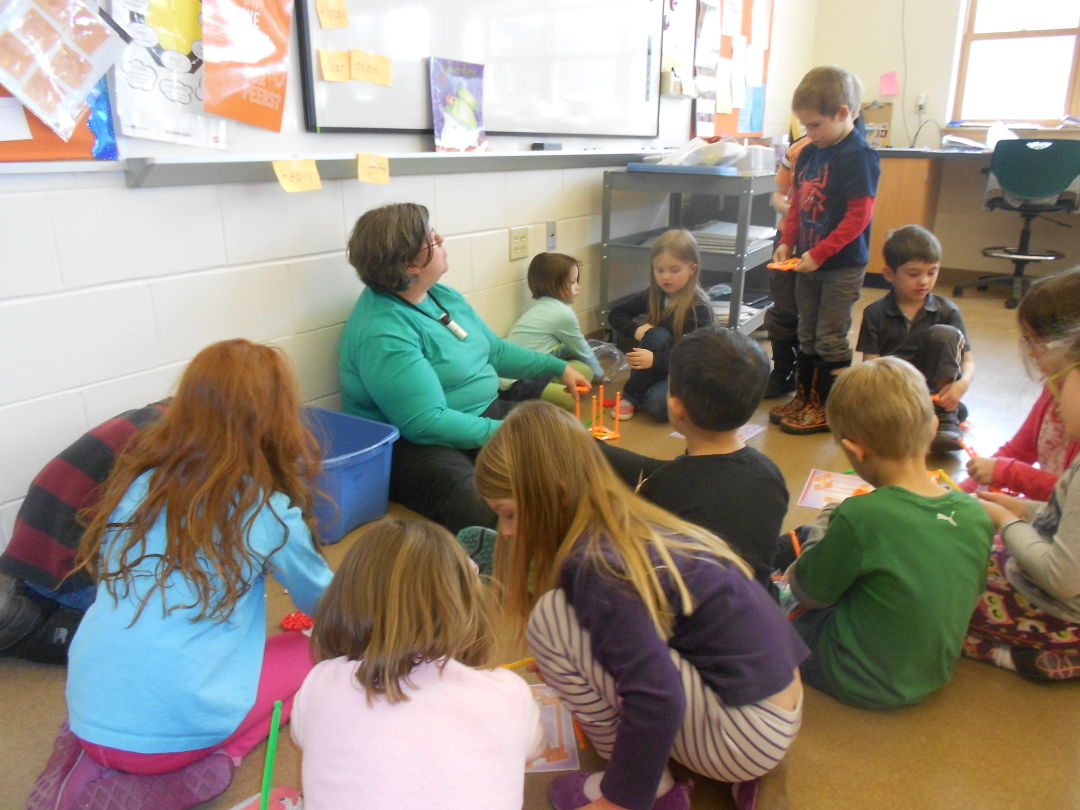 Would-be engineering students in Deb Bartlett’s kindergarten class at Durham Community School make three-dimensional boxes. Staff photo by Larry Grard
Comments are no longer available on this story