
Shelf Unbound has named “Dream Singer,” a novel by South Portland author Frank O. Smith, a Notable Book of the Year. Shelf Unbound is an international independent book review magazine that reaches 125,000 readers in more than 70 countries.
In addition, Smith’s book was also a finalist for the Bellwether Prize, which was created by bestselling novelist Barbara Kingsolver in support of literature for social change. Smith is a writer and ghostwriter and also teaches writing at the Maine College of Art.
“Dream Singer” was one of a 100 or so independently published books to garner the Notable Book nod, according to the Shelf Unbound website, which received nearly 1,000 entries for 2014.
Each year the editors at the magazine select one winner per category and also choose all of the notable books.
“Dream Singer” earned honors in the literary fiction category. Other categories include sports, history and more. Artisan Island Press, also located in South Portland, published “Dream Singer.” According to Smith, Artisan Island is “a small, literary press created by four investors (to be a middle way) between commercial and self-publishing.”
The editorial board at Artisan Island chooses projects and provides its writers with editorial services, including story development, editing, copy editing, custom cover art and interior design. It is also a member of the Independent Book Publishers Association.
Smith, a native of Colorado who was raised in California, has lived in South Portland for nearly 30 years. He and his wife, Dale, came to Maine in the mid-1980s because they felt it was a great place to raise their children. They live in the Willard Beach area and have two grown children. Their son, Gaelen, did the cover art for “Dream Singer,” and their daughter, Micah, has a master’s degree in speech and language pathology.
This week Smith spoke with the Current about his book, the writing process and his upcoming work.
Q: What gave you the idea for “Dream Singer” and what is it about?
A: I wrote two freelance magazine feature stories about riding freight trains. The first was about crossing the continent by train. The second was about riding freights in the Pacific Northwest where I met a tramp who was a Modoc Indian. I traveled with him for two weeks. He told me a story about a murder in a rail yard, which became the seed for “Dream Singer.” But it was the tramp, whose rail name was Lonesome Walt, who became the real inspiration for the book.
“Dream Singer” tells the story of Elijah McCloud, a man who lives alone in the mountains of the West, estranged from his family, his Modoc Indian heritage and even from himself. When he reluctantly assumes responsibility for a boy who has witnessed a murder in a rail yard, Elijah’s long dormant ability as a dream singer – the ability to see what is to come in dreams – is rekindled.
Q: How long did it take you to write the book and when was it first published?
A: Agents and editors will tell you to never reveal how long you worked on a book. But I worked on “Dream Singer” for 30 years. During that time I wrote several other novels as well, and also ghost wrote a few books. However, I kept coming back to “Dream Singer.”
In manuscript form my book was a finalist for the Bellwether Prize. It also came very close be being published by a New York City publishing house for which I did a rewrite. “Dream Singer” was finally published in October 2014.
Q: How did you choose Artisan Island Press to print and distribute your book?
A: I’d received numerous what I call “rave rejections” over the years. Then, last year, four friends of mine, who’ve followed my career for years and have read many of my stories, created Artisan Island Press. They believed that “Dream Singer” merited publication, and it was the first book that Artisan Island Press published. But the editorial board also plans to publish other books, as well.
Q: How do you qualify as a Notable Book with Shelf Unbound?
A: I guess the simple answer is to write a good book. The publishers of Artisan Island Press submitted “Dream Singer” to Shelf Unbound in October and we were deeply pleased that it was named a Notable Book of the Year in December.
Q: What is the most difficult part of writing a novel?
A: Starting out, I think the biggest challenge is believing you are capable of doing it. Having faith and not allowing yourself to be intimidated by the great uncertainty of it is also important. In terms of a writing career, I think the biggest challenge is not to succumb to rejection.
“Dream Singer” was my apprenticeship as a writer. It went through more than 35 drafts, including rewriting it twice completely from scratch. I consider myself self-taught and believe that learning to write is a matter of writing lots and lots of sentences. For me, it was probably upward of two million sentences before I began to truly come into my own.
Q: What did you most enjoy about the process?
A: There was a five-year period when I stopped writing entirely because I was so dejected by the rejection. And then it occurred to me to ask: “Who is this hurting?” And I started writing again. I love the whole process, especially becoming so immersed that I inhabit the story. You lose all sense of time and place. That’s what brings me back again and again. Of course not every day is like that. But the more you write, the more often that happens.
Q: What kind of research did you do for “Dream Singer?”
A: In addition to the two trips riding freight trains, I visited every location in four western states that serves as a setting in the story – visiting several more than once. I also acquired and read a small library of books and I interviewed numerous people. I love research, although much of it never makes it into the story. But I do it so that it’s available to my mind, ready to enrich the details.
Q: Have you written other books or are you working on a new book now?
A: I have four or five other novels in the drawer, including a couple that have been shopped around. I just spent a week rereading three of them trying to decide which one I’ll work on this year. I started with what I thought was most likely, then read the next most likely. It wasn’t until I was halfway through the third one that I experienced that moment of clarity – sparked by one sentence – and knew that it was the one.
I’ve also ghostwritten four books; one is a children’s book that I co-ghost wrote with my wife. The most recent one is called “Sonny Days” and is about a former federal undercover narcotics agent who became a champion of community policing. It was published in June.
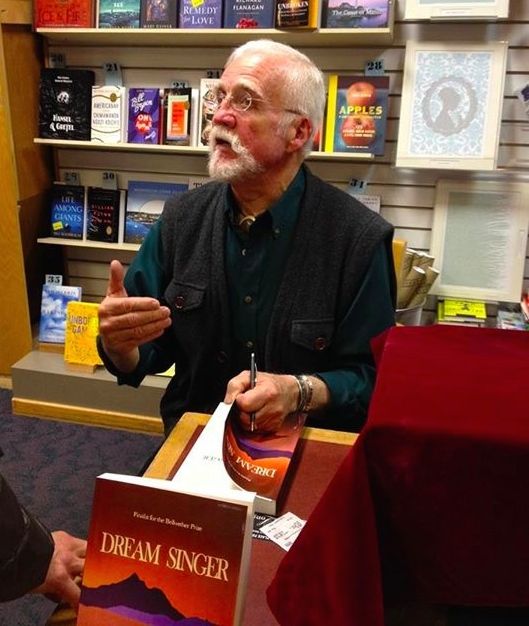 Shelf Unbound, an independent book review magazine, has named “Dream Singer,” a book by South Portland author Frank O. Smith, a Notable Book of the Year. Photo by Mei Selvage
Comments are no longer available on this story