
WESTBROOK – Officer David Thompson has been down this road before. For the last 13 years, Thompson has worked on a police K-9 unit, the last five in Westbrook, and has transitioned through three different partners – Murphy, Maria and Brady.
A few weeks ago, the Westbrook Police Department purchased a new dog to replace Thompson’s current partner, Brady, who will be retiring next summer. Now, Thompson has begun the transition process again, with training already under way.
Before Brady, Thompson’s partner Maria was credited with saving four lives. According to a May 2013 story in the American Journal about Maria, she saved a woman who had wandered away from her home, got lost and broke her hip, and had also found a person who tried to commit suicide and a person with dementia.
After working together for six years, Maria was diagnosed with degenerative myelopathy, an incurable, progressive disease of the spinal cord, which forced her retirement. She died shortly after her diagnosis.
The Westbrook Police Department has two K-9 units. The dogs, which cost $7,500 on average, live at home with the officers. In many other states, the dogs live at the office where they work.
Thompson, 48, began training K-9s, and their handlers four years ago. Westbrook now hosts training classes for K-9 units seeking the necessary certification.
Thompson grew up in Windham and lives in Scarborough. The American Journal spoke to him this week about Westbrook’s K-9 unit, the training process, and what makes a good police dog.
Q: Your K-9 partner, Brady, is set to retire soon. Tell me a little about the transition process. After working so closely with a dog, is it difficult to part ways?
A: The transition started a couple of months ago. Brady will be 9 in July, and that is getting up there in K-9 working years. By getting a new K-9 now, it gives us time to identify, purchase, and test a suitable K-9 prospect, select a handler, and train both to be certified as a team by the summer. It won’t be hard to part ways with Brady because he will still live with me.
Q: The Westbrook Police Department is acquiring a new police dog, Angie. What is the training process like? How long does it normally take? Is the process different depending on the dog?
A: First we needed to find a K-9 that meets our needs and requirements as an agency and community. Next, we need to pre-test the K-9 to ensure it had the qualities to attend school and pass a medical exam. Then the K-9 and handler will attend a Maine Criminal Justice Academy patrol school for four months, which consists of a written test for the handler and field test as a team, to include an evidence search, obedience, agility, tracking, building searches, and suspect apprehension. After graduation, the team must attend eight hours of monthly trainings and yearly re-certifications. When the team is proficient in patrol duties they can attend a drug detection school, which consists of another two-month school. After graduation, they must have another eight hours of training a month and yearly re-testing. Angie will be called Justice.
Q: You are also a certified K-9 instructor in the state. What does that mean? Is Westbrook a host for statewide trainings?
A: To be a certified instructor you first need to be an assistant trainer. To be an assistant trainer you have to work with a K-9 for a minimum of three years (usually it’s much longer) and then be identified by a head trainer as a candidate. Next, the handler needs to have 80 hours in each discipline (patrol/drug) under the supervision of a trainer. To be an instructor you need to be a K-9 handler for a minimum of five years, must complete 500 hours of training teams and train three K-9 teams that pass certification. Westbrook is a host of statewide trainings with teams ranging from Berwick to Houlton and agencies from the state police, county patrol, and municipalities. I am fortunate to have local businesses, such as Super 8 Motel, Boulos Management, Bill Dodge, and BSP Shipping that allow us to use their facilities to train at. We always need and are looking for areas to train at.
Q: What makes a successful police dog?
A: The selection process of the K-9 is important, which is why they cost so much. We are paying for a K-9 that is guaranteed health and the ability to pass certifications, which is huge amount of time and investment. They are not pets and more like elite athletes. Also, the training and testing that is required and the support of the agency and community is a big help. The most important thing a K-9 needs to learn is obedience. Obedience is the foundation for all other training. The K-9 needs to have a clear head to do what it’s told when it’s told to. That is why it’s not just the K-9 or a handler. It’s a “team.” The K-9 needs to trust and respect the handler to be clear headed.
Q: Tell me about your former K-9 partner, Maria. Why was she such a successful police dog? She was credited with saving four lives, correct?
A: My former partner Maria was a great dog and won accolades for saving lives. She was successful because of the reasons stated above. Brady is just as strong, and has found several suicidal and missing people. I have been lucky to have several great K-9s, that’s why I follow a process, because it works.
Q: How much of a police dog’s success rests on its handler’s shoulders? How does a handler establish a close relationship with a K-9 partner?
A: I think a little more than half of the success rests on the handler because he is in charge. A big saying is, the K-9 doesn’t make mistakes, the handler does. A handler establishes a relationship by being fair, clear, consistent, understanding, and realistic. These animals are not robots, they are social by nature; they have good days and bad days just like us.
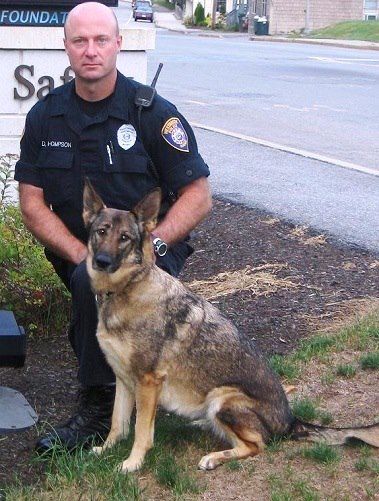 Officer David Thompson, who has been with the Westbrook Police Department for five years, is pictured here with his former K-9 partner, Maria. Thompson’s current partner, Brady, is retiring soon, and the process of training his replacement has begun.
Comments are no longer available on this story