
STANDISH – Dick Randall, 75, of Standish, the proprietor of the 109-year-old Randall Orchards farm on Route 25, has placed an agricultural conservation easement on about 300 acres of the property for a variety of reasons, he said Monday.
First, the easement, which was signed on Aug. 14 with the Presumpscot Regional Land Trust, ensures that a fourth generation of Randalls can continue to manage the farm, which was founded in 1905 by Edgar Randall. The permanent easement also provides the residents of Standish and Gorham with a scenic natural setting for low-impact recreational activities, as the two communities continue to field rapid residential development.
But Randall also envisions the protected farmland, which has about 7,500 apple trees, as an insurance policy for the Greater Portland area, in the case of a catastrophic event, such as a cyber attack that shuts down the nation’s power grid.
“If things go to hell in a handbasket, there’s still 100 acres here that’s been set aside by this trust so that local food can be raised here, whether we raise potatoes, tomatoes or apples,” Randall said, referring to the portion of the roughly 500-acre property that is suitable for farming.
With the placement of the easement, which protects 297 acres of farmland and forest on the property, in tandem with a December 2011 conservation easement, which protects 185 acres of mostly wooded property, Randall has now protected 482 acres of the property.
Randall has left a few portions, including an orchard at the farm’s Route 25 entrance, unprotected, in the hopes that those acres can be used for civic-minded development at some point in the future.
The Presumpscot Regional Land Trust of Gorham assisted Randall’s efforts to place the easement. According to Michael Parker, president of the trust’s board, the state’s Land for Maine’s Future program and the National Resources Conservation Service were the primary financial supporters of the project.
“This is a truly great event for the community,” Parker said. “It has been a pleasure and an honor for the land trust to help ensure that this landmark remain intact and that it be conserved as farmland for generations to come.”
On Monday, Randall relaxed on a face-to-face glider swing, in front of his orchards and the 1776 white farmhouse where he lives. Randall, who carries a breathing tube that plugs into his nostrils, said that his health has taken a turn for the worse in recent months. Now that he is beginning to suffer serious effects from his 2011 plane crash on Sebago Lake, Randall said, it is time to think about passing on the farm to the next generation.
“I’ve got two daughters and two sons, and it’s going to be passed on, and my health the way it is, I’ve got to get going at it quicker than later,” he said.
Randall disdains the residential “over-development” that has spread across the region, which he believes has been degraded and devalued by poor political management and suburban sprawl. The thought that his family farm would be converted into a subdivision appalls Randall.
“I could have developed this land when my father died,” Randall said. “I could have been the richest guy around. That isn’t what I was put on earth to do – squander your inheritance.”
Randall, a pilot who was in the business of aerial advertising for three decades, said that he watched meadows and farms turn into subdivisions as he flew above southern Maine through the years.
“I’d fly out of here and I’d head for Old Orchard Beach, and I’d look down and there’s a road in there to a field in behind there that I’ve flown over for 15 years and there’s six or eight houses in there in a year,” Randall said.
Randall believes that the suburban sprawl discounts the potential for catastrophic risk and the disruption of the global food supply chain.
“If every good piece of land gets sold to put a house on, then where is your backup plan?” Randall said. “The day will come when the Internet, that thing in the sky, does us more damage than Sept. 11. When somebody that’s very smart figures out how to screw with it and shuts things down for a very short time, what do you think it’s going to do to the airlines, the banking, the hospital industry? What do you think it’s going to do to transportation? I can still get to my customer base from here, and buying local is nothing wrong with it. You haven’t got 3,000 miles between where the guy raised it and 1,500 miles where the Mexican had to come to go pick it.”
Randall acknowledges that his farm could not sustain the metropolitan Portland population alone. But he thinks it could be part of a local agricultural network that could weather a disruption of the food supply.
“I’m saying if somebody’s over in Scarborough raising corn, and somebody’s over in Fryeburg raising potatoes, and Dick Randall’s in Standish raising apples, and somebody else is raising peas and beans in Cape Elizabeth, we’ve got to have enough land so rascals like that can continue to do it,” Randall said.
Randall said he hopes that someone will still be working his family farm in 200 years.
“I’m leaving a heritage, and the fourth generation’s going to take over the farm,” he said. “To me, that means something.”
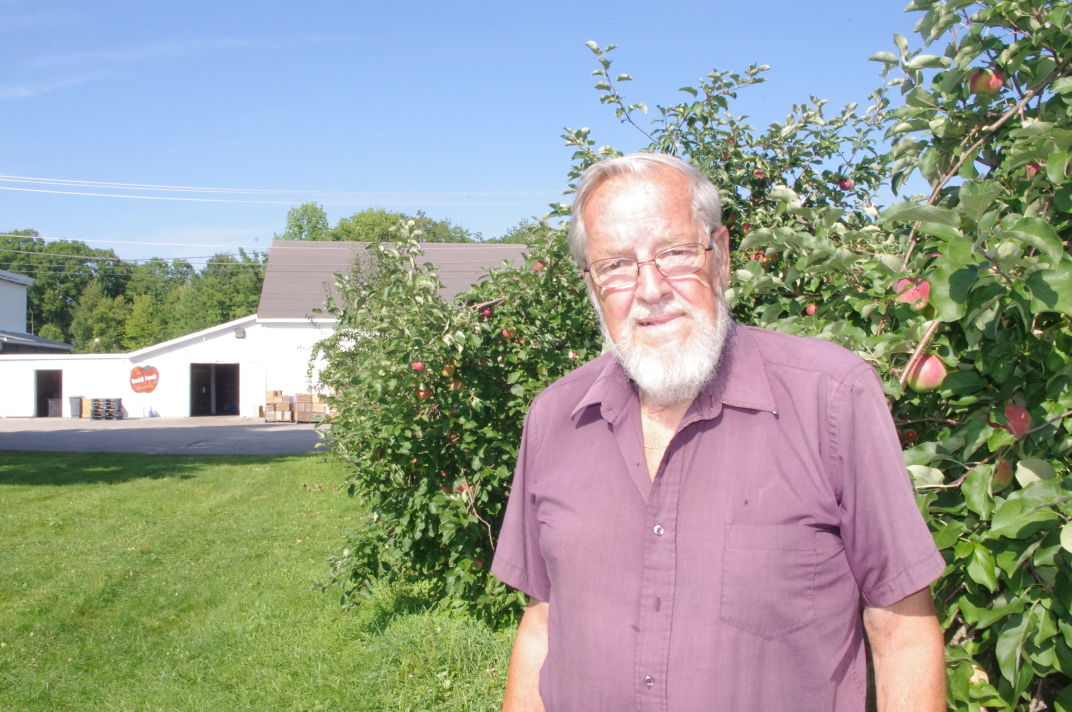 Randall Orchards owner Dick Randall has signed a conservation easement designating almost all of his 500-acre farm in Standish to the Presumpscot Regional Land Trust.
Comments are no longer available on this story