
CAPE ELIZABETH – If the Spurwink Rod & Gun Club does not receive a $28,000 grant from the Maine Department of Inland Fisheries and Wildlife, club leaders say it could take up to nine years to fully address noise and safety issues at its facility on Sawyer Road.
“If we had assistance with grant money, the whole upgrade would probably take three years,” said the club’s former president, Mark Mayone.
“We want to get it done as quickly as possible,” he said, of the upgrades.
Ironically, the grant was already approved by the state, but concerns from the gun club’s neighbors have derailed the funding.
Despite the club’s plans to make improvements to its 60-year-old facility, some residents of the Cross Hill Road neighborhood, which abuts the shooting range, continue to question the gun club’s operations and how it plans to address noise and safety.
According to Mayone, the Maine Department of Inland Fisheries and Wildlife said that residents raised concerns about noise impacts and safety. They were also concerned that by upgrading the facility, the club would be increasing its size and expanding the use of the shooting range, Mayone said. While the club is considering adding archery to its activities, the size of the range wouldn’t change, he said.
Efforts to contact concerned neighbors were unsuccessful by the Current’s deadline.
“We’re not expanding it; we can’t expand it. Physically, it is what it is,” Mayone said. “We’ve been here for 60 years. We’re not just going to fold up and leave.”
But not all of the Cross Hill Road residents are determined to shut down the shooting range, Mayone said.
“Some of the residents don’t mind the club being there at all and just want to know it’s as safe as it can be,” he said.
According to Tammy Walter, club president, a couple of individuals who live in the Cross Hill Road neighborhood recently approached the Department of Inland Fisheries and Wildlife expressing concerns related to what was written in the grant.
Just last week, the gun club learned that the money could not be issued as a result of the residents’ concerns.
“They said they have to do their due diligence,” said Walter, of the state.
Nathan Webb, special projects coordinator with the Maine Inland Fisheries and Wildlife, who contacted the club about the grant being delayed, could not be reached by the Current’s deadline.
Calling the move “ironic,” Walter said, “Among the primary reasons underlying the proposed changes and upgrades was our desire to directly address concerns which had been expressed by some of our Cross Hill neighbors.”
According to Walter, those who contacted the Department of Inland Fisheries and Wildlife “unnecessarily interfered” with the gun club’s plans to improve the facility in “a responsible and expeditious manner.”
In March, the Cape Elizabeth Town Council adopted a shooting range ordinance that regulates the operation and development of new and existing outdoor shooting facilities in town. The club has up to 12 months from the passing of the ordinance to meet town requirements.
A site walk was held on the property in July to give the town’s Firing Range Committee and residents a better idea of how the club plans to meet the new requirements. Improvements include erecting three additional 8-foot-tall, sound-absorbing walls according to National Rifle Association standards, said Mayone. For its 100-yard range, the club plans to increase its berm walls from 8 feet to 20 feet.
In addition to creating more barriers to improve shot containment, Mayone said that the club would implement a “no blue sky” design. This includes constructing a set of engineered baffles above the shooting range to contain stray bullets. A plan for mitigating sound is still being developed, he said.
Applying for the grant would only contribute to Phase 1 of improving the facility, Mayone said. Next year, he said, the club will continue to seek more grants for upgrades.
Ninety days after the shooting range ordinance took effect, on July 10, the gun club met its deadline for submitting a site plan and registration to the town. The Firing Range Committee determined, however, that more details were required for the gun club to come into full compliance with the ordinance, which addresses liability insurance, maintenance, hours of operation and more.
The gun club must comply with 100 percent shot containment, and noise levels must not exceed 65 decibels at the club’s property line if a home is within 1,000 feet.
Mayone said the construction of the barriers could have been completed by Sept. 15 if the club had received the grant. In July, Mayone said that a contractor was chosen and that he expected the work to be completed by October.
“We spent a long time on the grant,” said Walter. “It was actually approved, and we were signing the contract to get the money. There are a few people in Cross Hill (development) that I believe are determined to shut us down,” she continued.
Despite the setback, the gun club is still trying to meet the town’s shooting range ordinance rules, said Mayone. The Firing Range Committee met Aug. 13 to discuss the site plan and application. At the meeting, Code Enforcement Officer Ben McDougal said the club would need to hire a wetlands scientist to flag the edges of the shooting range and add it to the site plan. He said that he couldn’t issue a permit until the club’s license application is completed.
Construction likely won’t begin for another few months, he said. The Firing Range Committee still needs more details about construction plans, specifically with regard to shot containment.
On Monday, Walter said the club has hired a sound engineer to complete a sound contour study. The gun club is in the process of providing the committee its current and future shot containment and safety plans, she said.
According to Walter, “several neighbors at the Firing Range Committee meeting stated that they were opposed to the gun club using taxpayer money to improve the club.”
Under the federal Pittman-Robertson Act of 1937, the Department of Inland Fisheries and Wildlife funds come from hunting and fishing licenses and excise taxes on gun, ammunition and archery equipment sales.
Walter said she “didn’t want to paint everybody on Cross Hill (Road) with the same brush,” but she is “frustrated” that a few neighbors would be so determined to shut the club down.
“They don’t care about safety, they don’t care about noise. They don’t care about anything except for us not being there,” she said.
Mayone said at the end of July, he received a letter from the Department of Inland Fisheries and Wildlife stating that the gun club had received the grant. Within the first week of August, he said, the department called Mayone to notify him the site would need to be inspected by the state because of “concerns about the firing range and where it is situated.”
“It really caught us by surprise,” Mayone said. “It’s frustrating. Some of the residents just won’t be happy until the club is closed.”
Though a date has not been set, Mayone said the Department of Inland Fisheries and Wildlife would do a site walk of the property at the end of the month.
“The club is, and will, go through with the upgrades,” Mayone said. “We want to ensure all of our neighbors they have nothing to worry about as far as safety on their property.”
According to Walter, even without the grant, the gun club will continue to operate as it has for years. She said while the club was counting on the grant money for improvements, if it does not receive the grant, it would have to rely on community support and fundraisers.
“We have operated in good faith for years now,” she said. “We would like to make clear to everyone that we will continue to work in constructive directions so that a club which has existed in Cape Elizabeth peacefully for the past 60 years will continue to pursue its legal activities.”
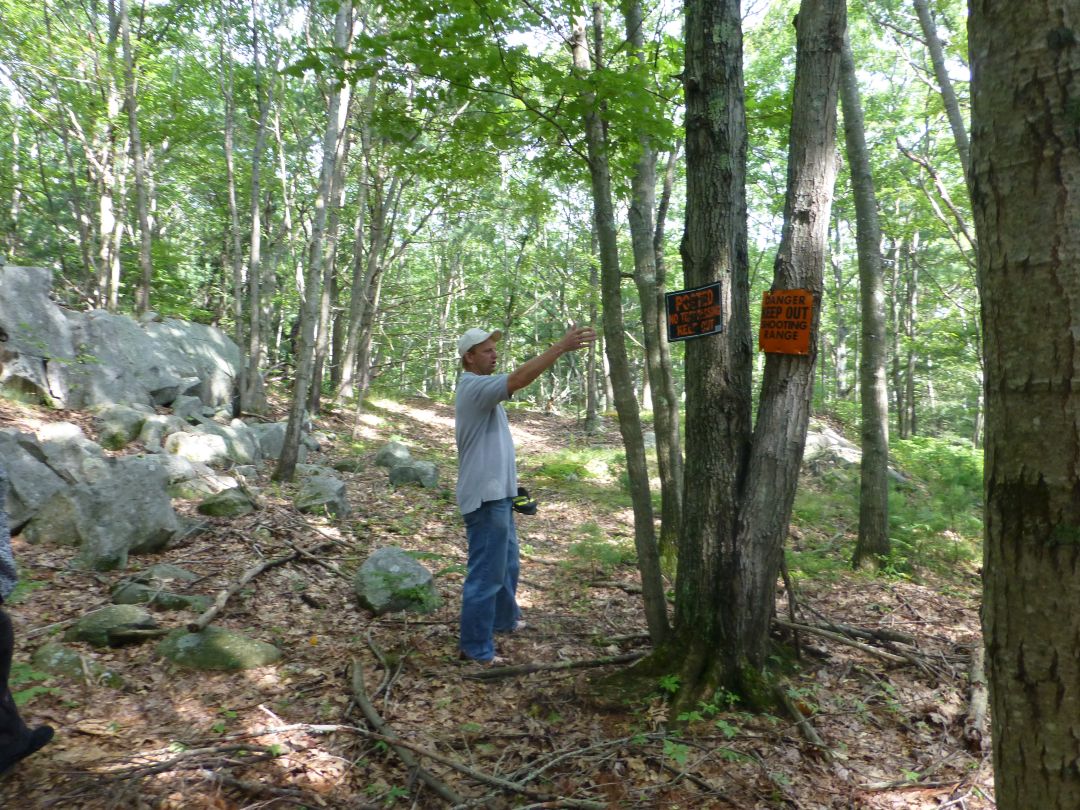 Mark Mayone, former president of the Spurwink Rod & Gun Club in Cape Elizabeth, points to no-trespassing signs that were recently installed along the property boundary to comply with the town’s new shooting range ordinance.
Comments are no longer available on this story