
SCARBOROUGH – Keeping the Scarborough Marsh, the state’s largest saltwater marsh, healthy and functioning well is the mission and passion of various diverse groups, including the Friends of the Scarborough Marsh and Maine Audubon.
This month groups of volunteers have been assisting the local Audubon society in assessing the state of the marsh by conducting plant, insect and bird surveys. And for the past several years the friends group has worked hard to eradicate the invasive plant species phragmites, a common reed.
Linda Woodard, director of the Scarborough Marsh Audubon Center, which is located off Pine Point Road, said this is the fifth year that Audubon has used volunteers to get an inventory of the many species that call the marsh home.
She said the goal is to compare data from year to year, which helps the experts to access the overall health of the marsh. Woodard said using volunteer labor is also a way of “empowering people to take ownership of the marsh.”
As part of the effort to get more people engaged, Woodard said the Audubon Center has also created a Scarborough Marsh Project on a new smartphone app called iNaturalist, which allows anyone, anywhere in the marsh to upload photos about what they are seeing.
She said the volunteer surveys, as well as the iNaturalist app, are allowing those who work on conserving the marsh an opportunity to really see what’s out there.
“We’ve found some fun stuff we didn’t even know was here,” Woodard said. “We’re finding some truly interesting things.”
Rick Vogel, president of the Friends of Scarborough Marsh, said the group first formed in 2000 with the goal of “protecting wildlife habitat, restoring the salt marsh closer to its original state, conserving neighboring land and educating the public about the ecological and economic significance of this precious resource.”
The friends group is made up of a coalition of private citizens, businesses, civic organizations and governmental agencies, such as the Maine Department of Inland Fisheries and Wildlife, Vogel said.
Four years ago the state and the friends, along with other partners, began an effort to remove phragmites from various areas of the marsh, totaling about 100 acres. Vogel said the overall goal of the eradication project was to achieve a 95 percent or greater elimination rate.
The expectation is that some re-growth will occur, but Vogel said the friends would closely monitor the situation in the coming years in order to prevent large stands of phragmites from growing back.
He said the importance of removing phragmites is that this “aggressive wetland grass can be an indicator that a wetland ecosystem is out of balance.” Vogel added, the “thick and rapid growth of phragmites (also) chokes out valuable plants and reduces the biodiversity of the marsh’s delicate ecosystem.”
He said residents could help protect the marsh by taking “appropriate care with lawn fertilizer applications” and “choosing garden plants wisely,” such as avoiding non-native species like purple loosestrife, Japanese barberry, bittersweet, rambler rose, Japanese knotweed and certain honeysuckles.
Other measures residents and visitors to the marsh could employ include proper disposal of trash, using slow speeds when boating in the marsh, helping to educate others about “this unique habitat,” respecting wildlife in the marsh and volunteering with local conservation groups, like the Friends of Scarborough Marsh.
Both Woodard and Vogel said keeping the marsh healthy is vital because it accounts for 15 percent of Maine’s total salt marsh area, and it provides essential breeding and feeding habitat for plants, birds, mammals and fish including various rare, threatened or endangered species.
Vogel also said the marsh is important because it shelters “us from winds and waves. It buffers our shoreline against erosion during storms and has an outstanding capacity to absorb flood waters.”
In addition, the marsh serves “as a great recreational venue, as a source of scenic beauty, as an outdoor classroom for environmental education and as a nursery for numerous commercial fisheries supporting jobs and the local economy,” Vogel said.
A CLOSER LOOK
For more information about the Friends of the Scarborough Marsh and its various marsh conservation and restoration efforts, see www.scarboroughmarsh.org.
Also, go online to https://maineaudubon.org/find-us/scarborough-marsh for more information about the Maine Audubon’s Scarborough Marsh Center and its various educational programs.
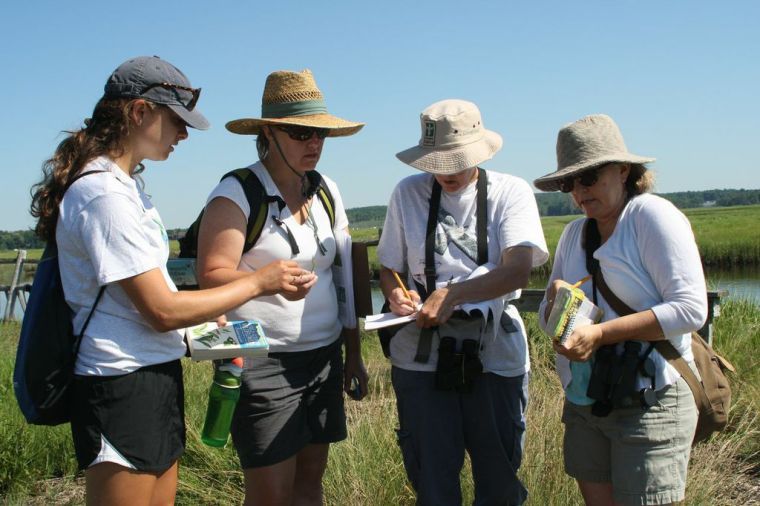 Earlier this month volunteers helped the Scarborough Marsh Audubon Center conduct a plant and insect survey. The results of the survey will be used to evaluate the overall health of the marsh.
Comments are no longer available on this story