
In 1840, Charles Dickens and Victor Hugo were bestselling authors. Antarctica was discovered that year, and most new babies were named Mary or John. People were, for the most part, still cooking on hearths and fireplaces. The United States wasn’t 100 yet, but Windham celebrated its 100th birthday in 1839 when almost 2,300 people lived in town.
Windham had 361 houses and most of the people were farmers. Many of the residents worked at one of the mills along the Presumpscot River. These included five sawmills, a chair manufacturer, a woolen mill, a mill that made wooden kegs, three grist mills, seven grocery stores and two tanneries where leather was produced. In those days, travel was made possible by horses and Windham had 10 blacksmith shops that made horseshoes, along with many essential tools.
The town owned two properties: The town house (or town hall), which cost $750 to build and a poor house (farm and buildings) that cost $2,500.
Children (884 of them between the ages of 5 and 18) attended neighborhood “district” schools.
The 18 districts were named Anderson, Little Falls, Gambo, Pleasant River, Windham Corner (today’s Windham Hill), Amos Hawkes, Kennard’s, Bakers Corner, Dole’s, Ireland, Scotland, Canada Hill, Plains, Windham Upper Corner (North Windham), Hodsdon’s (Windham Center), Friends, Great Falls and Outlet.
Ireland school in East Windham had the most population, with 78 children in the school on Nash Road near Falmouth Road. The Outlet school near the Raymond line had the fewest at seven. Each of the 18 districts was administered by citizens in the district, who had petitioned the town to get permission to either build or start a school. The citizens set the tuition, hired the teacher(s) and furnished the school, including the books, slates and supplies. Schoolhouses were generally one-room and within walking distance of everyone in the district.
In 1840, Windham had a post office in South Windham, North Windham and at Windham Hill. There were two doctors in town, the Parsons brothers, both at Windham Hill.
Abraham Anderson was the oldest person in town at 82 and he had been born in the Province fort.
Statistics for 1900, just 60 years later, show how Windham had changed, due partly to the Civil War and other elements causing people to leave.
In 1900, the census shows a total population of just over 1,900 with 435 (half of the 1840 number) school pupils. By this time, many of Windham’s “district” schools had already begun consolidating.
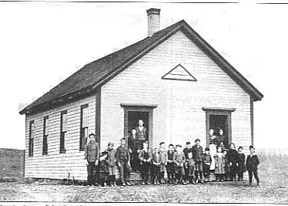 The Anderson School, on lower River Road, as it appeared about 1900. The first school built was in this first-settled section of Windham and originally was near the Parson Smith House. The building shown here was probably the second structure known as Anderson School and is today a privately owned home.
Comments are no longer available on this story