
POWNAL – Life is unhurried at Tir na nOg Farm in Pownal.
Partners Holly Morrison and Susan Mack do have outside jobs that keep them busy, but the animals on their organic farm live according to a natural cycle, in the Celtic tradition. The pigs and cows are not stressed by overbreeding. They feed on the grasses of the farm, located at 44 Leighton Road, a dirt road well into the woods, yet so close to the up-tempo life of the midcoast. Chickens are free range. Crops are grown organically, in greenhouses.
“We believe that each kind of animal should live the way it was designed to live,” said Morrison, who is a United Church of Christ minister at Poland Congregational Church. “We raise them the old-fashioned way, avoiding chemicals and large equipment.”
In Irish, Tir na nOg means “Land of Youth,” a mythical island of happiness west of Scotland and Ireland, where people go to their final resting places. No one suffers on Tir na nOg.
“Who wouldn’t name a farm that?” said Mack, who is family services coordinator at Freeport Community Services.
Morrison and Mack have four Scottish Highland beef cattle, 16 Tarnworth pigs and 70 chickens on the 45-acre farm. They raise their vegetables in two greenhouses and another located at nearby Alpaca Farm.
They cooperate with like-minded farmers and share resources with them – just like farmers used to do.
“We run our pigs up to Alpaca Farm to help them clear the land for new pasture,” Morrison said. “We’ve become really good farm neighbors. In a way we’re returning to a village model of agriculture.”
“We use the neighbors’ lawn sometimes to graze our cows,” Mack said. “Neighbors help with the bees.”
Morrison and Mack sell their produce, meat and eggs on the premises and at the Cumberland Farmers Market Association, which runs farmers markets in Cumberland and Falmouth. They offer unusual products such as foraged mushrooms, heirloom tomatoes and many kinds of edible plants.
“We’re doing better all the time,” Morrison said. “We’ve developed a customer base.”
Tir na nOg Farm operates thanks in no small way to volunteers from the Willing Workers on Organic Farms (WWOOF) program, which has spread to this country from, naturally, the United Kingdom, where it started about 40 years ago. Rooted in Celtic-British tradition, it is a networking system that allows member farms to seek assistance while allowing “WWOOFers” to seek hands-on education in sustainable agriculture. Farmers and volunteers arrange the details of each informal internship, everything from a single weekend stay to full-season or full-year engagements.
Morrison did a blog post a few years ago, called “The Gael Who Cried WWOOF.” Most of their WWOOFERS stay for up to a month, though occasionally some volunteers remain for a full season. This summer, Jon Martin of Michigan and Rachel Drescher of Virginia have been the WWOOFERS. It’s the first such experience for both. Drescher, 22, headed back to Indiana at the end of June while Martin, 23, heads back for his final year at Northern Michigan University in mid-August. They feed and care for the animals, maintain the greenhouses and eat farm-fresh food.
“I love it,” Martin said, as he combed one of the Highland cows.
Tir na nOg Farm is lively with the noises of roosters crowing and piglets squealing with delight as they are being fed.
“That one was a rescue rooster,” Morrison said, pointing to one that was making a ruckus. “Somebody called us in desperation. It’s common for people to dump roosters in the country, because they can’t have them in towns. They produce fertile eggs. And like the hens, they contribute to tick control.”
Mack came to what was a broken-down piece of property in the early 1980s, and raised two sons there. Following a divorce, she and Morrison got together in 2001.
“We had this crazy dream, starting up a farm,” Mack said. “But it’s a crazy balancing act.”
Morrison hails from a farming family in the Pacific Northwest.
“In 2006,” Morrison said, “we became a serious operation. We hooked up with the Cumberland County Conservation District, where we’re both on the board, and the USDA. Our goal is to make the land better than we found it.”
Nutrients in the topsoil were stripped when Mack arrived there. They still find broken glass, metal, bricks and fragments of shoes when they turn up the land.
“We envisioned plants and animals guided by the Celtic tradition of crofting,” Morrison said. “We let the lay of the land and the rhythm dictate them. We’re constantly learning.”
The farm’s offering of edible plants includes calendua, pea flowers, nasturtiums, day lilies, tuberous begonias and roses.
“Usually when we bring things to market there are raised eyebrows,” Morrison said.
The bacon is a big hit, with customers and on the farm.
“Oh, our bacon,” Mack said. “We’re getting a reputation for our bacon. It makes me hungry thinking of it.”
The Celtic tradition at the farm extends to music. Mack plays the bagpipes and Morrison sings traditional Gaelic songs. They tell stories. The WWOOFERS love it.
“It’s a good excuse to have a campfire,” Mack said.
“We listen,” Drescher said. “We are the audience.”
As they spoke, two people on horseback rode by the dirt road at a leisurely gait. It all fit.
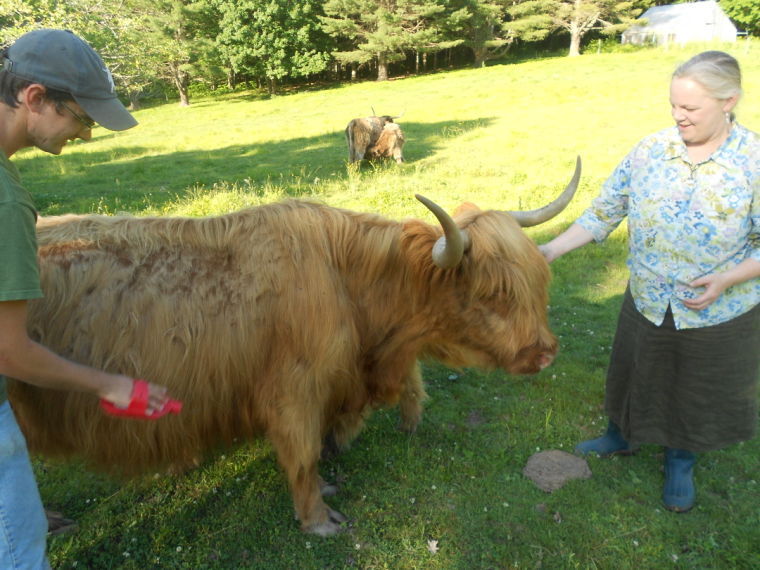 Holly Morrison and volunteer Jon Martin comb one of the Scottish Highland cows at Tir na nOg Farm in Pownal.
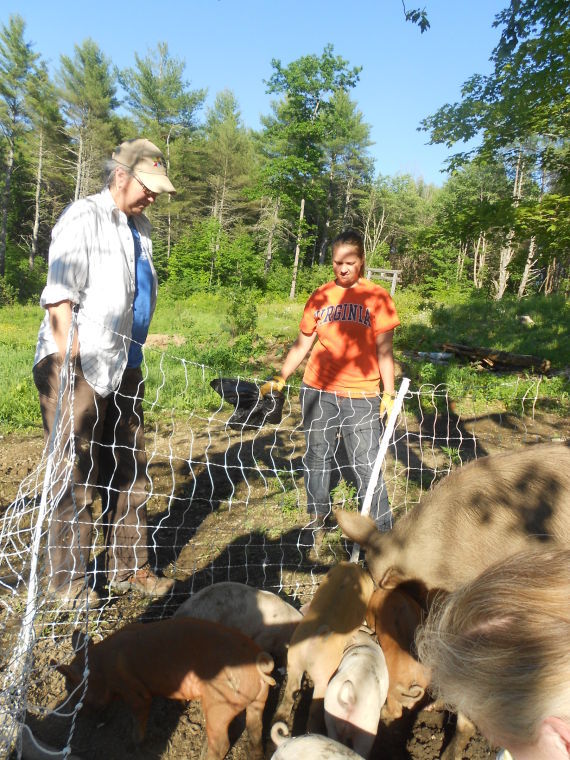 Susan Mack, who with her partner Holly Morrison owns Tir na nOg Farm in Pownal, and volunteer Rachel Drescher watch piglets feed.
Comments are no longer available on this story