
WESTBROOK – Students from Westbrook and Gorham middle schools described their unique efforts toward sustainability in front of a large audience on Monday, as both programs were awarded $1,000 from the Chewonki Foundation’s Zero Waste Challenge.
The Chewonki Foundation, an environmental education organization based in Wiscasset, launched the Zero Waste Challenge three years ago, and has since inspired middle schools across the state to compete in the program.
Participating students are charged with helping their schools save money and resources by evaluating waste streams and creating plans to reduce waste. Teams are then judged on their plans. Last year Gorham and Westbrook finished in first and second place, respectively.
On Monday, in front of a large audience at the Westbrook Performing Arts Center, judges of the competition announced the awards for 2014. Judges included representatives of Pine Tree Waste and EcoMaine.
According to Tom Twist, the sustainability officer for the Chewonki Foundation, this year’s challenge included two categories, one for programs that have yet to receive prize money, and one called “Frequent Flyers,” reserved for schools, such as Westbrook and Gorham, that have been honored in the past. Frequent Flyers are judged on the results of already-established programs.
Twist said that judges have been “overwhelmed” with the submissions to the challenge. In describing Westbrook and Gorham’s programs, he said that both were so strong that judges decided to award both schools the $1,000-dollar prize.
He added that Westbrook’s team, which created an in-depth website to coincide with their program, “knocked their socks off,” and he said the teams from Westbrook and Gorham had to institute goals for their projects to keep going, as many students who received awards last year had moved on to high school.
Last year, Westbrook student volunteers were used each lunch period to direct those finished with their meal to dump their trash, food, liquids, recyclables and reusable’s into specifically labeled bins. Now, the school doesn’t need assistance.
According to the Westbrook team’s website, the initiative has reduced the waste in the cafeteria by 94 percent, and where custodians used to throw out eight-12 bags of trash each day, they are now only tossing one, on average.
Last year, Gorham’s first place team hung signs around their middle school informing fellow students of what could be recycled and steered school administration to buy smarter when making purchases, such as buying new reusable silverware and recycled products.
While speaking to the audience on Monday, Twist said that he is proud of all the students for taking the initiative to participate in the program, and not “waiting for life” to happen.
“I’m tremendously appreciative of you students who are here, and who have ceased waiting,” he said. “You’re making change happen right at your very own schools.”
Al Hardy, a Westbrook Middle School special services aide who has assisted with the program the last two years, said this year’s team fine-tuned its sorting system and has also spread the word throughout the district.
“In terms of success, we’re in a situation where there is probably five times as much recycling being hauled out of here than trash,” he said.
Hardy added that outside of the school cafeteria, the students are looking at more ways to initiate recycling in all classrooms, including bins in each room, as well as initiatives aimed at reusing items during annual locker cleaning that are normally thrown away.
Students from Leonard Middle School in Old Town took home first prize in this year’s challenge, followed by Troy Howard Middle School in Belfast and Brunswick Middle School.
Many teams introduced sorting and recycling techniques in their school cafeterias and worked toward producing compost for gardens. Westbrook’s program, which this year expanded to the high school level, already has a composting system in place.
Brett Richardson of Resurgam Zero Food Waste, a Portland-based company that works with area schools to pick up food waste and compost, said Monday that the Zero Waste Challenge is a “win-win” because it boosts recycling and creates a learning opportunity for students.
According to Richardson, Resurgam works with 18 schools in the greater Portland area, gives training to staff and feedback for the overall program, and the end result is organic certified compost that is used to grow “tomorrow’s food.”
“The students do a terrific job to help reduce waste, and we’re proud of our partnership with Westbrook,” he said.
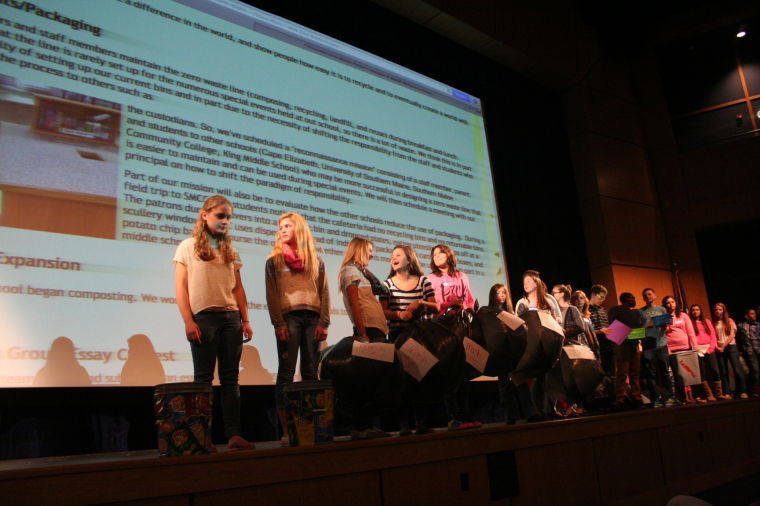 Students participating in Westbrook’s Zero Waste Challenge line up Monday at the Westbrook Performing Arts Center while accepting an award from the Chewonki Foundation for their initiative to reduce waste. Students are seen with examples of the number of trash bags and other waste that has been saved on a daily basis.
Comments are no longer available on this story