
FREEPORT – Amber Tatnall, library director at York County Community College and author of “The Trolley Parks of Maine,” will present a talk and illustrations on the history of trolleys in Maine on Wednesday, March 12, at the Freeport Community Library.
Tatnall’s presentation will include a segment on Casco Castle, built in South Freeport in 1903. The event, which begins at 7 p.m., is free.
A 1985 Bates College graduate, Tatnall lives in Kennebunk. Her fiance, Randy Leclair, is the shop manager at the Seashore Trolley Museum, and will speak with Tatnall at the presentation.
Tatnall, who said she likes to drive around Maine searching for traces of old trolley parks and railroad buildings, answered some questions from the Tri-Town Weekly about her fascination with old trolleys.
Q: Is “The Trolley Parks of Maine” your first book? How did you become interested in the subject?
A: Yes, it’s my first book. It grew out of an online exhibit of the same name that I helped to create for the Maine Memory Network. I originally became interested in the subject almost by accident. I am a volunteer for the Seashore Trolley Museum’s Library, and while learning about the technology and business of electric railways, I also learned of the existence of these parks. It was fascinating to me that the trolley parks existed all over Maine, and yet there is little trace left of them today. I’ve always been very interested in social history, especially around the turn of the century, so it was very fun to do the research.
Q: Would you think of the trolley parks as a precursor of sorts to the old roadside motels that served the early motorists? But there also was more to the trolley parks, wasn’t there?
A: No, not a precursor of roadside motels, but the parks that successfully negotiated the arrival of the automobile (and very few of them did) were the precursors to early amusement parks. Canobie Lake in (New Hampshire) was originally a trolley park, for example. Lakewood Theater in Madison was also originally a trolley park. These parks were originally created as a way for electric railway companies to make money on Sundays. During the work week, the cars were running, moving freight, delivering folks to work. But on Sunday, they sat idle. So the companies came up with the idea of trolley parks. They would buy some cheap land outside of town (and in the double-fare zone), create an attractive destination, and then rake in double-fares all day long. And this is actually how the suburbs came into existence, as people built their homes outside of the city, but near the tracks for an easier commute.
Q: Did most people on trolleys travel alone or as couples? Were they used mostly to get to work, or for recreation?
A: All of the above, and also in groups. During the work week (Monday through Saturday), people rode the trolley cars to work or to run errands in town. Street railways were the first affordable public transportation within and between towns, typically costing only a nickel for a one-way, one-zone fare. On Sundays, travel was mostly recreational: going to a trolley park, going to the beach, going to church, etc. Groups could hire trolley cars for special excursions as well. For fancier events, like bridal parties, you might hire a “parlor car.” These cars were beautifully appointed with velvet upholstered arm chairs, curtains in the windows, mirrors, and stained glass windows, wrought iron railings, and highly varnished cherry or mahogany woodwork, all for only $5.
Q: What’s the time frame we’re looking at here?
A: 1863-1947. The automobile was the death-knell for trolley cars.
Q: Can you tell us about South Freeport’s Casco Castle, when it was built, its duration, what was there and the crowds it drew? Was it festive?
A: Here is the section on Casco Castle from the book: “The Portland & Brunswick Street Railway opened Casco Castle Park in 1902. The park’s casino was unlike any other in the state of Maine. It was built to look like a real castle, with stone-colored shingles, crenellations, parapets, and a 100-foot-tall tower. It even had a moat. Passengers disembarked from trolley cars at an enclosed waiting room. They then made their way across a 300-foot long suspension bridge that spanned the deep ravine of Spar Creek.” The imposing, castellated hotel could house 100 guests who paid a mere $3 for a night’s stay, including meals. Broad piazzas extended entirely around the building on the first and second floors, inviting guests to relax and enjoy the view. Up among the parapets on the hotel roof was a roof-top garden. The tower, build of local stone, had an electric elevator and observation stations that commanded a broad vista of land and sea. A small zoo delighted the children. Despite its grandeur, Casco Castle Park was never a profitable operation for the railway company. In 1910, with the entire railway company in financial difficulties, the property was sold. In 1914, the hotel and casino wer destroyed by fire. The tower, however, is still standing to this day and can be viewed from Freeport’s Winslow Park on Staples Point Road.
Q: What were the amenities at a typical Maine trolley park?
A: Most trolley parks had a “casino” – not a gambling establishment, but a place to dine, play cards, billiards, dance, listen to music or lectures. Some of the more ambitious ones had a theater. Restaurants were also pretty standard. Other features: gardens and walking trails, picnic areas, croquet courts, small zoos, swimming, boating, sport fields, steam carousels, playgrounds, dance hall and a bandstand.
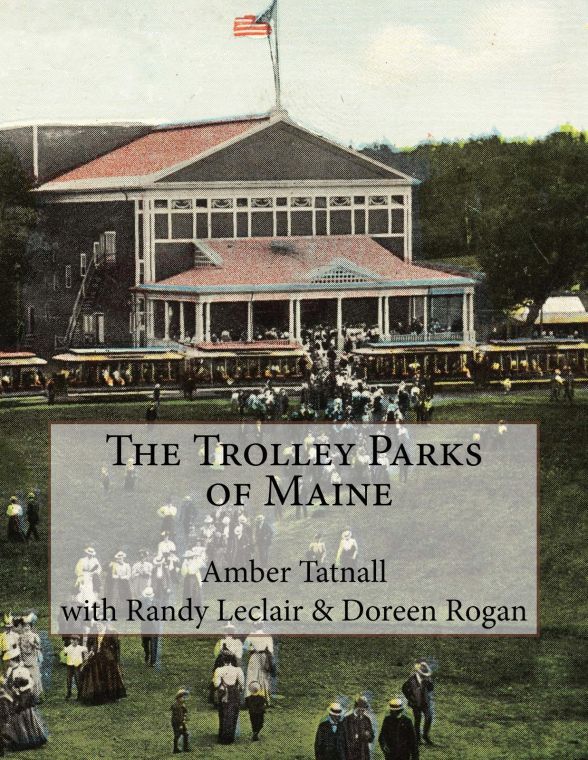 Casco Castle, built in South Freeport in 1903, is among the attractions covered in Amber Tatnall’s book, “The Trolley Parks of Maine.” She will talk in Freeport next week.
Comments are no longer available on this story