
CAPE ELIZABETH – Cape Elizabeth has received a $182,567 grant from the Maine Department of Environmental Protection to launch the second phase of efforts to clean up Trout Brook, a three-mile-long stream on the state’s list of “urban-impaired” water bodies.
The impaired classification means Trout Brook does not meet state and federal water quality standards due to polluted runoff from “impervious cover,” such as roads, roofs, parking lots and other hard surfaces. Additionally, until 2005, a “combined sewer overflow” discharged effluent directly into the brook whenever heavy rainstorms backed up the sewer system. That same year, the department conducted water quality sampling completed during development of a Watershed Management Plan, now followed in both Cape and South Portland, and found areas with low dissolved oxygen, elevated phosphorus, and elevated chloride, all life-threatening to the brook’s namesake, as well as a host of other flora and fauna.
In 2006, a study prepared by the South Portland Land Trust, with the help of a citizens group that had worked to collect water samples since 2002, found 86 separate pollution points into the stream, seven of them toxic. Those, according to land trust Executive Director Jon Dore, were due in part to the fact that 13 percent of the land area around Trout Brook Nature Preserve is made up of impervious surfaces.
The total watershed for the steam, which begins near Maxwell Farm in Cape and runs to Mill Creek Park in South Portland, is 2.35 square miles. Most of that area, 1.45 miles, is in Cape.
The grant will help pay for a manure storage shed at the Walnut Hill Equestrian Center, which abuts the stream, as well as a “gravel wetland” to capture stormwater runoff, both at the horse farm and at the adjacent Church of Latter Day Saints. Work will begin this spring, necessitating review of the projects at a March 4 Planning Board workshop.
According to Town Manager Michael McGovern, most of the town’s $22,000 match for the project was paid with fees received from the Eastman Meadows Condominium project, which is located in the Trout Brook watershed and triggered state review. According to McGovern, under the state’s Site Location of Development Law, when a development is located in an urban impaired watershed, it must either complete a stormwater mitigation project or pay a fee. Cape Elizabeth is authorized to collect such fees under a Community Fee Utilization Program allowed by the state and adopted by the Town Council in 2007.
However, the council had to vote to add this spring’s work, as listed in a 2011 Trout Brook Watershed Management Plan, to the list of projects for which the fee can be used.
“The DEP strongly supports the efforts to restore the Trout Brook watershed and has indicated that a letter from the town requesting expansion of the Community Fee Utilization Program should be adequate to qualify the cash match,” said McGovern.
The Trout Brook Watershed Management Plan was created using a $35,000 grant from the state, which last year funded implementation with another $70,000 grant. The first steering committee meeting was held last June.
“The fixes are pretty straightforward,” said Fred Dillon, stormwater program coordinator with the South Portland Water Resource Protection Department, who is heading up Phase I implementation there. “A lot of it is working with abutting landowners to put in buffers and more benign landscaping practices.”
According to Patrick Marass, urban watershed coordinator with the Cumberland County Soil and Water Conservation District, which developed the watershed plan alongside South Portland and Cape Elizabeth, the Phase I grant reimbursed the owners of land abutting Trout Brook for up to 50 percent of materials they purchase to build those vegetative buffers.
In Cape, however, Phase II work will be administered by the town, rather than completed by private landowners, while Cumberland County Soil and Water Conservation District will serve as project coordinator, with Cape offering in-kind services from Town Planner Maureen O’Meara and other staffers.
Together, the town and the conservation district will complete a field survey of the two properties and surrounding project area, complete engineering designs for up to six project areas on the two lots and complete construction by the end of this year.
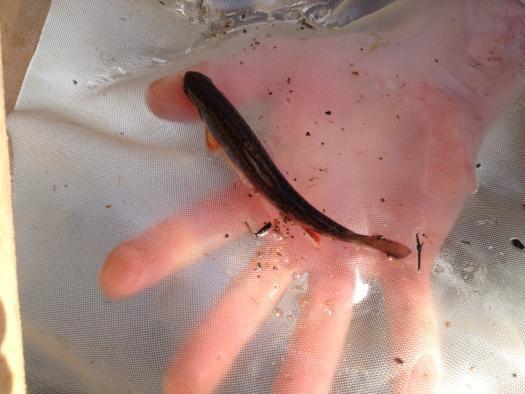 In a photograph taken last May, Thomas Parr, a doctoral student at the University of Maine, shows off a juvenile brook trout captured in Trout Brook, just below the culvert at Providence Avenue, in South Portland, proving that at least some fish released by local students in 2012 did survive to maturity.
Comments are no longer available on this story