
Steven Bridge, a professor of theology at Saint Joseph’s College of Maine, has been traveling to Haiti since 1992. But this year, inspired by a recent trip to Guatemala, Bridge brought his $3,000 diamond-cutter along – a first.
“I was in Guatemala a few years back, and we were digging a foundation,” said Bridge, a resident of Naples and self-described rock hound who crafts jewelry out of the gems he finds. “As we were digging it, I came across this glass bottle. It was a beautiful cobalt blue, and I thought, ‘I bet I could cut and facet this.’ So I picked up some of the shards of glass, and I took them back with me, and I cut some pieces here in the United States. They’re beautiful, but I didn’t really make too many connections until I got thinking a little more about this Haiti trip.”
In planning for his annual service trip with St. Joe’s students, Bridge realized that he could teach Haitians how to use the diamond-cutter, despite the fact there is a scarcity of easily retrievable precious gems on the island, the poorest country in the Western Hemisphere.
“They don’t have tourmaline lying around down there,” Bridge said. “They don’t have quartz lying around down there. Actually what they have is a lot of garbage. They don’t have any systematic sanitation. What they’ll do is they’ll burn their garbage. They’ll burn what they can. But what they can’t burn is glass. So consequently you’ve got glass all over the place down there. You’ve got it in the dirt, it’s broken, it’s discarded, it’s trash.”
When Bridge arrived in the Port-au-Prince area in early January, diamond-cutter in hand, he started to teach seven Haitian women how to cut glass using the solar-powered tool. By the end of Bridge’s trip, the group had cut a 19-carat dodecagon, a 4.31-carat octagon, a 2.17-carat trillion, and a 5-carat octagon.
“These women went around and they picked up pieces of this discarded glass,” Bridge said. “We had some blue glass, we had some sea foam green glass, we had some emerald green, and we used that and we cut it and polished it and we basically produced gemstones from it. They’re beautiful. They came out gorgeous. They look like diamonds. They look like emeralds. They look like sapphires.”
Bridge, who is now back in Maine, left the diamond-cutter in Haiti. The glass jewels have been sold on eBay for $306.50 – half of which went to the women as wages, and half of which went toward equipment maintenance. The women have now cut two more of the glass items on their own, Bridge said.
Bridge frequently monitors the project and plans to visit the women soon. He hopes that the women will be able to sell the glass in the future, without merchandising it as a charitable purchase.
“My goal is to get them to produce something so beautiful that people are going to want it regardless of the back story,” Bridge said, “something so beautiful and high quality that people are going to say, ‘I’m willing to pay for this regardless of the back story.’ ”
Bridge hopes the women will expand the operation, and that more Haitians will take up diamond-cutting in the future.
“I think it’s got tremendous potential,” he said. “Absolutely. That’s the idea. We start with these seven women with one machine and see how far they can get. Hopefully they can start to produce and start selling, and maybe get a second machine.”
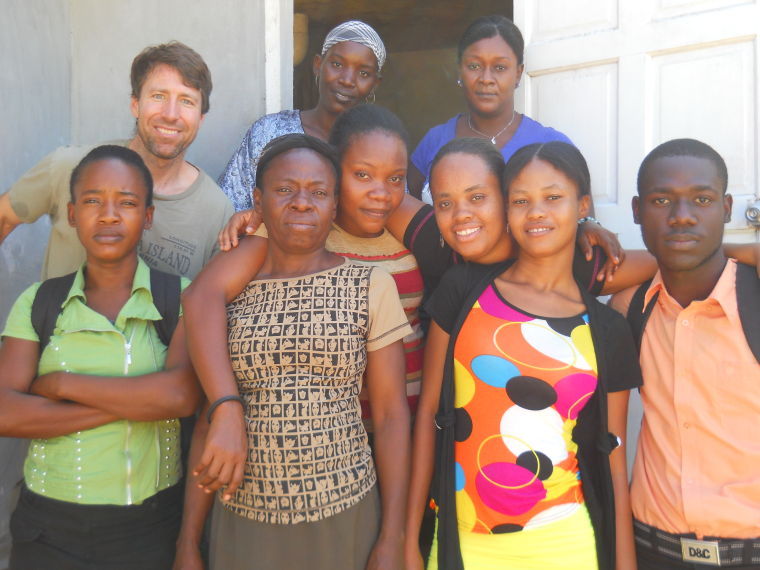 On his recent service trip to Haiti, Steven Bridge, top left, a theology professor at Saint Joseph’s College in Standish, taught a group of Haitian women how to make jewels using shards of glass.
Comments are no longer available on this story