
SCARBOROUGH – After butting heads through its first few meetings, Scarborough’s ad hoc Animal Control Advisory Committee started to make headway Monday on crafting dog regulations that both dog and bird supporters can agree on.
In meetings on Jan. 6 and 9, the seven-person committee failed to find consensus on its charge, to recommend to the Town Council new rules regulating dog access to Scarborough beaches during the summer.
Town officials hope to mitigate a $12,000 federal fine levied against Scarborough following the mauling of a plover chick by a dog on Pine Point Beach on July 15. An Oct. 2 council attempt to make the problem go away by requiring dogs to be leashed when on any public property, anywhere in town, year-round, was beaten back by voters at a Dec. 3 special election, which reset the leash law as it exists now.
That rule allows dogs to run free on municipal beaches between sunrise and 9 a.m. from June 15 to Sept. 15. During those months, dogs are banned from beaches between 9 a.m. and 5 p.m. and can put in an appearance from 5 p.m. to sunset only if on a leash. There are no restrictions between Sept. 16 and June 14.
The U.S. Fish and Wildlife Service recommends that dogs be limited to leashes no greater than 8 feet in length between April 1 and Aug. 30. Town councilors hope to satisfy the feds by having something in place to control dogs before the start of this year’s plover nesting season in late April to mid-May. However, anything to come out of the advisory committee needs time to work through the public hearing process, which gives the panel very little time to act. The council set a Jan. 21 deadline for an initial committee report.
In early meetings, the committee members – three recruited from Dog Owners of Greater Scarborough (DOGS), three picked for prior plover advocacy, and Councilor Bill Donovan – have circled each other, largely limiting themselves to marking out territory.
“If all our intent here is to simply adopt the U.S. Fish and Wildlife guidelines and eliminate all off-leash time in the morning for dogs, then we’re never going to reach a compromise,” said committee member Katy Foley, president of the DOGS group, laying out her line in the sand.
Meanwhile, the committee, in a strict party-line vote, with Donovan taking the bird side, decided 4-3 at its Jan. 6 meeting against asking the Town Council for a deadline extension.
That prompted general derision from a 30-strong audience of DOGS members, who have said they feel railroaded by the committee-selection process – members were recruited by Town Manager Tom Hall following a special council workshop on Dec. 4 – and the short turn-around time the committee was given to complete its work.
“The handwriting seems to be on the wall that the committee is stacked four-to-three to get a pre-conceived outcome,” said DOGS spokeswoman Suzanne Foley-Ferguson in a Jan. 9 email. “Overwhelmingly, the people in our group are furious at how this supposedly transparent process is going down.”
Donovan and the three plover advocates on the committee – Glennis Chabot, Lucy LaCasse and Noah Perlut – have taken a hard line on protecting the endangered shorebird by severely limiting dogs on the beach.
“We are almost half of what the productivity rate is for the state of Maine,” said Donovan. “We are doing very poorly. It shows we are underperforming dramatically.”
According to Traczie Bellinger, a seasonal biologist with Maine Audubon specializing in piping plovers, Scarborough remains a hard habitat for plovers. Statewide, the productivity rate for the bird, defined as the number of surviving chicks per mating pair, was 1.9 this year. That’s up from 1.52 in 2012. Fish and Wildlife says 1.5 is the minimum needed to sustain the species.
In Scarborough, however, the productivity rate of the four nesting pairs observed was a mere 0.7 percent.
However, committee members Margot Hodgkins and Daniel Ravin have generally sided with Foley, who says humans, home construction, fireworks, cats, wild animals and even rising sea levels are all more to blame for poor plover productivity than any presumed canine culpability.
While the two voting blocs held firm Monday, the meeting was marked by an early agreement on a bookend range of dates to consider. The dog side agreed to begin leash restrictions April 1, instead of June 15, while birders approved truncating the end date on leash restrictions from Sept. 15 to Labor Day. That seemed to finally break the three-meeting impasse.
“I think you might have a unanimous vote on that, and that would be an amazing thing,” said Foley.
Next came a second unanimous vote, to ask the Town Council for a deadline extension to Jan. 29. Town Manager Tom Hall said Tuesday that request would likely be approved, as the council does not meet again until Feb. 5.
Monday’s meeting was originally scheduled to be the last of three when the committee schedule was laid out at its first organizational session, Dec. 27. However, group members have now agreed to gather again at 6:30 p.m. on Jan. 22, 27 and 29, at town hall.
When the first of those meetings get under way, the proposal on the table will be to require dogs to be leashed when on beaches, with no more than an 8-foot lead, between April 1 and Labor Day. However, if a sufficient volunteer monitoring system can be devised – and Foley says some 50 DOGS members have already stepped forward – beaches could be cleared for a return of unleashed dogs during the usual sunrise-to-9 a.m. window after July 15, in areas where no plover nests have been sighted, or 40 days after any chicks hatch. Further compromises include the possibility of giving dog owners a free-run period on cleared beaches from 7 p.m. until sunset, while giving people a guaranteed reprieve from dogs from noon until 2 p.m., between Labor Day and April 1.
Still, those general guidelines have yet to be set in stone for conveyance to the Town Council. For one thing, Perlut, a University of New England professor and wildlife biologist, says continuing to restrict habitat areas even after chicks are grown, can help to ensure their return in future seasons. Before migrating, he said, young plovers scout the area, essentially house hunting for their return trip.
“They move north and south and tend to check out habitats,” he said. “Young birds are assessing all of their habitat quality, should they survive, for the next year.”
Meanwhile, dog owners still want a place to exercise their pets off leash, when the April 1 to July 15 leash law is in effect, and that demand may loom large on continuing negotiations.
“Nothing is settled here until we see that we are going to provide other places for dogs to be off leash,” said Ravin. “So, I’d put an asterisk next to every vote for that reason.”
Debate on an appropriate place for dogs will continue at upcoming committee meetings. Still, group members seemed to agree Monday that things are looking less contentious than they did just a few days ago.
“I think we’ve done a really good job tonight,” said Donovan. “It feels like progress.”
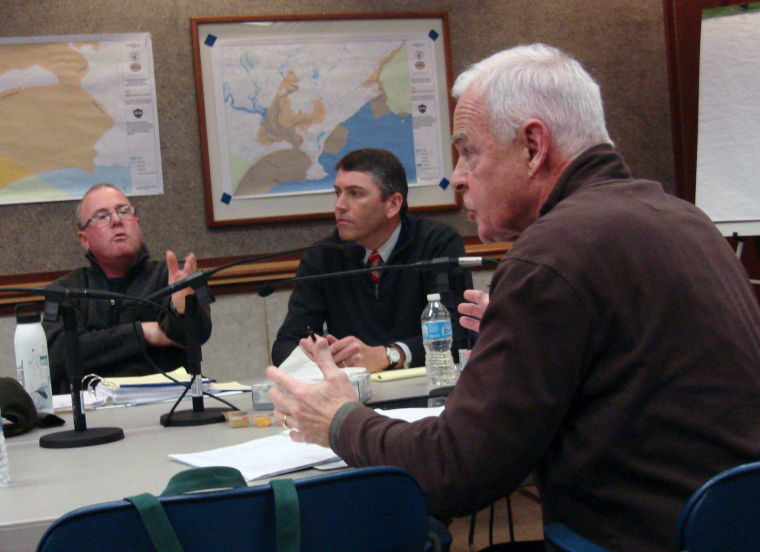 As Scarborough Town Manager Tom Hall, center, looks on, Daniel Ravin, left, rebuts a point being made by Town Councilor Bill Donovan during a meeting Thursday of the town’s ad hoc Animal Control Advisory Committee.
 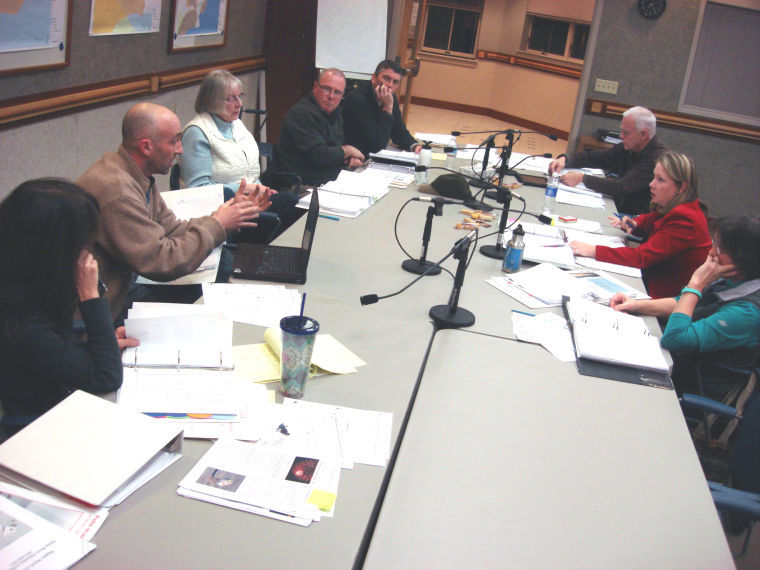 Scarborough’s ad hoc Animal Control Advisory Committee, from left, are Margot Hodgkins, Noah Perlut, Glennis Chabot, Daniel Ravin, Town Manager Tom Hall (serving as group facilitator), Councilor Bill Donovan, Katy Foley and Lucy LaCasse.
Comments are no longer available on this story