
The months-long campaign to keep so-called “tar sands” oil out of South Portland came to an end Tuesday with defeat at the polls of a citizen-initiated Waterfront Protection Ordinance (WPO), but that didn’t stop supporters from declaring victory.
Despite public visibility of the highly contentious campaign, voter turnout was far below what was expected. Town Clerk Susan Mooney said she ordered as many ballots as she would in a presidential election year. However, the 45.6 percent participation rate was, “About average for an off-year election,” she said.
Bolstered by a 4,261 to 4,453 vote, members of the grassroots advocacy group Protect South Portland rallied at their 72 Ocean St. campaign headquarters after the vote, declaring amid cheers and applause that the slim 192-vote margin had sent a clear signal to the petroleum industry.
The tar sands vote now appears to be transforming into machinations in public and behind the scenes to select the city’s next mayor. But, on Tuesday, the first order of business was interpreting the referendum result.
“The way I look at it, folks, we won, because I am now 100 percent convinced that tar sands will never, ever come to this community,” said Mayor Tom Blake, addressing supporters of the ordinance, which would have blocked tar sands by banning the construction of new facilities along the city’s waterfront zone, and the loading of oil tankers in the harbor.
“Thank goodness to all of you; you have woken up our citizenry,” said Blake, a leading supporter of the WPO. “I am so proud of all of you. I couldn’t ask for better friends. I was told, Tom, you’ve lost some longtime supporters in this. I said, no, I’ve gained hundreds of new supporters.”
On the night the cause he’s become intrinsically linked to lost at the polls, Blake handily won re-election to the City Council, capturing nearly 30 percent of the vote in a four-way race.
“Thank you for your guts!” shouted one person in the crowd of about 150 people.
“We know we had the best cause,” said Blake, in reply. “We simply lost to an industry that I’m ashamed of. I’m ashamed of the money they spent. I’m ashamed of the ploys that they played and of the lies that they spread. I am embarrassed of the petroleum industry and they should feel the same way of themselves.”
For tar sands opponents, attention now turns to a proposed moratorium on waterfront construction. The City Council has called a special workshop session for 6 p.m. Wednesday, Nov. 6, to consider a 180-day work halt while it contemplates its own way to block the import of tar sands in ways less restrictive to seaside businesses.
Blake said “all seven councilors are against tar sands,” even those who advocated against the WPO. All, he said, will support the moratorium, fortunate for the cause because it requires a unanimous vote.
Because a city cannot regulate interstate or international commerce – tar sands, if imported, would come to South Portland along a 236-mile pipeline from Montreal – opponents of the product tried to attack the issue through local zoning. The ordinance, crafted by Ferry Village resident Natalie West and designed to leave no loophole for Portland Pipe Line Corp. to exploit, was criticized by some, including strong majorities on both the City Council and the Planning Board, for casting too wide a net.
“We are deeply grateful to the community for its support this evening,” said Jamie Py, president of the Maine Energy Marketers Association at the “No WPO” victory party, attended by about 75 people at the Maine Military Museum on Peary Terrace.
“For over a century South Portland’s waterfront has provided good local jobs for area residents, vital tax revenues to support our municipal infrastructure, and served as Maine’s most important link to global markets,” said Py. “Tonight’s vote against the WPO is a vote to protect those jobs and promote the economy. Our fact-based campaign has stood in stark contrast to the proponents’ campaign, based on fear and misinformation about oil sands.”
Typical of a ballot initiative widely seen as causing a “neighbor-against-neighbor” rift, others saw things differently.
“When you look at an oil industry that invested well over $600,000, to only win by less than 200 votes, I would definitely view that as a significant loss on their part and a huge win on our part,” said Bob Klotz, a city resident and state coordinator for the environmental group, 350 Maine, who decried what he called “outright lies” perpetuated by Py’s side about potential industry job losses.
“A year and a half ago most people in this city didn’t even know what tar sands was, so, of nothing else, we’ve gained enormous traction on that,” said Klotz. “But really, the relationships that we’ve developed, the neighbors that we now know in ways that we never knew before, that’s the real win. This kind of solidarity isn’t going to go away.”
“I think the men and woman of the working waterfront won tonight. I think South Portland won tonight,” said Jim Merrill, spokesman for the Working Waterfront Coalition, describing reaction to Tuesday’s vote as “jubilant.”
“We started out behind and had a lot to catch up with. They got a head start with the petition. They were out there for months collecting signatures and talking to voters. We didn’t get up until much later and had a lot of ground to make up.
“This was never about oil sands, no matter how much they wanted to make it as such. This was about a lot of businesses where people’s jobs were at stake, their livelihood was at stake,” Merrill continued. “It took a lot of time to educate people on this ordinance and we’re really grateful to all the people who came forward and got involved to support those jobs, from the labor unions and business, to the chambers of commerce and the newspapers, to folks like Governor Baldacci and the city councilors.”
Portland Pipe Line president Larry Wilson refused to comment Tuesday night on campaign spending, the future potential for tar sands in South Portland, whether the company will participate in moratorium talks, if it will sit on Blake’s proposed task force to rebuild relations between the city, its residents, environmental activists and the petroleum industry, or even what, if anything, the Sept. 17 sale of his Cape Elizabeth home means to his future with the company.
“We’re just very thankful for the South Portland citizens listening to our message and giving us the opportunity to go forward collaboratively with open communication. We’re anxious for the opportunity to continue those discussions,” he said. “ But no one has talked with me about anything beyond the meeting we are aware of tomorrow night.”
That meeting, said Protect South Portland co-founder Rob Sellin, promises to set the stage for a new phase in the ongoing tar-sands debate.
“We are going to have to keep a very close eye on our City Council,” he said. “They’ve now taken on this responsibility to protect us and we’ll have to see what they come up with. The ball is in their court. The prize has always been to keep South Portland tar-sands-free, and that’s ongoing. A lot of people are pretty discouraged with what’s going on with this city and what happened during the campaign in terms of council activities.”
For members of Protect South Portland, which has vowed to stay together in the post-election era, the next task is to propel Patti Smith, its other proponent on the City Council, to the mayorship.
During Tuesday night’s campaign rally, Rosemarie De Angelis, herself a former mayor, said Councilor Gerard Jalbert is gunning for the gavel. Jalbert privately circulated a letter ultimately signed by five councilors that urged voters to reject the WPO, a move seen by many as skirting, if not actually breaking, Maine’s open meeting laws.
“Jerry Jalbert would be the worst choice, a horrible choice,” said De Angelis. “That is not who we want representing our city. I urge everybody to lobby their councilors saying it would be a shame and an embarrassment to have Jerry Jalbert as the figurehead of this city. To have somebody who has undermined transparency in this city be the leader would be a devastation.”
“I am considering talking to my fellow councilors about being mayor, that is correct,” said Jalbert, Wednesday morning. “I don’t know if that will happen or not, but as far as any comments from Rosemarie De Angelis, she and I are certainly not on the same polecat page by a long shot.”
Noting that he and two other councilors campaigned against De Angelis during her 2012 reelection bid, Jalbert categorized her effort to now deny him the mayorship, “political payback.”
Jalbert also said that, despite Blake’s public comment Tuesday that Smith “has my vote,” he, too, is lobbying to lead the council.
“But, as recently as two weeks ago, he said he would support me,” said Jalbert. “One of the first things you learn in politics early on is that, while you’d like to take everyone’s word at face value, you have to understand that there are sometimes motivations that people aren’t telling you about.
“We’ll see how it all works out,” said Jalbert.
Blake said Tuesday he is “not adverse” to another term as mayor, but that, “it’s up to the other six councilors.”
“I’ve always said, it’s not a turn thing, it’s an earned thing,” said Blake.
The City Council caucus for mayor is scheduled for a Nov. 18 workshop.
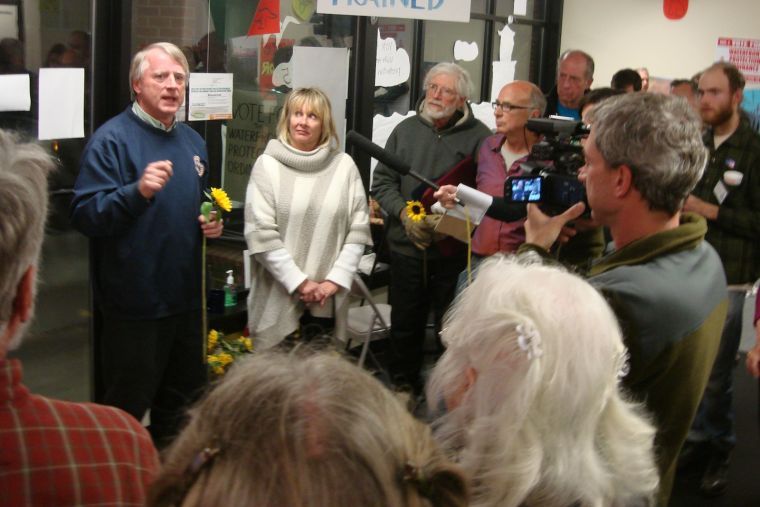 South Portland Mayor Tom Blake addresses members of Protect South Portland at the advocacy group’s 72 Ocean St. campaign headquarters Tuesday night, saying that although the Waterfront Protection Ordinance it championed lost at the polls by 192 votes, the close result means, “tar sands are never coming to this city.”
Comments are no longer available on this story