
BRIDGTON – While lakes are the backbone of the economy for hundreds of Maine towns, they have not been protected as well as they should have been, said Peter Lowell, executive director of the Bridgton-based Lakes Environmental Association, in a recent interview.
“Protecting lakes means fully understanding what’s happening in their watersheds as well as below the water’s surface,” he explained.
That’s why Lowell is hoping the proposed Lake Science Center, slated for development in Bridgton by 2020, will help preserve and promote water quality. A project budget for the research center is in a development phase.
As Maine experiences a decline in water quality, its economic base becomes slowly jeopardized, Lowell said. Maine towns, especially those in the Lakes Region, “anchor their economy on good water quality, both for property tax and tourism,” he said.
The association’s mission is to preserve and restore the high water quality and traditional character of Maine’s lakes, watersheds and related natural resources. Their long-term survival is critical to present and future generations, Lowell said.
“Five years ago, we began to wonder if we were keeping up with science and lake protection, and started talking with researchers and academics around the state,” Lowell said.
He and fellow association members traveled to New Hampshire, Vermont, New York and Florida to learn how other states performed lake research and found that Maine was not up to date with its lake protection.
In order to fulfill its long-term mission, and by authorization of the association’s board of directors in May, the association is negotiating to buy a tract of land in Bridgton to build a Lake Science Center, where scientists and educators could come together to provide the leadership, resources and knowledge necessary for better understanding lake ecosystems and learning how to address degradation, Lowell said.
Progress toward establishing an energy-efficient Lake Science Center has been significant, especially this past year, Lowell said.
With the help of the association’s “mystery foundation,” the association hired its first lake researcher, Amanda Pratt, this past spring to implement the group’s advanced lake-testing program.
The association has also established a lake science advisory board, which consists of around 10 researchers who will help define the scope of its research for the proposed facility.
Plans
The Lakes Environmental Association aims to build the research center by 2020, which is also the association’s 50th anniversary, Lowell said.
The concept has been in the planning stages for several years, but with staunch support from its members and generous foundations, the plans for a research center are beginning to emerge.
The property, the location of which Lowell wouldn’t disclose since it’s under negotiation, is about 16 acres. Once built, the vision is for the campus to include a headquarters, a field outpost and field study sites, administrative offices, a mapping lab, conference rooms, research labs, a library, demonstration sites, researcher housing units and more.
“The Lake Science Center is meant to attract researchers … and create a network of people working on lakes [research] and to expand the education programs from elementary school and up,” Lowell said.
The facility would be open for local students to take field trips, and it would provide space for college students to learn about lake and watershed protection at the science center’s various study sites, he said.
The development would be quite a change since the group’s current facility can accommodate no more than 12 students. The new facility would be able to hold three times that number, and could be occupied by more than one group at a time for research, Lowell said.
Depending on whether the land purchase goes through and if enough money is raised, he said, the hope is that the Lake Science Center will be built ahead of schedule.
According to Lowell, Maine scientists predict that there are fewer than 20 years to turn around “what appears to be a slow, but steady decline in water quality. The lakes are already showing signs of stress.”
He points to Lake Auburn as an example.
According to Lowell, the lake had received 8 inches of rain within just 24 hours last year, contributing significantly to its oxygen depletion, eventually causing a fish kill.
“From the 38 lakes that we test,” he said. “We are seeing some real warning signs, but we need more information to learn what a lake’s tipping point is.”
Hence the reason, he says, for building the research center.
Fundraising has begun for the project and the association is submitting grant applications to various Maine foundations, like the Outdoor Heritage Fund, to support future lake research.
“This particular Phase [1] we are in now is around $400,000, but we are not sure what the [cost of the] final phase might be,” Lowell said.
The Lakes Environmental Association was established in 1970 and for the past four decades has been the voice of lake protection in the Lakes Region. One of its missions is to increase enforcement of Maine environmental protection laws and educating landowners about why lake protection is vital, Lowell said.
The group has five year-round employees and employs a total of 45 people during the summer, Lowell said. A handful of scientists from Maine’s colleges and universities, some of them also LEA board members, have shown interest in using the research center.
Lowell has been a dedicated member of the Lakes Environmental Association since 1971. According to Lowell, the disciplines, expertise and experience represented by the group of candidates the center is recruiting cover the gamut for lake research and protection.
Orrin Shane, a board member, said of the research center proposal, “In my opinion, the association has reached the point where it needs to expand its scientific capability. To do this, we are creating a facility that is available for lake researchers to come and study lakes year-round.”
One of the visions for the center, Shane said, is to provide facilities that researchers can use for extensive research, which is not easy to find.
“If someone from the University of Southern Maine wants to come to Bridgton … they have to rent some kind of facility for it, and those are hard to find. By providing the facility and laboratory resources, it can help them a lot and help get more intensive research done for Maine’s lakes and rivers. We can all benefit from that,” Shane said.
“It’s a place where people [researchers] can live for two or three weeks … while they are doing research. It’s not a full laboratory, but it would be a place where field samples, that come out of lakes, can be processed to take back to be studied on a campus.”
Shane said that the research center project would be completed in three phases. The first phase is to acquire the property. The second phase is to renovate existing housing on the property and make it available to students and researchers to begin their work. The third phase is to add on to the existing buildings by constructing a relatively small, but modern, research facility, he said.
“Ultimately, if the Lakes Environmental Association were going to build a new building, it certainly would want it to be energy-efficient and perhaps, cutting edge,” Smith said.
Another main motivator for creating a science center is the peer-to-peer interaction it will encourage among researchers, said president of the association’s board of directors, Sean Dundon.
He speculates that once built the initial facility would be roughly 5,000 square feet and would fill LEA’s immediate need of expanding its education programs and desire to house researchers.
“The idea here is to do serious academic research to answer what can make a lake’s health go south, and what the indicators we can collect and monitor prior to a lake having an algal bloom,” Dundon said.
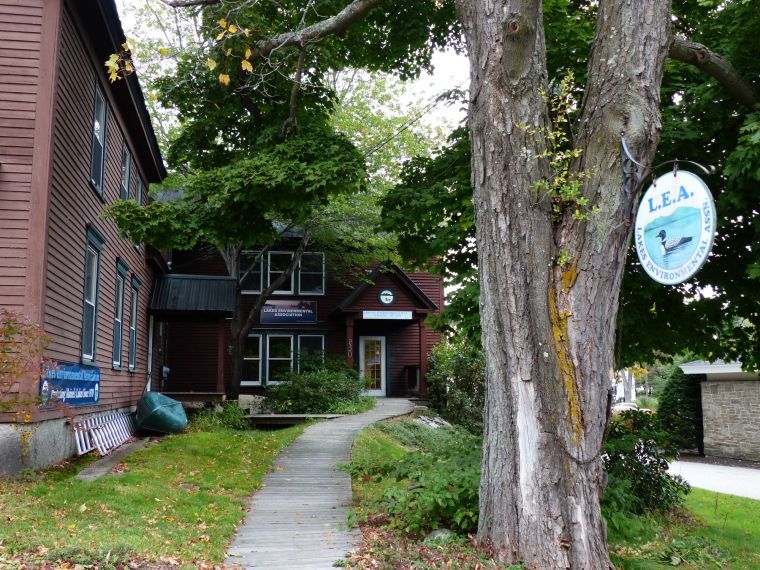 Lakes Environmental Association headquarters, located in downtown Bridgton.
Comments are no longer available on this story