
SOUTH PORTLAND – An errant comma delayed the South Portland Planning Board from weighing in on a measure to keep so-called “tar sands” oil out of city ports, but it didn’t stop four hours of testimony last week on how it should decide.
Not since debate over whether dogs should be allowed on Willard Beach have so many South Portland residents spent so many hours debating a single topic before city leaders. In March, a record crowd of nearly 400 people packed the South Portland Community Center to decry through five hours the possibility of Portland Pipe Line Corp. importing diluted bitumen – called “oil sands” by industry officials and “tar sands” by its detractors – into its South Portland terminal from Montreal.
Tar-sands protesters have claimed that pipeline and oil industry officials want to change the flow the pipeline, which now sends oil out of South Portland, to bring oil sands from deposits in Alberta, Canada. The thicker oil sands, they argue, are more corrosive than regular crude, and increase the chances of a line break and oil spill, a claim that oil officials reject as fear-mongering.
Since then, a grassroots advocacy group, Concerned Citizens of South Portland, has successfully placed an ordinance proposal on the November ballot designed to prevent tar sands from ever entering local ports. On July 23, industry officials got their chance at the microphone, during a marathon hearing before the Planning Board.
Although proponents of the ordinance restrictions matched them blow for blow by arguing the environmental hazards of tar sands, industry executives, attorneys and spokesmen steered clear of that argument. Instead, they attacked the ordinance itself, calling it, in the words of one industry official, “the death knell of all of our terminals.”
The proposed Waterfront Protection Ordinance, for which supporters gathered 3,779 signatures – almost four times the minimum amount needed – bans any enlargement, expansion or construction of any petroleum storage or distribution facilities anywhere in South Portland’s shoreland area, or in the city’s shipyard and commercial districts.
Natalie West, a resident who crafted the ordinance language, argued that it actually protects terminal operators by allowing all current uses to continue. Only changes of the type needed to import oil sands are restricted, she said.
“We do not want your businesses affected in any way by this ordinance,” said West’s husband, Rob Sellin, who co-chairs the concerned citizens group. “The only thing we are cautious about as a community is a change in function. This ordinance protects all current jobs and operations.”
But industry officials say they can’t survive on current operations alone.
“If that actually goes through, that will be the death knell to all of our terminals,” said Burt Russell, vice president of operations at Sprague Energy. “If we had taken a snapshot of our Searsport terminal in 1906, or 1950, or 1970, and only been allowed to do what it did at that time, without expansion, it would not now exist. In the 17 years we’ve owned our South Portland terminal, about every two or three years we’ve had to go back and reinvent it to address the needs of the consumer, the business, and increased environmental standards.”
As an example, Russell said Sprague was first to market with a biofuels product, which arguably helps to reduce greenhouse gas emissions.
“Under our reading of the ordinance, that would not be allowed,” he said.
However, what hobbled last week’s meeting was a reading even stricter than the one envisioned by Russell.
According to City Attorney Sally Daggett, a paper version of the Waterfront Protection Ordinance was submitted to the city clerk’s office and accepted by the City Council, while another, in electronic format, was solicited by the clerk’s office for internal use. That version was the one posted online in public notices of the July 22 meeting. The sole difference between the two versions, said Daggett, was a single comma that appeared in a list of use restrictions.
According to Jim Katsiaficas, an attorney for Irving Oil Terminals Inc., the comma changed how sentences in a paragraph modified each other, potentially adding additional restrictions.
“We know that the voters are going to get the one without the comma, but what was referred here tonight was the one with the comma,” he said. “It does make a difference. The version with the comma has fewer negative implications for marine terminals.”
At Daggett’s suggestion, the Planning Board elected to refrain from making a recommendation to the council on the proposed ordinance. Instead, it will hold a second public hearing at its Aug. 13 session, weighing in then on whether the ordinance is consistent with the city’s comprehensive plan.
City Manager Jim Gailey said Friday that councilors will still hold a first reading on the ordinance at their Aug. 5 meeting, as planned. However, that work will be largely perfunctory, he said.
“Anything substantial in the way of debate will have to wait until after we’ve heard from the Planning Board,” he said.
At last week’s hearing, Portland Pipe Line President Larry Wilson claimed those in the audience in support of the proposed ordinance were “duped” by “extremists.”
“We’ve been correcting the misstatements and the rhetoric and the fear-mongering for many, many months, and it’s exhausting,” he said. “But the truth is on our side. We are not an evil corporation. I’ve seen so many crying grandmothers. I’ve seen children thrust in our face like we’re trying to do harm to them.”
Wilson went on to list some recent safety awards earned by his company, noting again that while he would not refuse an offer to move tar sands, there is no proposal to do so on the table. Wilson also claimed that, depending on the grade of tar sands shipped, it may not even be necessary to build smoke stacks to burn off the volatile organic compound contained in tar sands – a major rallying point during the petitioning process.
“Don’t let these extremists steal the environmental argument,” he said. “We’re all environmentalists. I love God’s creation.”
“Don’t demonize us by saying we are demonizing you,” said Whitehall Avenue resident Bob Klotz. “To suggest we were somehow duped is incredibly offensive.
“This is not make believe, Climate disruption and pollution associated with the fossil fuel industry is a fact,” said Klotz. “We cannot allow tar sands to even come out of the ground, let alone come into South Portland.
“We need to move into a future that protects all of us, not just your bottom line,” he told Wilson.
According to City Planner Tex Haeuser, Code Enforcement Officer Pat Doucette will speak at the Aug. 13 meeting to explain how she would interpret the ordinance, if adopted by voters.
West said petroleum industry officials and attorneys “are misrepresenting the ordinance” by arguing it prevents future safety enhancement, or construction at marinas in the affected zones.
Worse, she said, was the idea that Doucette should testify on the topic.
“It’s not the job of the city to tear it apart before the people adopt it,” she said. “I really resent that this board is thinking of trying to get an administrative interpretation. That is way beyond what you are supposed to be doing at this point in the process.”
But Haeuser countered that an interpretation by the person who will be called on to enforce the ordinance is necessary.
“Zoning is legal stuff and you can’t go by intent,” he said. “You have to go by what the words say.”
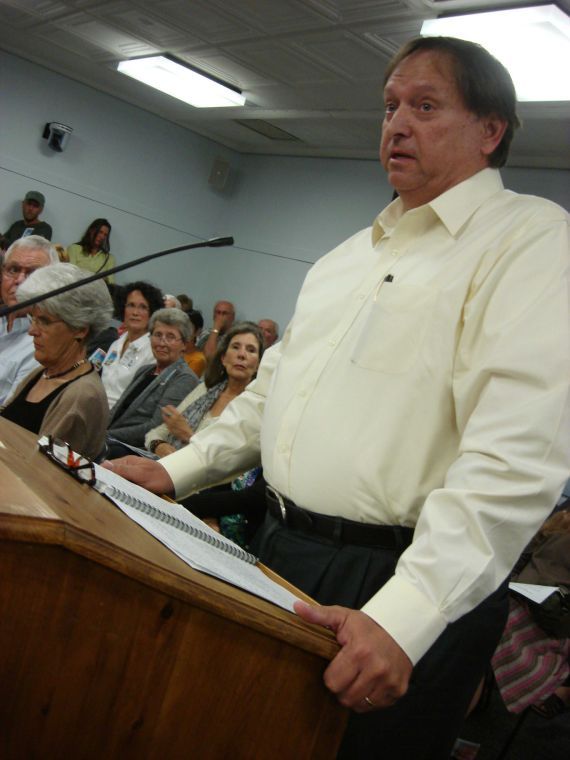 Larry Wilson, president of Portland Pipe Line Corp., said at a South Portland Planning Board public hearing July 23 that supporters of the proposed Waterfront Protection Ordinance had been “duped” by environmental “extremists” behind the formation of the grassroots advocacy group Concerned Citizens of South Portland, which is trying to prevent the importation of so-called tar sands oil into the city.
Comments are no longer available on this story