
WESTBROOK – Westbrook residents are used to seeing big blue recycling bins parked next to their trash cans on garbage day, but soon there will be a new addition to the trash day family – a little white bucket.
These buckets, the brainchild of Tyler Frank, 27, are used to store food waste, and are picked up by Frank’s Garbage to Garden team on trash day. The team then leaves a clean bucket, or a bucket filled with compost, depending on the wishes of the client.
Starting next week, Westbrook residents will be able to sign up for the $11 per month program through the Garbage to Garden website and pick up their white bucket and lid at the city’s public works department or any Rosemont market. The company received a commercial waste hauler’s license from the city on June 10.
After the food scraps have been picked up, they are taken to Benson Farm in Gorham, where they are put onto a pile and left to bake. According to the farm’s website, microorganisms feed on nitrogen and carbon found in the garbage and break them down. The compost is then cured for about four months.
More than 125 households in Westbrook have already signed up for the service.
“Last August, I decided I wanted to do something more responsible for the environment. It’s unrealistic for society at large to compost; there are a variety of challenges to doing it yourself. This is providing a service for the masses. It’s grown so fast,” Frank said.
Frank also operates in Falmouth, Yarmouth, South Portland and Cumberland. So far, Frank said, he’s gotten at least 5 percent of Portland’s population, roughly 1,300 households, to sign up for the rapidly expanding business.
While $2.75 per week may not seem like a lot of money, Frank has another way to cut down on the cost for customers. For those who volunteer for activities such as cleaning up parks and beaches with the business, the compost fee is waived.
If Frank can reach 25 percent of the population in Portland or gets enough densely populated areas to pick up the program, the price will drop.
“I wanted to make this accessible to everyone. Composting is making a huge impact. That’s what this is all about,” Frank said.
Frank’s environmental responsibility started young – his family composted in North Yarmouth. When he moved to Portland, his yard wasn’t big enough to compost, and Garbage to Garden was born.
“I thought, ‘Why can’t you put the composting on the curb somehow?’ Food waste makes up almost half the trash. We’re good at recycling and so it wasn’t too hard to start,” Frank said.
Armed with a few hundred dollars and a pickup truck, he went to a First Friday Art Walk in Portland last year to promote his idea.
“Seventeen people signed up in the first couple of hours. I didn’t have enough buckets with me. I had 12 then and we have 4,000-plus now,” Frank said. “People have told me this has changed their lives.”
At the company’s headquarters in Portland, one of Frank’s five other team members is washing out compost bins collected that morning using biodegradable soap. One of the two trucks that are used to pick up the compost bins runs on biodegradable fuel. Frank is working on building a community garden and expanding his operations to someday include an environmental learning program geared toward children.
Vegetables, fruit, coffee grounds, teabags (without the staple), grass clippings, leaves, brush, clean, non-glossy paper, meat, dairy, bones and shells can all be thrown into the compost bucket, which comes with a top to keep the smell out.
If the compost bins are lost, broken or stolen, customers can simply go pick up another one at no cost.
“Most people do it for the recycling aspect. Right now all trash ends up being incinerated or in landfills. When food waste breaks down in a landfill, it releases methane gases, which are 30 times worse than greenhouse gases,” Frank said. “This is the next big thing, like recycling was 20 years ago.
The project potentially can save money in trash fees. Trash haulers are paid by the ton, and with food scraps making up an estimated 40 percent of all trash, the lowered weight of the bags could eventually result in a net savings for the city.
Lynn Leavitt, Westbrook’s recycling coordinator, agrees that composting is the next big environmental push. She advocated for the business to offer its services in Westbrook after a composting project at the middle school was a huge success.
“If people start compositing, others will think recycling is more of a normal thing to do. The programs will help each other,” Leavitt said.
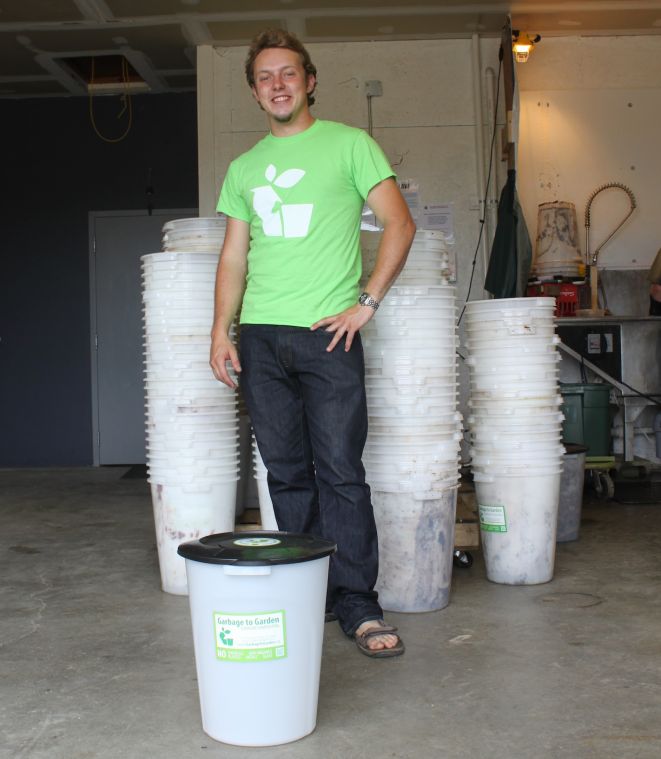 Tyler Frank, founder of Garbage to Garden, stands in front of hundreds of dirty buckets used to collect food waste that will be converted to composte. His company will start operating in Westbrook next week. Staff photo by Suzanne Hodgson
Comments are no longer available on this story