
In the early 1870s, travel along the main road was by stagecoach. The road was dirt and the sidewalks were paths. Elm trees lined the roads, trees that would later fall victim to Dutch Elm disease. Water troughs along the way were a welcome respite for travelers – horses and humans. Along the narrow dirt road, the horses clip-clopped, leaving behind not the gasoline fumes of today’s traffic, but reminders of their travel, all the same. (There was no pooper-scooper movement in those days!)
Blacksmith shops were the precursor to today’s filling stations. At these shops, the hot fire and clanking of the smithy’s tools must have seemed as loud as the motors and tires of today. Along with the blacksmith, there were a number of taverns or inns – places where meals were served and overnight accommodations for the traveler and his team of horses.
When one got to the village of North Windham, after a long journey from the city of Portland, the first building on the left was the schoolhouse. Later, it would be moved across the street. It was a plain building with a low gable roof. It had one door in the south end, an entry on the east side and a wood room on the west end. (Wood was the fuel in those days.) School began at 9 a.m. and the kids, all ages together in one room, left at 4 p.m.
Water for the students was carried from a nearby well. The water was in a pail at the school, where students used a dipper when they were thirsty. Kerosene lamps provided light in the school. One night a week, a writing school was held at which old and young could attend.
Beyond the school was the North Windham cemetery. The portion which is oldest is to the far right, as one faces the cemetery from Route 302. It was a small place, compared to today’s site, named Arlington.
The residence of John Stevens was next to the cemetery. Today, this is an office. The building was moved there from another location. Next door to that dwelling was a cooper shop, where barrels and barrel parts were made.
A two-story building stood next to the cooper shop. This building had a clothing store downstairs, and a dance hall upstairs. Just beyond this store was another home, with a jewelry store next to the road. The man who lived in the house did a lot of watch repair and cleaning.
Next door to the jewelry shop was a hotel (probably rooming house by today’s standards) and on the corner, a place where clothing was made, and one could purchase groceries, clothing and country produce.
Many dwellings lined both sides of Route 35.
Back on today’s Route 302 and going north, was another general store, a butcher shop and several more residential dwellings. Further on was a sawmill. Traveling south from the sawmill area, there were several homes, another cooper shop and at the corner, which we call Boody’s Corner, was another hotel called Nemasket House.
On the road to Gray (Tandberg Trail or Route 115) there were more homes, and one man owned all the land between the intersection and Collins Pond!
From the corner where the hotel was, down toward today’s Manchester School, was a group of residences, a millinery hat making shop, the Masonic Hall and in 1874, a church was built.
Today’s traffic may make this area seem uniquely busy – but it appears from this firsthand account, it was always a busy little corner!
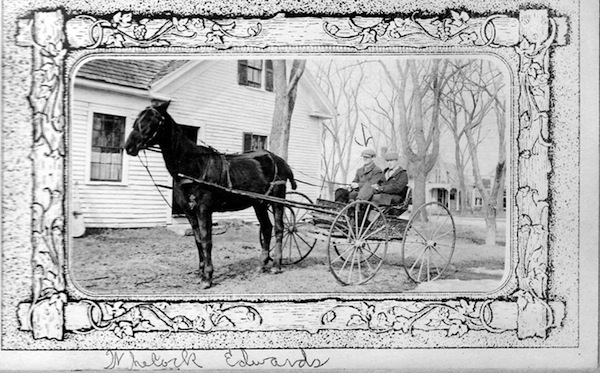 Ed Wheelock was a blacksmith in the village of North Windham, located about where Dunkin’ Donuts is today.
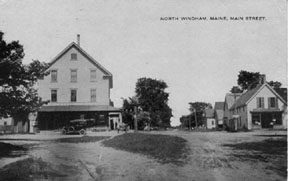 The intersection of 35, 302 and 115 – looking toward Route 115, after Boody’s store was built. Courtesy photos
Comments are no longer available on this story